First Seen
2023-05-10T21:03:35+00:00
simple-description (llama3.2-vision_11b)
The "Never Gonna Say Never" meme is a humorous image featuring a cartoon character with a shocked expression. The text "Never Gonna Say Never" is written above the character, while the text "Never Gonna Say Never" is written below it, but with a slight modification to "Never Gonna Say Never" to read "Never Gonna Say Never".
detailed-analysis (gemma3-27b-vision)
Okay, let's break down this meme image using the lenses you've provided. It's important to remember that applying these theoretical frameworks can be interpretative and a bit of a stretch for something ostensibly "silly" like a meme, but that’s the point of the exercise!
Visual Description
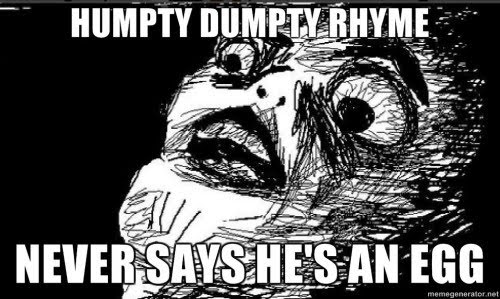
The image is a black and white, highly stylized close-up of an owl's face. The style is reminiscent of energetic, agitated scribbling or quick sketch lines. The owl’s eyes are large and appear intensely focused, almost glaring. Superimposed onto the image are the words "HUMPty DUMPTY RHYME / NEVER SAYS HE'S AN EGG" in stark white, blocky lettering. The bottom edge includes the URL for the meme generator "memegenerator.net." The overall effect is frenetic and emphasizes the "revelation" of the text. The contrast between the detailed, wild lines of the owl and the blunt text further amplifies the comedic effect.
Foucauldian Genealogical Discourse Analysis
This meme can be approached through Foucault's ideas about discourse and power. The image disrupts a familiar children's rhyme by drawing attention to an unstated assumption. The "Humpty Dumpty" rhyme, usually understood as a simple narrative about a fall, implicitly defines Humpty Dumpty as an egg, but it never states it. This meme performs a genealogical excavation. It unearths a hidden "truth" in the discourse of the rhyme.
The meme therefore operates as a counter-discourse. It exposes the gap between what is understood and what is said within the Humpty Dumpty narrative. The frenzied image of the owl highlights the sudden "discovery" of this previously unexamined assumption. This is a subtle exercise in deconstructing the power structures embedded within what is typically considered innocent children's literature. The meme questions the authority of the original narrative.
Critical Theory
From a Critical Theory perspective, the meme can be seen as a commentary on how seemingly neutral cultural products (like nursery rhymes) subtly reinforce existing power structures and assumptions. The meme deconstructs the "common sense" understanding of the Humpty Dumpty story. It reveals how ideology operates: not by explicit instruction, but by shaping our unconscious understanding of the world.
The meme performs a small act of "demystification," revealing a hidden ideological assumption embedded in the childhood narrative. It draws attention to how cultural narratives construct "reality" and shape our perceptions. In this case, the meme suggests that we accept a pre-defined categorization (Humpty Dumpty is an egg) without critical thought.
Postmodernism
The meme embodies several key characteristics of Postmodern thought. The deconstruction of a classic, well-known narrative ("Humpty Dumpty") aligns with Postmodern rejection of grand narratives and universal truths. The image plays with the idea of "truth" – highlighting how it's constructed and contingent.
The meme's fragmented, visually chaotic style (the scribbled owl) mirrors Postmodern emphasis on fragmentation, instability, and a rejection of traditional linear narratives. The humor arises from the disruption of expectation and the highlighting of absurdity. There’s an element of irony here, as it’s a light-hearted treatment of a deeper philosophical concept.
Queer Feminist Intersectional Analysis
This is the most challenging application, but potentially insightful. The meme can be approached through the lens of categorization and the limitations of assigned identity.
The act of naming something as an egg is, in a way, an act of categorization. The meme reveals that this categorization is not inherent, but imposed. This resonates with queer and feminist critiques of essentialism—the idea that people or things have fixed, inherent qualities. Humpty Dumpty is assumed to be an egg, but the rhyme itself never states it.
The meme could be interpreted as a playful analogy to the pressures of conformity and the imposition of labels based on assumptions. The meme encourages us to question such assumptions.
Important Note: The interpretations above are deliberately theoretical and somewhat playful. A meme is, first and foremost, a form of popular culture and entertainment. These analytical frameworks are tools for understanding potential meanings, but they shouldn't be seen as definitive explanations.
simple-description (llama3.2-vision)
The meme "Humpty Dumpty" is a parody of the classic nursery rhyme, with a twist on the original's famous phrase "all the king's horses and all the king's men" (they) "can't put Humpty Dumpty together again". The image features a cartoonish, angry-looking character with a red face and a speech bubble that says "I said to myself, 'Something's not right with my eggs, boys'".
tesseract-ocr
Mae oe Po a. he a TEN EN Se be aS SS aoe ee PART ETE