First Seen
2025-11-04T05:13:01.524282+00:00
simple-description (qwen3.5_2b-q8_0)
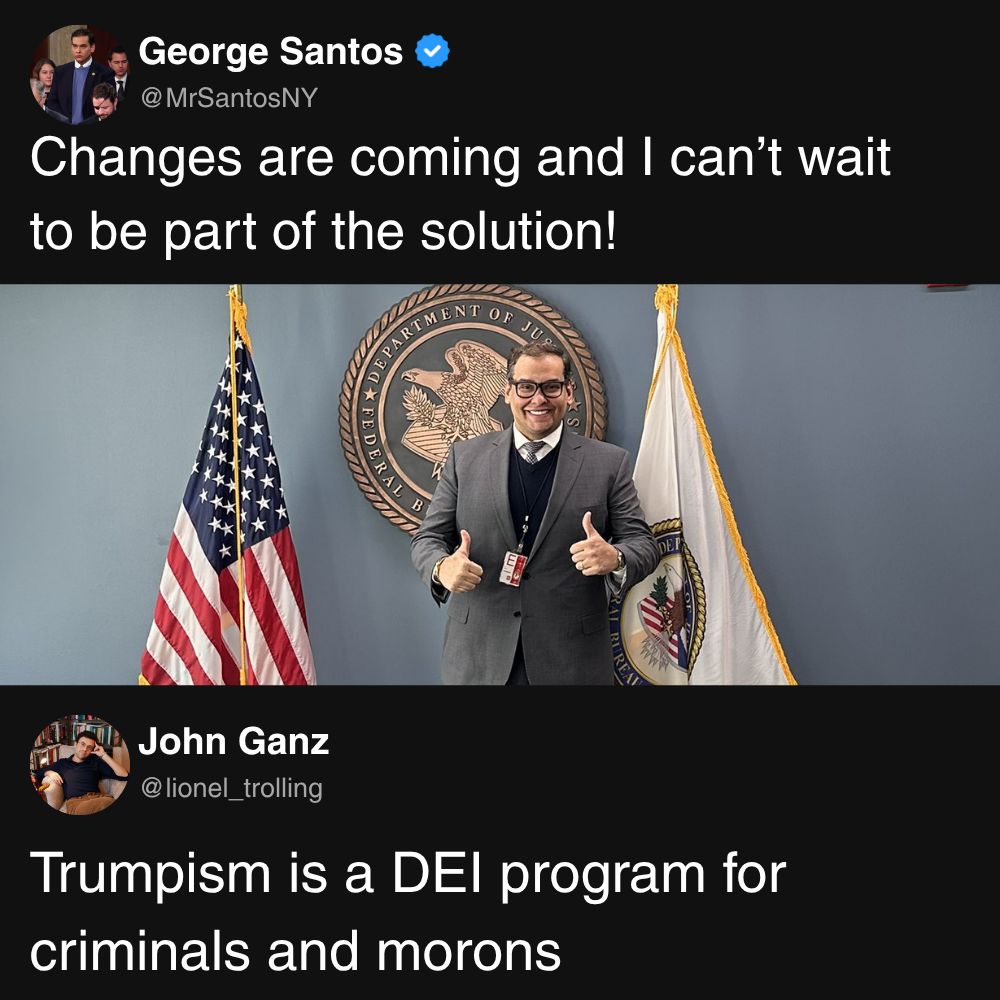
A kakistocracy is ruled by strict legal adherence where formal procedures often dictate reality over personal emotion. This meme captures that exact tension: the top tweet shows George Santos promising to follow established law to fix problems, while his rival attacks him from outside as an illegal "moron" who violates these same legal norms.
detailed-analysis (gemma3_27b-it-q8_0)
Okay, let's break down this meme through the lens of kakistocracy – the governance by the worst people – and explore how various theoretical frameworks illuminate its meaning.
Understanding the Core: Kakistocracy
Before diving into specific analyses, it’s crucial to establish that kakistocracy is the central concept. It’s a system where power is held by those least qualified to wield it, characterized by incompetence, corruption, and a disregard for the common good. The meme’s context, framing Trumpism as an invitation to criminals and morons, strongly suggests this is the foundational framework.
Visual Description
The image prominently features George Santos, a U.S. Representative known for widespread accusations of fabrication and deception regarding his biography and finances. He is positioned in front of the Department of Justice seal, an emblem of law and order, but also framed by American flags. Santos is smiling, arms slightly outstretched in a welcoming gesture.
This imagery is instantly jarring. The juxtaposition of Santos – a figure widely perceived as embodying dishonesty and political opportunism – with the DOJ and national symbols creates a potent visual statement. The confident smile suggests a brazen acceptance, or even celebration, of his own problematic status. The overall effect is performative and unsettling.
Foucauldian Genealogical Discourse Analysis
Michel Foucault’s work on power, discourse, and genealogy is incredibly relevant here. Foucault would not focus on the intentions of Santos or the meme’s creator, but instead on the power dynamics and the historical formation of the discourses surrounding concepts like "truth," "legitimacy," and “qualification.”
- Genealogy of Qualification: Historically, “qualified leadership” was tied to notions of virtue, education, experience, and social standing. However, Trumpism (and figures like Santos) represent a disruption of this genealogy. They exploit a growing distrust of elites and a rejection of traditional standards. The meme exposes the manufacture of the "qualified leader" as a social construct.
- Discursive Shift: The meme implicitly critiques the discourse of political accountability. Santos’ presence in front of the DOJ isn’t a challenge to the legal system so much as a blatant mockery of its principles. He owns the absurdity of his position. The framing of Trumpism as a “DEI program” is a perversion of language, hijacking the well-meaning intentions of Diversity, Equity, and Inclusion, and recasting it as a system that actively attracts the undesirable.
- Power/Knowledge: Santos represents a form of power that thrives not despite a lack of qualification, but because of it. His very unsuitability becomes a source of appeal for a segment of the population. This illustrates Foucault’s idea that power and knowledge are intertwined – the knowledge of his dishonesty doesn't diminish his power; it may even enhance it within certain discursive frameworks.
Critical Theory
From a Critical Theory perspective (drawing on thinkers like Max Horkheimer, Theodor Adorno, and Jürgen Habermas), this meme highlights the decay of reason and the rise of instrumental rationality.
- The Dialectic of Enlightenment: Adorno and Horkheimer argued that the Enlightenment’s emphasis on reason ironically led to new forms of domination and barbarism. Santos represents a perversion of the Enlightenment ideals of transparency and accountability. His dishonesty isn’t a glitch in the system, but a symptom of its inherent contradictions.
- Culture Industry: The meme can be seen as a critique of the “culture industry” – the mass production of standardized cultural goods that promote conformity and suppress critical thought. Trumpism, with its reliance on spectacle and emotional appeals, is a product of this culture industry. Santos is a character produced by this system, rather than an outlier.
- Communicative Rationality: Habermas’ idea of “communicative rationality” (reaching understanding through open, reasoned dialogue) is demonstrably absent in this scenario. The meme points to a political environment where truth is relative, and reasoned argument is replaced by performative outrage and deliberate misinformation.
Marxist Conflict Theory
A Marxist analysis would focus on the class dynamics and material interests at play.
- False Consciousness: The meme suggests that a segment of the population is operating under “false consciousness” – a distorted understanding of their own interests, manipulated by the ruling class (in this case, represented by the Trumpist movement). Santos appeals to resentment and frustration, channeling class anxieties into support for a system that ultimately benefits the wealthy and powerful.
- Hegemony: Trumpism’s success represents a temporary disruption of the established hegemonic order (the dominant ideology that justifies the status quo). Santos, as a figure embodying this disruption, challenges conventional notions of political legitimacy.
- Crisis of Capitalism: The meme can be interpreted as a symptom of a deeper crisis within capitalism – a system characterized by inequality, alienation, and a loss of faith in traditional institutions. The appeal of a figure like Santos reflects a desperate search for alternatives, however flawed.
Postmodernism
A postmodern reading would emphasize the fluidity of meaning and the rejection of grand narratives.
- Deconstruction: The meme deconstructs the very concept of “leadership.” By presenting a figure like Santos as a "solution," it undermines the traditional criteria for political competence. It reveals the arbitrary nature of power and the instability of meaning.
- Simulacra and Simulation: Jean Baudrillard's ideas around simulacra and simulation are relevant. Santos is essentially a simulacrum – a copy without an original. His constructed persona obscures any underlying "reality." The meme suggests that contemporary politics has become a hyperreality where appearances are more important than substance.
- Rejection of Metanarratives: The meme rejects the idea of a coherent national story or a shared sense of purpose. It embraces the fragmentation and uncertainty of the postmodern condition.
In Summary
The meme is deeply cynical. It’s a sardonic commentary on the state of contemporary politics, suggesting that a system governed by the worst elements has become not only possible, but perhaps even desirable for some. The core idea, reinforced by the lens of kakistocracy, is that we've entered an era where incompetence, dishonesty, and a disregard for truth are not impediments to power, but qualifications for it. The various theoretical frameworks add layers of nuance, illuminating the historical, social, and ideological forces that have contributed to this disturbing reality.
simple-description (llama3.2-vision_11b)
This meme is a commentary on the current state of politics, specifically the rise of populist leaders who have been accused of being authoritarian and anti-democratic. The image features a quote from George Santos, a politician who has been accused of being a "kakistocracy" (a government by the worst or most unqualified people), with a photo of him in front of a US flag and a seal of the US Department of Justice. The quote reads "Changes are coming and I can't wait to be part of the solution!" which is ironic given his own controversial past.