First Seen
2023-05-10T21:03:42+00:00
simple-description (llama3.2-vision_11b)
The meme is a humorous commentary on the differences between urban and rural lifestyles, with the image of a wealthy person ( likely a "1%er") being juxtaposed with a stereotypical "urban" individual. The text reads: "You want a walkable neighborhood so you don't have to drive. I want a walkable neighborhood so I can walk all over your neighborhood."
detailed-analysis (gemma3-27b-vision)
Okay, let's break down this meme through various theoretical lenses. This is a complex image, so the depth of analysis will vary per section.
Visual Description
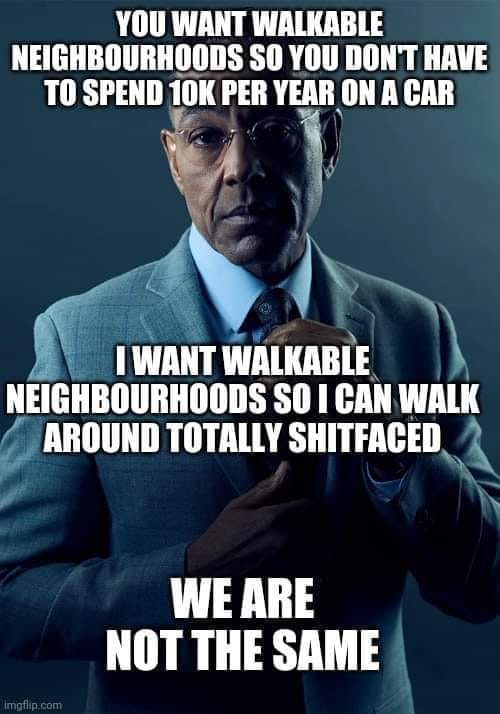
The image is a digitally manipulated meme featuring a close-up, darkened portrait of actor Samuel L. Jackson, in a suit. His expression is stern and severe. He's looking directly at the viewer. A semi-transparent white box contains text. The text is presented in a hierarchical manner. Top text says: "YOU WANT WALKABLE NEIGHBOURHOODS SO YOU DON'T HAVE TO SPEND 10K PER YEAR ON A CAR." The bottom text: "I WANT WALKABLE NEIGHBOURHOODS SO I CAN WALK AROUND TOTALLY SHITFACED" , and lastly at the very bottom “WE ARE NOT THE SAME.” The overall aesthetic mimics a "sigma male" or similar internet meme format, playing on self-perceived exceptionalism and a sense of being "different" from the masses.
---
Foucauldian Genealogical Discourse Analysis
This meme demonstrates a key Foucauldian concept: discourse and power/knowledge. The discourse around "walkable neighbourhoods" is traditionally framed within a language of rationality, sustainability, economic benefit, and civic wellbeing. It's a discourse tied to urban planning, environmentalism, and middle-class aspirations. The meme subverts this discourse by introducing a radically different motivation – a desire to walk while intoxicated. This isn’t necessarily about the practicality or benefits of walkability, but about a personal freedom and indulgence.
The meme decenters the official “rational” discourse. It reveals how seemingly neutral concepts (walkable neighbourhoods) are always embedded within power dynamics. Who gets to define the meaning of walkability? The urban planner? The environmentalist? Or the individual exercising their hedonistic desires?
A genealogical approach would investigate the history of how walkability became a valued concept, and how it's been used to justify certain urban developments (and exclude others). The meme implicitly challenges those historical constructions by presenting an alternative, less "respectable" justification.
---
Critical Theory
From a Critical Theory perspective (drawing on Frankfurt School thought), this meme reveals the tensions between instrumental reason and subjective experience. The first line represents an appeal to instrumental reason: Walkability is good because it saves money (a rational, economic calculation). The second line reveals a subjective, irrational, and hedonistic desire. It's a rejection of the rationalizing forces of modern society in favor of immediate gratification.
The meme functions as a subtle critique of the commodification of experience. While the initial claim frames walkability as a practical solution to a financial problem, the second claim shows how the experience of walkability itself (the freedom, the ability to wander) is valued— but in a way divorced from any societal "good." It suggests a kind of alienation – needing to find personal gratification in a world dominated by economic concerns.
---
Marxist Conflict Theory
The meme, at first glance, doesn't immediately lend itself to a traditional Marxist analysis. However, we can see class tensions at play. The first line represents a concern for economic necessity: saving money on transportation is a pragmatic concern, likely more prevalent among working-class or middle-class individuals. It is about necessity and survival. The second line demonstrates a level of disposable income and leisure time that indicates a higher social class. The ability to casually pursue the state of being "totally shitfaced" is a privilege tied to financial stability and the absence of pressing material concerns.
The image exposes a contradiction in capitalist ideology. Capitalism promotes both economic rationality and consumerism/hedonism. The meme highlights the tension between these forces, as it suggests that while some individuals are concerned with basic economic survival, others are privileged enough to indulge in pure, self-serving pleasure.
---
Postmodernism
This meme is deeply embedded in postmodern sensibilities. It plays with irony, pastiche, and the deconstruction of grand narratives. The meme directly opposes the traditionally accepted “good” reasons to support walkability, offering a deliberately trivial and contrarian justification. This challenges the idea of a universal, objective "good."
It exemplifies the postmodern fascination with fragmentation and the blurring of boundaries. It juxtaposes seemingly disparate motivations (economic pragmatism vs. hedonistic indulgence). It rejects the idea of a coherent, unified self. The persona presented in the meme embraces a kind of anti-hero status, rejecting the norms of rational behaviour.
---
Queer Feminist Intersectional Analysis
This is the most challenging area of application. At first glance, the meme appears to lack direct connections to queer or feminist concerns. However, we can interpret it through a lens of resistance to normative behaviour.
The rejection of “responsible” reasons for wanting walkable neighborhoods (economic benefit) can be seen as a refusal to conform to societal expectations around productivity, practicality, and responsible citizenship. This could be related to queer and feminist critiques of normativity – the expectation that individuals should adhere to certain prescribed roles and behaviours.
It’s a stretch, but you could argue that the embrace of pleasure and indulgence (walking around intoxicated) can be seen as an act of reclaiming agency in a society that often attempts to control and regulate bodies and desires. It represents a deliberate rejection of the "sober, responsible citizen" ideal, which can be a form of social control.
It's important to note, however, that this is a highly speculative interpretation. The meme is not overtly feminist or queer. It relies on internet humour tropes that can easily be co-opted by regressive ideologies.
Disclaimer: It's important to remember that these analyses are interpretations. The meaning of the meme is subjective and can vary depending on the viewer's background and perspectives. These theoretical frameworks offer different lenses through which to examine the image, but they do not necessarily represent definitive or universally accepted conclusions.
simple-description (llama3.2-vision)
This meme is a play on the classic "I want to live in a..." format, but with a humorous twist. The image shows a person in a suit, with a caption that reads: "I want to live in a neighborhood where everyone is as miserable as I am." The text continues: "You know, where everyone's always complaining about something, where the air is thick with angst, where the only thing that brings us together is our collective disdain for life."
tesseract-ocr
PU CATE NEIGHBOURHOODS SO YOU DON'T HAVE POG Uy al i Vy SS Ee \ PUT AT VTL Ny St Ha i , KM A ) WE ARE mes |