First Seen
2023-05-10T21:03:42+00:00
simple-description (llama3.2-vision_11b)
This meme is a play on the phrase "I would never" and is presented as a humorous observation about urban living. The image shows a person standing in front of a city street, surrounded by tall buildings and bustling activity, with a caption that reads: "I would never walk 10 blocks to get to a restaurant that's 10 blocks away."
detailed-analysis (gemma3-27b-vision)
Okay, let's break down this tweet through the lenses you've requested. Keep in mind that some of these lenses will be a stronger fit than others, and we're interpreting a very concise piece of communication.
Visual Description
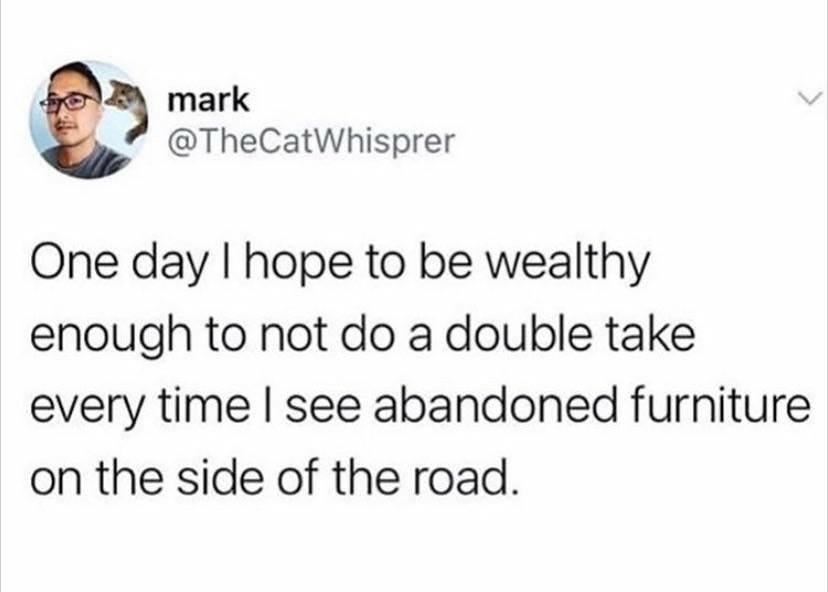
The image is a screenshot of a tweet from user @TheCatWhisper. The user has a profile picture of a man with dark hair and glasses. The tweet itself is a simple text post. The text states, "One day I hope to be wealthy enough to not do a double take every time I see abandoned furniture on the road." The background is the typical light blue of Twitter (now X).
---
Marxist Conflict Theory
This tweet implicitly touches on class differences and material conditions, making it relevant to Marxist analysis. The "double take" isn't just about aesthetics; it's about a subconscious assessment of value and need.
- Alienation: The abandoned furniture represents discarded use-value. In a capitalist system, objects are valued not by their utility, but by their exchange-value (what they can be sold for). When furniture is abandoned, its use-value is essentially ignored, pointing to a disconnect in a system that prioritizes profit over need.
- Class Consciousness: The user's desire to not react to abandoned furniture reveals a subtle awareness of economic disparity. The impulse to check if something can be salvaged suggests a consciousness of limited resources. A wealthy person likely wouldn't even consider repurposing discarded furniture; they’d simply see it as an eyesore. The user wants to reach a point where that thought doesn't even occur.
- Commodity Fetishism: While not explicit, there's a slight undercurrent of this. The furniture represents the potential for comfort, home, or status. The fact it's abandoned, suggests the breakdown of the value system. The user's reaction isn't just about the furniture as furniture; it's about what it signifies.
Critical Theory
This tweet provides a good point for exploring the concept of everyday life as a site of ideological struggle. The impulse to "double take" at discarded furniture is a seemingly trivial action, but it is loaded with meaning.
- The Culture Industry: Abandoned furniture can be seen as a product of consumer culture and the disposability of goods. The tweet hints at the constant cycle of production, consumption, and waste.
- Subjectivity & Experience: The tweet is about a personal experience—the user's internal reaction—and how that's tied to broader socio-economic realities. It asks us to consider how social structures shape individual consciousness.
- Critique of Rationality: The seemingly "rational" act of checking discarded furniture for usefulness is tinged with sadness and awareness of inequality. The user is forced to recognize the stark contrast between their own circumstances and those who may have discarded the furniture.
Postmodernism
Postmodern theory could explore the tweet's implicit commentary on the instability of meaning and the fragmentation of experience.
- Simulation & Hyperreality: The abandoned furniture is a sign of broader social issues (poverty, waste, consumerism). It isn’t just furniture; it’s a representation of these problems. The user’s reaction is to a simulated reality where they are forced to acknowledge a troubling truth.
- Deconstruction of Values: The tweet challenges the idea of a stable, inherent value in objects. The furniture's value has shifted from being a functional item to being a potential resource, then to being a reminder of social inequality.
- Irony & Self-Awareness: There's a subtle layer of irony in the tweet. The user is acknowledging their own subjectivity and the ways in which their perceptions are shaped by their economic status.
Foucauldian Genealogical Discourse Analysis
Foucault's genealogy would focus on the historical and social power dynamics that have led to the phenomenon of abandoned furniture.
- Disciplinary Power: The tweet implicitly connects to the ways that capitalism disciplines populations through the creation of needs and desires. Abandoned furniture represents the failure of this disciplinary system—the inability of some to maintain the appearance of normalcy or financial stability.
- Biopower: The ability to afford furniture is connected to the state’s ability to control its population. The discarded furniture may be seen as an object of lack within a broader system of controlling and evaluating citizens.
- Archaeology of Knowledge: A Foucauldian analysis would trace how the meaning of “furniture” and “wealth” have changed over time, and how these changes are linked to broader shifts in power relations.
Queer Feminist Intersectional Analysis
While a weaker fit, intersectionality can add nuance. Abandoned furniture can symbolize precarity, which disproportionately impacts marginalized communities.
- Precariousness & Vulnerability: The abandoned furniture highlights the precariousness of economic security, which disproportionately affects marginalized communities (e.g., people of color, women, LGBTQ+ individuals).
- Material Conditions & Gender: A feminist analysis might consider how access to resources (like stable housing and furniture) is often tied to gender inequality. Women are more likely to experience economic insecurity, which can lead to housing instability.
- Intersection of Class & Identity: The tweet implies that poverty and material hardship are not simply economic issues, but are also deeply connected to questions of identity, power, and social justice.
In conclusion, this seemingly simple tweet is surprisingly rich with potential for analysis. It touches on themes of class, consumerism, power, and the ways in which our perceptions are shaped by social and economic forces. While not every lens is equally strong, each one offers a valuable perspective on the underlying meaning of the tweet.
simple-description (llama3.2-vision)
This meme is a humorous commentary on the idea that one's life is not going as planned. The image shows a person sitting on a couch, surrounded by clutter and mess, with a caption that reads: "I'm not lazy, I'm just on energy-saving mode. Like your phone, but without the phone." The meme pokes fun at the notion that being lazy is not just a personality trait, but rather a necessary response to the demands of modern life.
tesseract-ocr
£> DT ai conene One day | hope to be wealthy enough to not do a double take every time | see abandoned furniture on the side of the road.