First Seen
2023-05-10T21:03:42+00:00
simple-description (llama3.2-vision_11b)
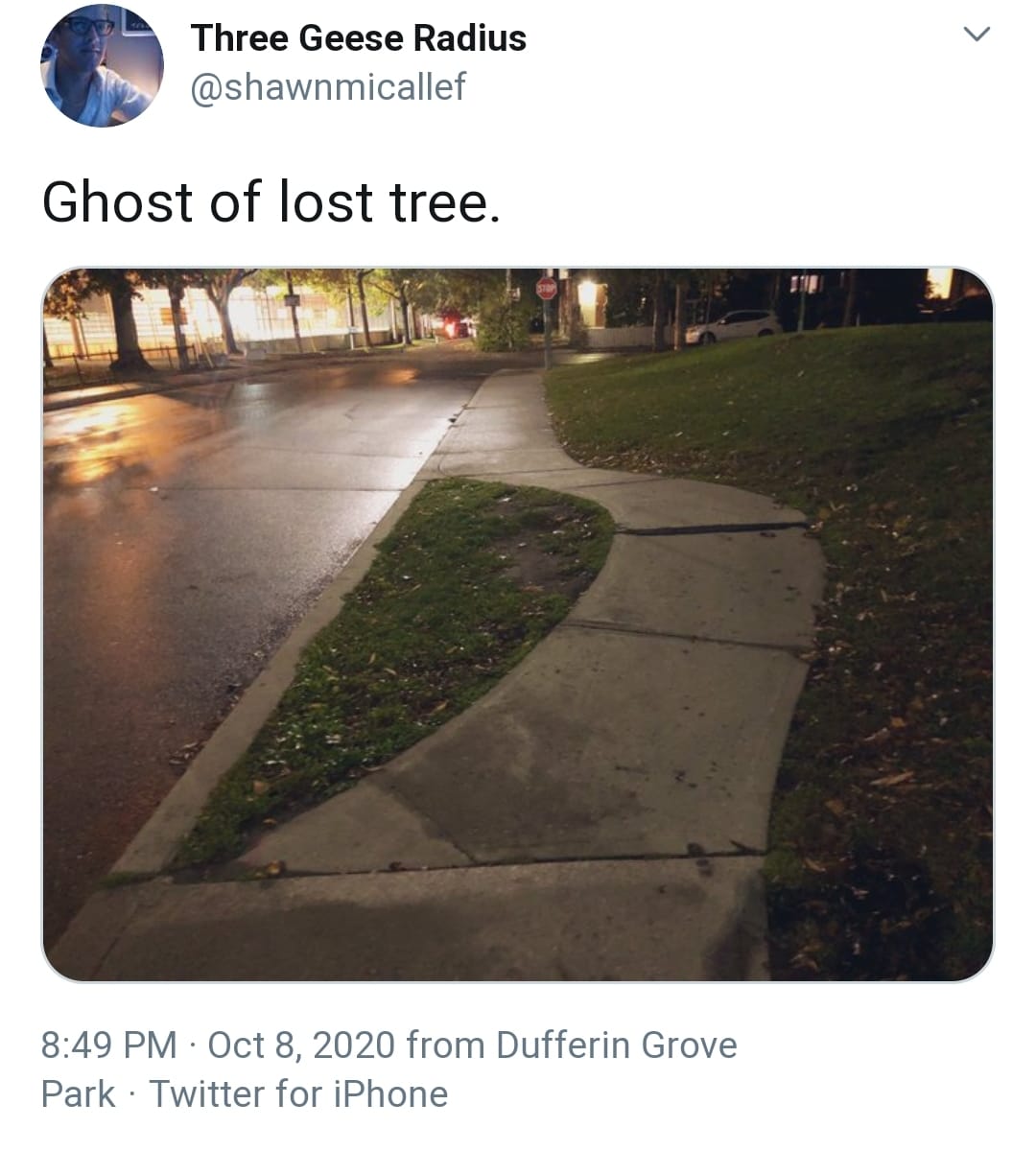
The meme is a photo of a sidewalk with a small patch of grass in the middle of the path, resembling a ghostly figure. The image is captioned "ghost of lost tree" implying that the tree that once stood there has been removed, leaving behind a small, eerie patch of grass.
detailed-analysis (gemma3-27b-vision)
Okay, let's break down this image and Twitter post through the requested theoretical lenses. It's a relatively sparse image, so we'll need to do some interpretive work to draw out these analyses.
Visual Description
The image depicts a paved pathway through a park at night. The path is delineated by a swathe of fallen leaves. A distinct, rounded shape formed by the leaf accumulation marks where a tree once stood. This creates a ghostly or negative space, resembling an imprint or outline. The path continues into the background, illuminated by sparse streetlights. In the distance are hints of buildings and other park structures. The overall color palette is dominated by dark greens, browns, and greys, with the limited artificial light creating a sense of quiet desolation. The image is taken at ground level, offering a direct, pedestrian perspective.
---
Foucauldian Genealogical Discourse Analysis
The phrase “Ghost of lost tree” combined with the visual establishes an interesting discourse. Foucault’s genealogical approach seeks to understand the historical construction of knowledge and power. This image doesn’t depict a tree, but its absence. The “ghost” isn’t supernatural, but a trace of a power dynamic. Historically, trees have been subject to human control—felled for urban development, park landscaping, or resource extraction.
The image reveals the discourse of control over nature. The circular imprint isn't simply the aftermath of a natural event; it’s a testament to the human ability to erase a natural element and reshape the landscape. It’s a site of forgotten decisions and the application of power. The tweet itself, a brief, poetic statement, functions as an archive of this lost power relation. It prompts us to ask how this tree came to be missing, who made that decision, and what systems or ideologies supported that action. The image is not just about loss, but the historical construction of loss through specific power relationships.
---
Critical Theory
Following the Frankfurt School's Critical Theory, the image can be viewed as a symptom of the “domination of nature”. The focus isn’t on the aesthetic beauty of the park but on the underlying process of instrumental reason. The missing tree exemplifies how nature is understood and treated as a resource to be managed and manipulated for human purposes.
The circular, imprinted space suggests a calculated removal, rather than a natural fall. This highlights the commodification of nature—the tree wasn’t valued for its intrinsic worth, but for its place within a pre-planned design or its potential usefulness. The tweet’s melancholy tone subtly points to the alienation from nature that accompanies this instrumentalist logic—a sense that something meaningful has been lost through the relentless pursuit of control and efficiency. The scene becomes a miniature representation of a larger system of exploitation and control.
---
Marxist Conflict Theory
From a Marxist perspective, the image and tweet suggest a conflict between humans and nature, mediated by class relations. The missing tree could symbolize the expropriation of natural resources by those in power for their benefit. The park itself, while seemingly a public space, might represent a controlled and curated environment that serves the interests of certain social groups.
The fallen leaves, while natural, can be interpreted as the remnants of a struggle—a sign of the decay of a once-vital natural element. The “ghost” of the tree is a reminder of the costs of development and the unequal distribution of resources. Even the aesthetic framing of the park—the paved paths, manicured lawns—suggests a dominance of artificial order over natural chaos. The tweet’s tone of loss implies an awareness of this underlying conflict and the resulting alienation.
---
Postmodernism
From a postmodern lens, the image and tweet highlight the constructed nature of reality and the instability of meaning. The “ghost” is a simulacrum—an image that stands in for the original tree but lacks its substance. This reinforces the idea that reality is not directly accessible, but mediated by signs and representations.
The tweet’s brevity and poetic ambiguity further contribute to this sense of uncertainty. It doesn’t offer a clear explanation or interpretation, but rather invites multiple readings. This reflects the postmodern emphasis on fragmentation, subjectivity, and the rejection of grand narratives. The image and tweet together function as a textual fragment, open to interpretation and resistant to any fixed meaning. The loss is not necessarily of a tree, but of the idea of a stable, natural world.
---
Queer Feminist Intersectional Analysis
While not immediately apparent, a queer feminist intersectional reading can focus on the ways power imbalances shape our relationship with the natural world and who gets to mourn or remember loss. The “ghost” can be seen as a representation of suppressed histories and forgotten forms of knowledge, particularly those connected to the land and Indigenous understandings of nature.
The act of removing the tree – and the lack of public acknowledgement of that removal – can be interpreted as a silencing of non-human voices and a disregard for ecological interconnectedness. From a feminist perspective, the dominance of patriarchal systems often manifests as a control over and exploitation of the natural world. A queer lens might highlight the ways in which rigid categories and binary oppositions (e.g., nature/culture, human/non-human) reinforce oppressive power dynamics. The tweet’s melancholic tone could be read as a subtle expression of grief for the loss of both a tree and the possibilities of a more equitable and sustainable relationship with the natural world.
I hope this detailed analysis provides a comprehensive understanding of the image and tweet through the various theoretical lenses you requested. Let me know if you'd like me to elaborate on any particular point or explore other perspectives.
simple-description (llama3.2-vision)
The meme is an image of a sidewalk with a small patch of grass that has been mowed into a ghostly shape. The text "Ghost of lost tree" is overlaid on the image, implying that a tree once stood in that spot but has since been removed, leaving behind a faint outline of its former presence. The image is likely meant to be humorous, poking fun at the idea that a tree can be so thoroughly erased from a public space that only its ghostly outline remains.
tesseract-ocr
Dm Three Geese Radius v y’ @shawnmicallef Ghost of lost tree. \ | Pe. te laa . 8:49 PM - Oct 8, 2020 from Dufferin Grove Park - Twitter for iPhone