First Seen
2023-05-10T21:03:42+00:00
simple-description (llama3.2-vision_11b)
This meme features a photo of a person walking down a street, with a dog running towards them. The image is captioned "I just got a new roommate" and includes the text "I just got a new roommate" and "I just got a new roommate". The meme is a humorous take on the challenges of living with a new roommate, particularly when they have a pet that is not well-behaved.
detailed-analysis (gemma3-27b-vision)
Here's an analysis of the image, broken down into relevant theoretical frameworks. It's important to acknowledge the somewhat arbitrary nature of applying these complex theories to a seemingly simple meme-like image – but that's often the point of such exercises!
Visual Description
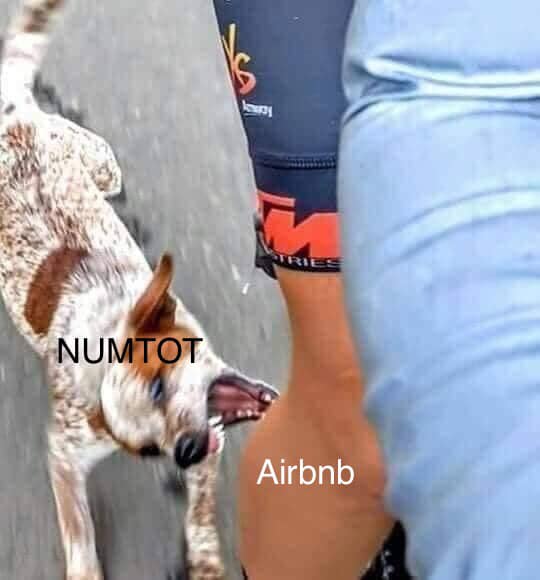
The image depicts a close-up of a dog (likely a Pit Bull or similar breed) appearing to “bite” or grasp at the leg of a person wearing athletic clothing. The background is blurry, suggesting an indoor space. Overlayed on the image are the words “NUMTOT” next to the dog, and “Airbnb” next to the leg, presented as if the dog is confronting or attacking the logo. The visual is dynamic, implying conflict or a challenging situation. The contrasting labels suggest a rivalry or opposition.
Foucauldian Genealogical Discourse Analysis
This image can be read through a Foucauldian lens, though it's a somewhat stretched application. The “NUMTOT” vs “Airbnb” pairing doesn't represent a straightforward power dynamic, but the juxtaposition creates a discourse.
- Discourse & Power/Knowledge: The image establishes a discourse around the perceived conflict between “NUMTOT” and “Airbnb.” This conflict isn't inherently meaningful, but the image creates a space for it to be talked about. This implies Airbnb has established a knowledge and power dynamic as a global brand.
- Genealogy: Tracing the ‘genealogy’ of these terms (NUMTOT is a meme-based term often used online) reveals how they've gained meaning through specific cultural contexts. NUMTOT, born from internet culture, represents an emergent, perhaps anarchic or playful force, while Airbnb represents the established, commercially driven system.
- Normalization: The image participates in normalizing the idea of conflict around these concepts. It suggests that there is something to be contested, even if the nature of the contest is undefined.
Marxist Conflict Theory
This is perhaps the most readily applicable theoretical framework.
- Class Struggle: We can interpret this as a visual representation of conflict, though in a metaphorical sense. Airbnb embodies a capitalist structure – providing lodging as a commodity. “NUMTOT,” as a more grassroots, internet-based term, can be seen as representing a resistance to this commercialization, a rejection of the commodification of experiences.
- Exploitation/Alienation: Airbnb, as a platform, often relies on exploiting housing shortages and displacing local communities, creating a sense of alienation. The dog "attacking" Airbnb can be read as a symbolic challenge to this exploitation.
- Ideology: The image suggests a challenge to the prevailing ideology of late-stage capitalism, where everything is a commodity, even experiences and housing.
Postmodernism
The image strongly aligns with several tenets of Postmodernism.
- Deconstruction: The image deconstructs the typical brand image of Airbnb. Instead of presenting a polished, inviting experience, it positions the brand as a target of confrontation.
- Simulacra & Simulation: The image is itself a simulation – a representation of conflict rather than an actual event. It plays with signs and symbols (“Airbnb,” “NUMTOT,” a dog biting) to create meaning, blurring the line between reality and representation.
- Irony & Parody: There's a clear element of irony and perhaps parody. The image doesn't offer a serious critique, but rather a playful, meme-like challenge to the status quo.
- Fragmentation: The image is fragmented – it doesn’t offer a complete narrative. The meaning is open to interpretation and relies on the viewer's prior knowledge and cultural context.
Queer Feminist Intersectional Analysis
This framework is the most difficult to apply directly, but some connections can be made.
- Disruption of Norms: The image disrupts the typical advertising or branding around Airbnb. It doesn’t present a seamless, welcoming image, instead it challenges the expectation of a safe, controlled experience. This disruption can be seen as a queer act, challenging conventional structures.
- Accessibility & Displacement: Airbnb has been criticized for contributing to housing shortages and displacement in many cities, disproportionately affecting marginalized communities (often racialized, low-income, or queer). The dog “attacking” Airbnb can be read as a symbolic resistance to these forms of displacement.
- Power Dynamics: The image highlights power dynamics – the power of a large corporation (Airbnb) versus potentially grassroots resistance (“NUMTOT”). This resistance could be interpreted as a reclaiming of agency by marginalized groups.
It’s crucial to remember that these are interpretations – the image is open to multiple readings and its meaning is contingent on the viewer's perspective. This exercise demonstrates how complex theoretical frameworks can be applied (and sometimes stretched) to analyze even seemingly simple visual material.
simple-description (llama3.2-vision)
This meme features a picture of a dog, likely a Pomeranian or a similar breed, with its tongue out and ears back, looking embarrassed or guilty. The text "I can smell the desperation" is overlaid on the image, implying that the dog is aware of something and is trying to hide it. The image is likely a humorous take on a situation where someone is trying to hide something, but the dog's body language gives away their true intentions.
tesseract-ocr
< | is = i er _