First Seen
2023-05-22T18:59:16+00:00
simple-description (llama3.2-vision_11b)
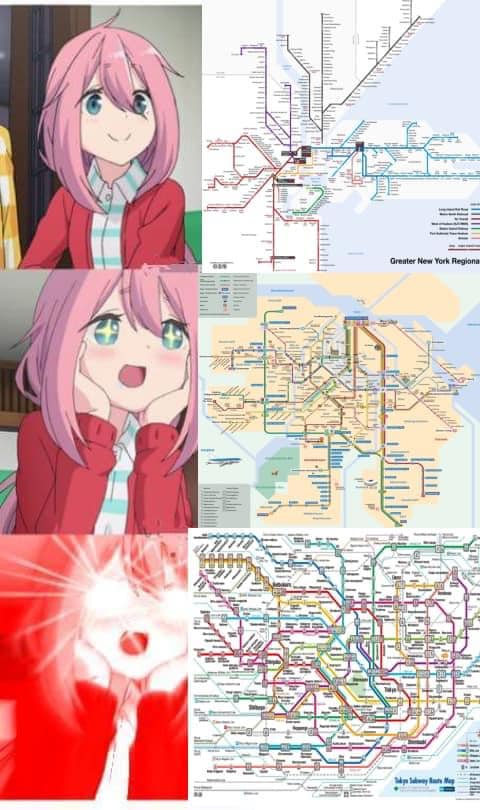
This meme is a play on the New York City subway map, with the character Rias Gremory from the anime series "High School DxD" superimposed onto the map. The image is captioned "When you're trying to navigate the NYC subway system but you're actually a demon lord".
detailed-analysis (gemma3-27b-vision)
Okay, let's break down this complex collage using the requested analytical frameworks. It's a rich visual, open to interpretation, and the analysis will be somewhat speculative given the open-ended nature of the combination.
Visual Description
The image is a collage featuring three vertically arranged panels. The left side displays a series of screengrabs depicting a young, anime-style female character. She is shown in varying degrees of surprise and expression, with vibrant pink hair and wearing a red jacket. The central and lower panels depict a highly detailed map of the Tokyo subway system. The maps are overlaid, suggesting a potential connection or juxtaposition between the character and the subway network. The map's complexity—a dense web of lines and station names—is immediately striking. The color scheme is largely composed of blue, grey, white, and green. The overall effect is one of visual overload and a layered composition that seems to demand interpretation.
Foucauldian Genealogical Discourse Analysis
This collage can be explored through a Foucauldian lens by examining the discursive formations around the depicted elements. The anime character represents a particular episteme—a way of knowing and understanding the world—rooted in Japanese pop culture, particularly the construction of female subjectivity through animation. This is a modern discourse that produces certain types of bodies, behaviors, and desires.
The subway map, however, represents a very different type of discourse – one of power/knowledge. It's not simply a neutral representation of a physical space, but a system that structures and controls movement, access, and urban life. The map constitutes the city as a network of regulated flows.
The juxtaposition suggests an investigation of how these discourses intersect and condition each other. How does the anime character's (constructed) identity, and therefore her potential movements, fit within the confines and possibilities offered by the subway system? Is she being “mapped” (literally and figuratively) onto the city? Is there a power dynamic inherent in controlling the routes of people like her?
We could also look at the historical genealogy of both elements. The subway system’s development is a story of urban planning, industrialization, and social control. Anime has a genealogy rooted in Japan’s post-war cultural landscape, evolving through various aesthetic and narrative shifts. Understanding these histories reveals the underlying power structures at play.
Critical Theory
Drawing from the Frankfurt School and thinkers like Adorno and Horkheimer, we can see the collage potentially reflecting the culture industry. The anime character is a product of mass media, a spectacle manufactured to generate desire and consumption. The subway map, though seemingly functional, can be interpreted as another element of the standardized, rationalized world of modernity.
The juxtaposition could be seen as a commentary on the alienation experienced within this modern landscape. The individual (represented by the anime character) is reduced to a node within a complex system (the subway), potentially losing a sense of autonomy and authentic experience.
The repetition inherent in the subway map—the identical stations, the parallel lines—mirrors the homogenization of experience characteristic of mass culture. The anime character’s exaggerated emotional expressions could be read as a symptom of the emotional numbness produced by this hyper-rationalized environment.
Marxist Conflict Theory
From a Marxist perspective, the collage can be understood as a representation of the material conditions shaping social life. The subway system is not merely a means of transportation, but a tool of class control. It facilitates the movement of labor, allowing capital to exploit workers residing in different parts of the city.
The anime character, as a consumer of mass media, might be seen as commodified, her image used to drive profit. Her vibrant appearance could also be interpreted as a form of false consciousness, obscuring the underlying economic exploitation that sustains her consumption.
The juxtaposition of the character and the map could be read as highlighting the contradictions inherent in capitalist society—the tension between individual desire and systemic control, between aesthetic expression and material necessity. Is her journey on the subway serving her interests, or is she simply a cog in the capitalist machine?
Postmodernism
From a postmodern perspective, the collage embraces fragmentation, intertextuality, and the blurring of boundaries. The combination of disparate elements – anime, urban planning, geography – creates a deliberately disjointed and ambiguous image. There is no single, coherent meaning; rather, the image invites multiple interpretations.
The simulacra (copies without originals) are evident in both elements. The anime character is a constructed representation, a hyperreal image that doesn't necessarily correspond to a "real" person. The subway map is a representation of a representation – a schematic diagram that stands in for the complex reality of the city.
The playfulness and lack of clear narrative suggest a rejection of grand narratives and universal truths. The collage celebrates the fluidity of meaning and the instability of identity. It embraces the idea that meaning is constructed through association and interpretation, rather than inherent in the objects themselves.
Queer Feminist Intersectional Analysis
This framework allows for a deeper exploration of how power operates through intersecting systems of oppression. The anime character, often hyper-sexualized in the medium, could be analyzed through a feminist lens, questioning the male gaze and the commodification of female bodies.
The subway system, as a public space, is not neutral. It can be a site of harassment and violence against women and marginalized groups. The map’s representation of space also influences who has access to resources and opportunities. Are certain areas "mapped" out for specific groups?
The intersectional angle acknowledges how race, class, sexuality, and other factors shape experiences within the city. Are there implicit biases in the subway system’s design or operation? Does the map reflect or reinforce existing inequalities?
The juxtaposition may be subtly subverting traditional expectations. The anime character’s expressive pose could be read as a challenge to societal norms. Her journey on the subway may represent a reclaiming of space and agency. The map, despite its seemingly objective nature, is ultimately a product of human choices and power structures, susceptible to critique and reimagining.
Disclaimer: This analysis is subjective and based on interpretation. The meaning of the collage is open to debate. The goal is to demonstrate how different theoretical frameworks can be applied to understand and analyze visual culture.
simple-description (llama3.2-vision)
This meme features an image of an anime girl with a shocked expression, alongside two New York City subway maps. The text "I can see my house from here" is written in a red box in the bottom-right corner of the image, referencing the infamous "I can see my house from here" song from the 1972 song of the same name by The , and .
tesseract-ocr
a a de Bir@) Jt | {Ss =: V we. a SEs wee 7 | eae ISS