First Seen
2023-09-22T22:49:22+00:00
simple-description (llama3.2-vision_11b)
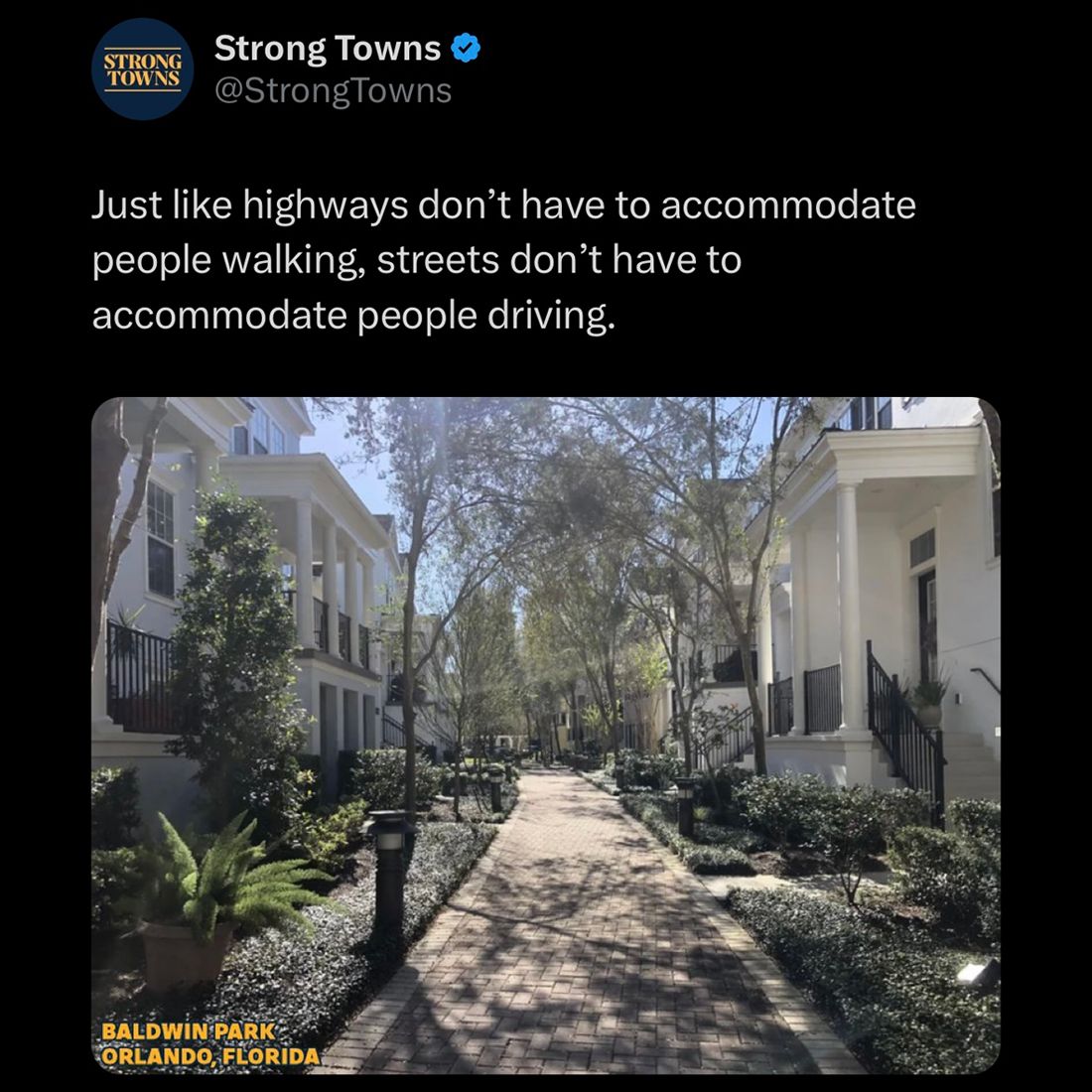
The meme is a humorous commentary on the design of urban infrastructure. It features a photo of a suburban neighborhood with a caption that contrasts the idealized notion of "streets" with the reality of urban planning. The image shows a tree-lined residential street with sidewalks, implying a peaceful and safe environment, but the caption "Just like highways don't have to accommodate pedestrians" pokes fun at the idea that roads are designed with cars in mind, rather than pedestrians.
detailed-analysis (gemma3-27b-vision)
Okay, let's break down this image and its accompanying text through various critical lenses.
Visual Description
The image depicts a pedestrian walkway or path running through a residential neighborhood. The walkway is paved with reddish brick or stone, appearing somewhat aged and potentially well-used. On either side of the path are rows of neatly-maintained, two-story houses. These houses have a distinctive architectural style, reminiscent of New Orleans or the American South. They feature white columns, pastel-colored facades (light blue/grey), and well-kept gardens with dense shrubs and flowering plants.
The path is shaded by mature trees, creating a somewhat tunnel-like effect. The overall impression is one of calm, peaceful, and potentially exclusive residential area. The composition focuses on the path itself, implicitly suggesting it's the intended point of focus. Text overlays at the bottom identify the location as Baldwin Park, Orlando, Florida.
Foucauldian Genealogical Discourse Analysis
This image and text operate within a specific discourse of urban planning and transportation. The statement—"Just like highways don't have to accommodate people walking, streets don't have to accommodate people driving"—is a challenge to the episteme (underlying system of thought) that prioritizes automobile-centric design in much of contemporary urban landscapes.
A genealogical analysis would trace the historical development of this prioritization. The post-WWII rise of suburbanization, fueled by car ownership and federal highway construction, created a system where roads were defined by their capacity for cars, and other modes of transport were treated as secondary.
The tweet subtly disrupts this established discourse by stating the obvious - different modes of transport have different needs. It’s a move to destabilize the taken-for-granted assumptions about how urban spaces should be designed. It's not arguing for complete exclusion of cars, but for a reimagining of streets as multi-modal spaces, prioritizing pedestrian and bicycle access alongside automobiles. The image reinforces this by showcasing a space designed for pedestrians, an anomaly in many contemporary urban environments.
Critical Theory
From a critical theory perspective, the image and text critique the dominant ideology of car-centric urbanism. This ideology is not simply about convenience, but is embedded within broader systems of power.
- Domination: Car-centric design reinforces the domination of a particular lifestyle (suburban, dependent on fossil fuels, privileging individual mobility over communal space).
- Rationalization: The emphasis on efficient roadways and traffic flow is framed as a rational solution to urban problems, masking the social and environmental costs.
- Commodification: The car industry is a massive economic force, and car-centric planning perpetuates its profitability.
The tweet, by pointing out that streets can be designed for people other than drivers, challenges this dominant paradigm. It suggests a need for a more holistic and equitable urban planning approach that prioritizes human-scale design and community well-being. The image represents a potential alternative to this current paradigm - an example of a designed space that prioritizes walking and community.
Marxist Conflict Theory
From a Marxist perspective, this image and text highlight the class conflict inherent in urban planning. Car ownership, and the ability to navigate a car-centric city, is often tied to socio-economic status.
- Bourgeoisie: The ruling class (or those with economic power) benefit from car-centric infrastructure. They can afford cars, own larger properties in suburban areas, and have greater freedom of movement.
- Proletariat: Lower-income individuals, those without access to cars, or those who rely on public transportation or walking, are disadvantaged by this system. They may face longer commutes, limited access to jobs and services, and increased exposure to pollution and traffic hazards.
The image and text, by advocating for pedestrian-friendly design, implicitly challenge this imbalance of power. A walkable city is a more equitable city, providing greater access and opportunity for all. The tweet advocates for the prioritization of all people in the built environment, not just car drivers.
Postmodernism
From a postmodern lens, the image and text can be seen as a rejection of grand narratives – specifically the narrative that progress is synonymous with increased automobile ownership and road building.
Postmodernism embraces deconstruction—breaking down established categories and assumptions. The tweet deconstructs the notion that streets must be primarily for cars. It’s a playful assertion that there are multiple ways to design and experience urban space.
The image itself lacks a single, dominant meaning. It’s open to interpretation and can evoke a range of associations (Southern charm, community, environmental consciousness). There is no 'correct' way to see it. This ambiguity aligns with the postmodern emphasis on subjectivity and multiple perspectives.
Queer Feminist Intersectional Analysis
This analysis would consider how car-centric planning impacts marginalized groups intersectionally – how race, gender, class, ability, and sexuality intersect to create unique experiences of urban space.
- Gender: Historically, urban planning has been shaped by a masculine perspective, prioritizing efficiency and individual movement over safety and care. Walkable neighborhoods, with pedestrian-friendly design, are often considered safer for women and children.
- Race: Car-centric planning has disproportionately harmed communities of color, who were often displaced by highway construction and left with limited access to transportation options.
- Ability: Individuals with disabilities may face significant barriers in car-dependent cities. Walkable neighborhoods with accessible sidewalks and public transportation are essential for their inclusion.
- Queer Identity: Queer people often seek spaces for gathering and socializing, and walkable neighborhoods can foster community and visibility.
The image and text, by advocating for pedestrian-friendly design, implicitly promote a more inclusive and equitable urban environment that addresses the needs of all community members, especially those who have been historically marginalized. The emphasis on community spaces and slower-paced movement can create a sense of belonging for queer and marginalized communities.
I hope this detailed breakdown is helpful! Let me know if you'd like me to expand on any of these analyses.
simple-description (llama3.2-vision)
The meme is a tweet from the Twitter account "Strong Towns" with a photo of a residential street in a neighborhood. The photo shows a tree-lined, paved street with houses on either side, and the text "Baldwin Park, Orlando, Florida" is in the bottom left corner. The tweet itself reads: "Just like highways don't have to accommodate people walking, streets don't have to accommodate people driving."
tesseract-ocr
SUL a) KON —— @StrongTowns Just like highways don’t have to accommodate people walking, streets don’t have to accommodate people driving. je A f lee V7 | Tai faeces ‘ ia * Be) ‘ ce ye ae a KS, | “Bene | : ba. GE x Mie i a lire ee VA = TS SSE ae a ae 1 - ve i ~ ae ey, ol ee RR es ae se eo 54 ey =f i 2 a as: ay = Se ae re ee OE Bee Cam Ae Merial i ee cL TUL ILL ie ig a aS