First Seen
2025-06-11T05:15:54.924184+00:00
detailed-analysis (gemma3_27b-it-q8_0)
Okay, let's break down this meme—a striking visual comparison of the same suburban street in 2009 and 2019, marked by dramatically increased housing prices—through the lens of urbanism/housing, employing the requested theoretical frameworks where applicable.
Visual Description
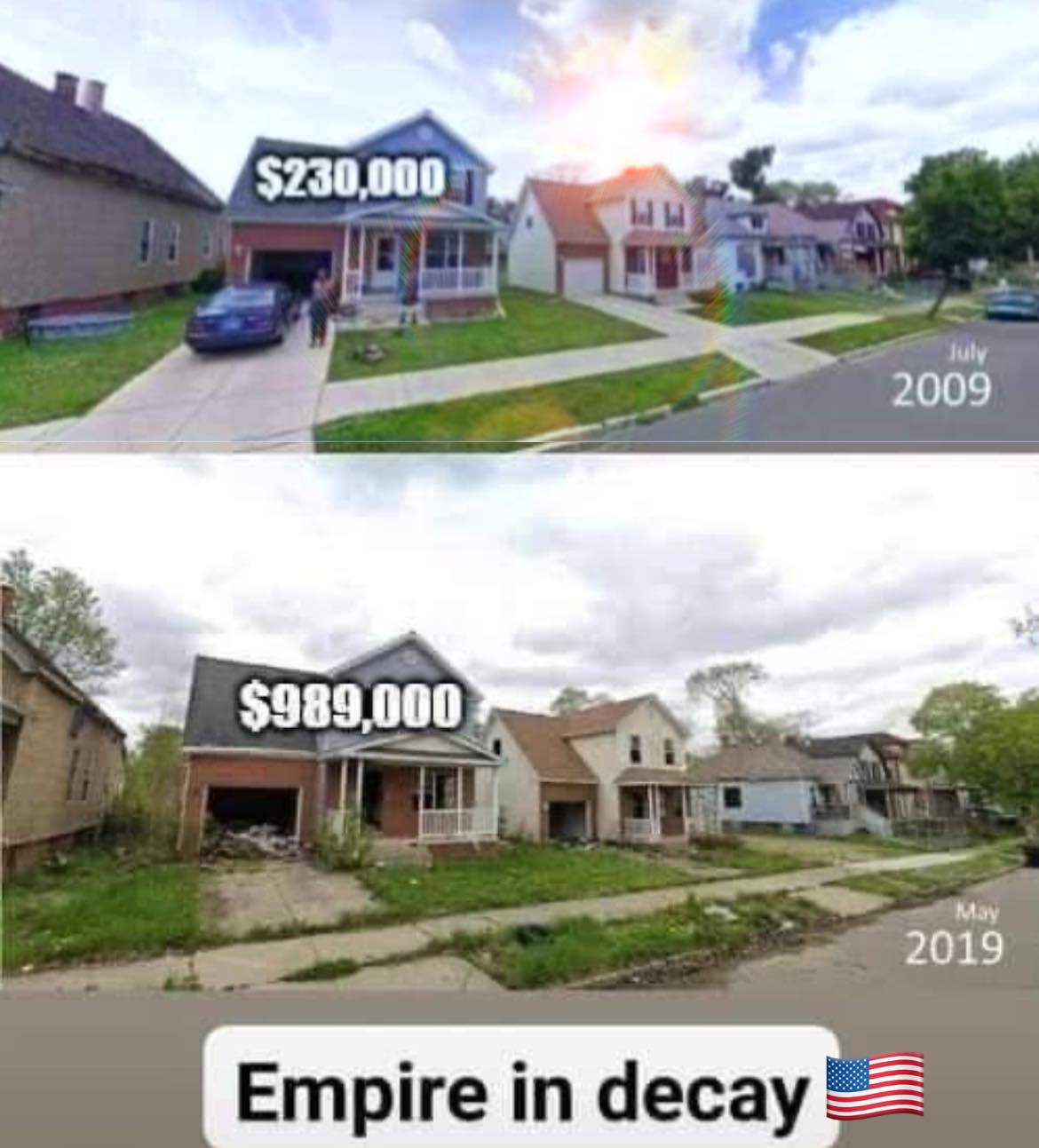
The meme presents a before-and-after comparison using Google Street View screenshots.
- 2009 Image: A well-maintained, but not ostentatious, suburban street. Houses appear solid, with neatly kept lawns. A car is parked in one driveway. The sky is bright and clear, evoking a sense of stability. The price tag on this scene is $230,000.
- 2019 Image: The same street, but the visual quality is starkly different. Houses appear somewhat dilapidated. Lawns are overgrown. There is more disrepair visible. The sky is overcast and gloomy, reflecting a sense of decline. The price is $989,000. The contrast is jarring, highlighting the massive increase in housing costs.
The overall message is a sense of loss, decay, and perhaps a critique of a changing economic reality. It implies that even as value ostensibly increases (house prices), the quality of life or visual appeal degrades.
Marxist Conflict Theory
This meme is ripe for a Marxist interpretation. The core of Marxist theory revolves around class struggle and the exploitation of labor. This image visualizes the consequences of financialization of housing, turning homes from places of shelter into commodities to be speculated upon.
- Capital Accumulation: The increase in housing prices represents capital accumulation—wealth concentrating in the hands of those who own property (the bourgeoisie) at the expense of those who need it for shelter (the proletariat). The meme suggests the means of production (land/housing) are no longer serving basic needs, but generating profit for a select few.
- Alienation: The deterioration of the homes despite increased prices can be interpreted as alienation. People are alienated from the fruits of their labor. They’re working harder (or taking on more debt) to afford increasingly dilapidated housing.
- Commodification of Housing: This meme encapsulates the commodification of housing, the process by which housing is treated as a tradable commodity rather than a basic human right. It shows how housing becomes less about providing shelter and more about generating profit.
- The Reserve Army of Labor: The fact that housing is unaffordable for many creates a “reserve army of labor” – people who are forced to move further from job centers, accept lower wages, or endure precarious living conditions because of housing costs.
Critical Theory
Critical Theory, emerging from the Frankfurt School, seeks to critique and change society as a whole. It is very related to Marxism. The meme can be seen as a critique of:
- Instrumental Reason: The relentless pursuit of profit and economic growth (as evidenced by the price increases) overrides other values like community, livability, and well-being. The houses are merely instruments for generating wealth, not homes.
- The Culture Industry: In a broader sense, the meme can be linked to the ‘culture industry’—how cultural products (in this case, the myth of homeownership and the American Dream) are used to maintain the status quo. The inflated prices reflect a distorted reality, a manufactured desire.
- The Erosion of Public Space: The decline of upkeep can reflect a broader erosion of communal responsibility and the decline of the public realm.
Foucauldian Genealogical Discourse Analysis
Michel Foucault's work emphasizes the relationship between power, knowledge, and discourse. Applying this to the meme:
- Discipline and Biopower: Housing policy, zoning laws, and mortgage practices can be seen as mechanisms of discipline and biopower – ways of controlling populations by regulating their access to shelter and the conditions of their lives. The inflated prices exert a form of control, dictating where people can live and how they must live.
- The Construction of “Home”: The meme implicitly challenges the discourse surrounding “home.” Historically, “home” has been constructed as a symbol of security, family, and the American Dream. This meme shows how that discourse is unraveling, replaced by a discourse of financial speculation and unaffordability.
- Genealogy of Housing Finance: A genealogical analysis would trace the historical development of housing finance (e.g., the rise of subprime mortgages, the role of Fannie Mae and Freddie Mac) to understand how the current situation came to be. It would show how seemingly neutral financial practices are actually imbued with power relations.
Postmodernism
Postmodernism, in this context, could offer the following:
- Rejection of Metanarratives: The meme implicitly rejects the metanarrative of upward mobility and the American Dream. It exposes the instability of these concepts.
- Simulacra and Simulation: The houses, despite increasing in monetary value, may become simulations of "home"—they look like homes, but lack the substance and livability of what a home once represented.
- Fragmentation and Loss of Meaning: The decaying houses reflect a fragmentation of community and a loss of meaning associated with homeownership.
Why certain frameworks don't apply directly:
- Queer Feminist Intersectional Analysis: While housing insecurity disproportionately affects marginalized groups (including LGBTQ+ people and people of color), the meme's core message is broader. It's about the systemic changes in housing economics. A queer feminist analysis would need more information about who is experiencing the negative effects of the price increases to be fully applicable.
In summary, the meme is a potent critique of the contemporary housing crisis and the broader economic forces that contribute to it. It’s a stark visual statement about the erosion of the American Dream, the commodification of shelter, and the growing gap between wealth and affordability. It resonates because it captures a shared experience of disillusionment and frustration with the current state of affairs.
simple-description (llama3.2-vision_11b)
The meme is a comparison of two images of houses, one from 2009 and one from 2019, with a caption that reads "Empire in Decay". The top image shows a well-maintained house with a high price tag, while the bottom image shows a dilapidated house with a significantly lower price. The meme is likely commenting on the decline of the "Empire" in a metaphorical sense, with the house representing a symbol of American power and prosperity, now in a state of decay.
detailed-analysis (gemma3-27b-vision)
Here's an analysis of the image, broken down into sections based on the requested theoretical frameworks. Given the image’s content, some frameworks will be more applicable than others.
Visual Description
The image presents a split-screen comparison of a street in an American neighborhood in July 2009 and May 2019. The top image shows a street with a house listed for sale at $230,000. The houses appear well-maintained, with green lawns and mostly intact facades. The bottom image, from 2019, displays a similar street with a house listed for $989,000. However, the houses appear dilapidated. Some appear to have significant structural damage. The overall impression is of a neighborhood in decline, with a stark increase in price coinciding with a clear visual degradation of property conditions. The text at the bottom reads “Empire in decay” with the American flag.
Marxist Conflict Theory
This image provides fertile ground for a Marxist analysis. The stark contrast in property values and conditions exemplifies the concept of capital accumulation and the inherent contradictions within capitalism.
- Exploitation & Gentrification: The image could be read as evidence of gentrification – the displacement of existing residents due to rising property values. While the price has increased dramatically, the physical state of the houses has declined. This suggests that capital isn’t being reinvested into the community for upkeep, but is simply extracted as profit. The gap between the value and the condition hints at speculative investment driving prices up, rather than actual improvements to the housing stock.
- Class Struggle: The decay could also signify a failure of the system to provide basic necessities for all. While some are profiting from the rising property values, the neighborhood is visibly suffering. This highlights the inherent class conflict within capitalism, where the interests of capital (profit) clash with the needs of the community.
- Commodity Fetishism: The inflated price tag on a decaying house demonstrates commodity fetishism – the attribution of value to an object beyond its actual use-value (its practical worth). The house is valued not for its structural integrity or habitability, but for its perceived potential as an investment.
Foucauldian Genealogical Discourse Analysis
A Foucauldian approach wouldn’t focus on the why of the decay but instead on how the idea of "decay" itself is constructed through discourse.
- Power/Knowledge: The image plays on the discourse of American homeownership, the "American Dream", and its associated values. The contrast in prices and conditions disrupts this discourse. The label “Empire in decay” frames the situation as more than just localized neighborhood decline, it connects it to a broader narrative of national decline. The framing of “decay” itself is a power move, constructing a narrative about the state of the nation.
- Archaeology of Knowledge: A genealogical approach would investigate how the concept of "decay" has evolved historically. What has “decay” signified in different moments in American history? How has it been used to justify certain policies or actions? The image pulls on existing anxieties about urban decline, economic hardship, and the perceived loss of the "good old days."
- Disciplinary Power: The very act of assigning a price to the decaying property is an exercise of disciplinary power. It seeks to quantify and control a situation that is inherently complex and subjective. The expectation that people will buy into this system reinforces the logic of capital.
Postmodernism
A postmodern lens would deconstruct the image's claims to truth and meaning.
- Simulacra & Simulation: The inflated price of the decaying house could be seen as a simulacrum – a copy without an original. The price doesn’t reflect the actual value of the house, but rather a detached, abstract economic force. The image highlights how signs (price, condition) can become detached from reality.
- Fragmentation & Instability: The image’s juxtaposition of two contrasting scenes embodies the postmodern theme of fragmentation. There is no coherent narrative, only a series of disconnected images and values. The concept of a stable "home" or a cohesive community is undermined.
- Rejection of Grand Narratives: The "Empire in decay" label is itself a grand narrative, and a postmodern analysis would question its validity. Is this "decay" truly inevitable? Is the "empire" inherently flawed? A postmodern perspective would resist any attempt to impose a single, overarching interpretation.
Critical Theory
This image can be analyzed through the lens of Critical Theory, which examines how power structures shape our understanding of the world.
- Ideology: The image implicitly critiques the ideology of unfettered capitalism. By juxtaposing rising prices with deteriorating conditions, it exposes the contradictions within the system and challenges the notion that market forces always lead to positive outcomes.
- Domination & Oppression: The "decay" of the neighborhood could be seen as a symptom of systemic inequalities. The forces driving up prices may disproportionately affect marginalized communities, exacerbating existing patterns of oppression.
- Emancipation: By exposing the flaws in the existing system, the image implicitly calls for a more just and equitable society. It suggests that alternative economic models are needed to address the root causes of urban decline and social inequality.
Queer Feminist Intersectional Analysis (Less directly applicable, but possible)
While not the most central framework here, an intersectional lens could highlight how the decay disproportionately affects specific communities.
- Spatial Justice: Urban decay often impacts marginalized communities, including LGBTQ+ individuals and people of color. The image could be interpreted as a manifestation of spatial injustice – the unequal distribution of resources and opportunities based on social identity.
- Housing as a Site of Oppression: Historically, housing has been a site of discrimination and exclusion for marginalized groups. Decay reinforces these inequalities and contributes to a cycle of disadvantage.
- Disrupted Domesticity: The broken-down homes disrupt the traditional ideal of domesticity, especially as it's historically been imposed on women. The image can symbolize a breakdown of societal expectations and the rejection of normative family structures.
Disclaimer: These interpretations are not exhaustive, and other theoretical frameworks could also be applied. The meaning of the image is open to interpretation, and different viewers may draw different conclusions.
simple-description (llama3.2-vision)
The meme is a satirical commentary on the decline of the American Empire. It features two images of houses, one from 2009 and one from 2019, with their respective prices. The meme's title, "Empire in decay," is a reference to the idea that the United States' power and influence are declining. The images and prices are meant to be humorous and ironic, highlighting the contrast between the country's past and present.