First Seen
2023-09-16T22:05:44+00:00
simple-description (llama3.2-vision_11b)
The meme depicts a Tesla car with a large, industrial-style trailer attached to its back, with a sign that reads "Electric Vehicle Charging Station". The image is meant to be humorous, implying that the Tesla is now a mobile charging station, taking the concept of electric vehicles to an absurd and satirical level. The meme pokes fun at the idea of electric vehicles being so environmentally friendly that they can even charge other cars on the go.
detailed-analysis (gemma3-27b-vision)
Okay, here's an analysis of the image, broken down into sections as requested. I'll indicate if a section doesn't apply as strongly. I'll aim for a nuanced interpretation, though it's important to remember these are interpretive frameworks, and there's room for multiple readings.
1. Visual Description
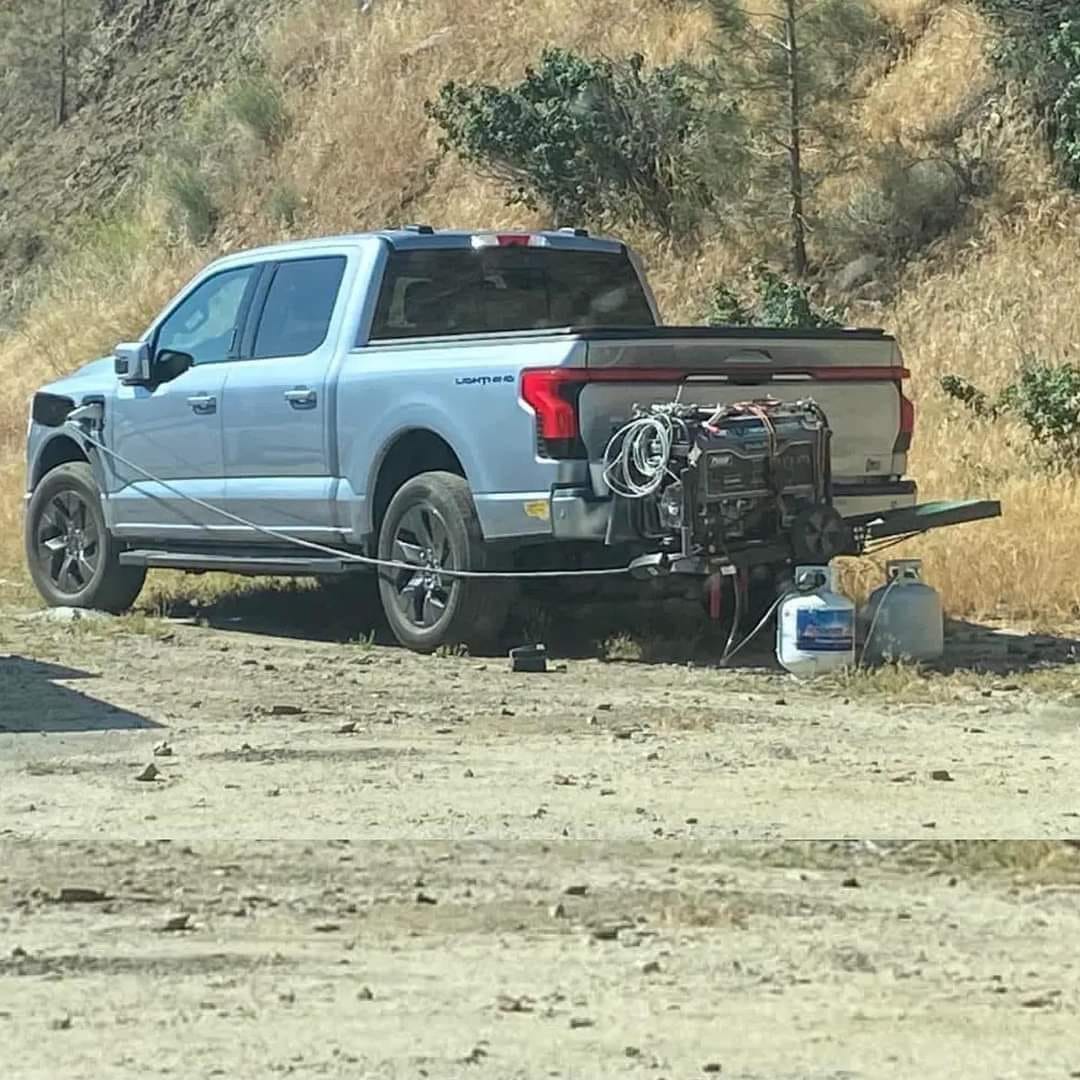
The image shows a light blue Ford F-150 Lightning (electric pickup truck) parked on a dirt/gravel surface. The truck appears to have sustained significant damage to the rear passenger side, with denting and apparent deformation of the metal. A complex apparatus is attached to the rear hitch, comprising what appears to be a small engine, pipes, and gauges – it resembles a makeshift or experimental setup. A gas can is positioned near the rear tire, adding to the sense of mechanical work or experimentation. The background consists of dry, grassy, hilly terrain, suggesting a rural or semi-rural location. The lighting indicates a sunny day. The framing is side-on, emphasizing the damaged rear of the vehicle and the attached mechanism.
2. Foucauldian Genealogical Discourse Analysis
This image provides fertile ground for a Foucauldian analysis. The truck, especially in its damaged state, can be seen as a site where discourses of masculinity, power, and technology converge and are disrupted.
- Discourse of Automotive Power: Pick-up trucks, historically, are deeply embedded in a discourse of rugged individualism, physical strength, and dominion over the natural landscape. The “Lightning” model, while electric, still attempts to claim this legacy. The damage to the vehicle immediately destabilizes that discourse, hinting at a failure of control.
- Discourse of DIY/Engineering: The contraption attached to the hitch represents a counter-discourse of tinkering, experimentation, and "making do." This suggests a deliberate reconfiguration of the truck's intended function. It’s a challenge to the pre-packaged, consumer-driven nature of automotive technology.
- Discourse of Repair and Failure: The damage isn't merely aesthetic. It embodies a discourse of failure within a system designed for reliability and control. The repair, or attempted repair, through the attached mechanism, indicates an attempt to reclaim control over that failure.
- Genealogy of the Truck: Tracing the “genealogy” of the truck reveals its historical connection to agriculture, labor, and the expansion of frontier culture – a historically masculine and often exploitative landscape. The electric nature of this modern model begins to complicate that history, but the form of the truck itself remains a signifier of those older power dynamics.
3. Marxist Conflict Theory
The image speaks to class, labor, and the relationship between technology and the working class.
- The Truck as a Symbol of Capital: The F-150, even in its electric version, represents a significant financial investment. It signifies access to capital and a particular lifestyle. The damage introduces an element of vulnerability and fragility even to this demonstration of wealth.
- Labor and Repair: The contraption attached to the hitch is indicative of labor. Someone has spent time, effort, and resources attempting to fix or repurpose the truck. This labor isn’t necessarily performed by a professional mechanic; it suggests a self-reliant, resourceful approach that may be driven by economic necessity or a rejection of consumerist repair models.
- Technology & Exploitation: The electric nature of the vehicle complicates traditional Marxist analysis. While it could be interpreted as a move towards sustainable technology, it also introduces new forms of resource extraction (lithium, cobalt, etc.) and potentially a new set of exploitative labor practices within the supply chain.
- The Conflict of Repair vs. Replacement: The decision to repair rather than replace is inherently political. It challenges the planned obsolescence inherent in capitalist production and the drive for constant consumption.
4. Postmodernism
The image displays several traits associated with postmodern thought.
- Deconstruction of the "Authentic" Vehicle: The truck, as a symbol of American culture, is deconstructed by its damage and the bizarre addition of the makeshift apparatus. It’s no longer a pristine signifier of power; it’s a fragmented, ambiguous object.
- Pastiche & Hybridity: The combination of a high-tech electric vehicle with a low-tech, cobbled-together mechanism is an example of pastiche and hybridity. It’s a mixing of styles and technologies that challenges the idea of a unified, coherent object.
- Ambiguity & Lack of Grand Narratives: The purpose of the attached mechanism is unclear. This ambiguity rejects the idea of a single, definitive meaning or explanation. It suggests a rejection of "grand narratives" – overarching ideologies that attempt to explain the world.
- Simulation & Hyperreality: The electric truck itself simulates ruggedness and power. The damage disrupts this simulation, revealing the underlying material reality.
5. Queer Feminist Intersectional Analysis (Potentially relevant, but requires more speculative interpretation)
This is the least directly applicable framework, but can be approached speculatively:
- Challenging Masculine Norms: Pick-up trucks are historically and culturally associated with hypermasculinity. The damage to the vehicle, combined with the non-standard apparatus, can be read as a disruption of those norms. It’s a rejection of the idea that strength and control are solely defined by physical power.
- Labor & Gendered Division of Work: The labor involved in repairing the vehicle—likely self-performed—may challenge traditional gender roles in mechanical work, historically dominated by men. This is a weak connection, but worth noting.
- Environmental Impact & Intersectional Justice: The electric truck, while touted as environmentally friendly, still relies on resource extraction and production processes that disproportionately impact marginalized communities. This aligns with intersectional feminist concerns about environmental justice.
- Deconstruction of "Fixer" Archetype: The self-repair, going beyond professional service, can be seen as a deconstruction of the "fixer" archetype. It subverts the expectation of a professional, typically male, expert.
Important Note: These analyses are interpretations. The "correct" reading depends on the theoretical lens you apply and your own subjective understanding. The image's ambiguity is its strength—it allows for multiple, valid interpretations.
simple-description (llama3.2-vision)
This meme is a screenshot of a car's navigation system, which is displaying a "recalculating" message. The message is accompanied by a photo of a car stuck in the mud, implying that the car's navigation system is trying to find a new route after getting stuck.
tesseract-ocr
OF pets LN 2rd a ,. Sia Wes AY bea oe er aa (50°) Er Gah ie Je ~ tid Pic op | OS a lea ry Hn» By Saga Mk ae: A A ae vy i we | ad / Se Bee Gla mer ze, fie z, Ee ve Se Bai | aes Fie Coat sea i A 4k SEGRE SB mee ae Le ERR. Age 5 1 4 cee te See ae a ee 7 of bape De ee aes Ge Sa SS hs a he a ee. Migdie 3 igs ae eo case ty aks "Wa , rene r MS ac cares aga ae Bee x Wawaur sy gi Sees ESN fe a 3S eee Ba CONG. Perr! io - URGE me. Bt. Re iat Pe? "i a ieee ae ay i rad aed j is ae er ee eS es s o i =r A te A Up NeS eta ~~ Bh —_ a MR iOS 3 ] —o-= = \e 1a Lok eo ——— ae dea a | = ae ~\e Wie) oe) iy ys ais) tart a : - Re UM a ts, — : | | ‘ . ia IES 4 i Di at o ss 22 mE — Pw a eae =“ Pie ee = y gf pr eee as ) z pile Meme Wars rs. : YA 1 pe Mae ae Sag aes a VA = pe abe Se eee eter eee mm loere = . os SiS PRC ib roeetale Ph r : ms : pa ee ee ed rte cee a aes ere res aren ge renee = Cape GERAGpa ae So . ae ee aay a os < 5 Ae ai Tete se 7 BPR Sra nae rama LPs es ‘. See in A eal eS abe i" Saree ert eens oe i ere a Gee ee ae TidiniE ERRIRESy. . a. eis < meen in! > =i a ma ~ _—- SVS PEM TTDAKO a a LER: 2 sox 3 8 oot - oe a“ i Aer or r — = = er LT ta hk é 4 Bic