First Seen
2023-10-13T21:52:04+00:00
simple-description (llama3.2-vision_11b)
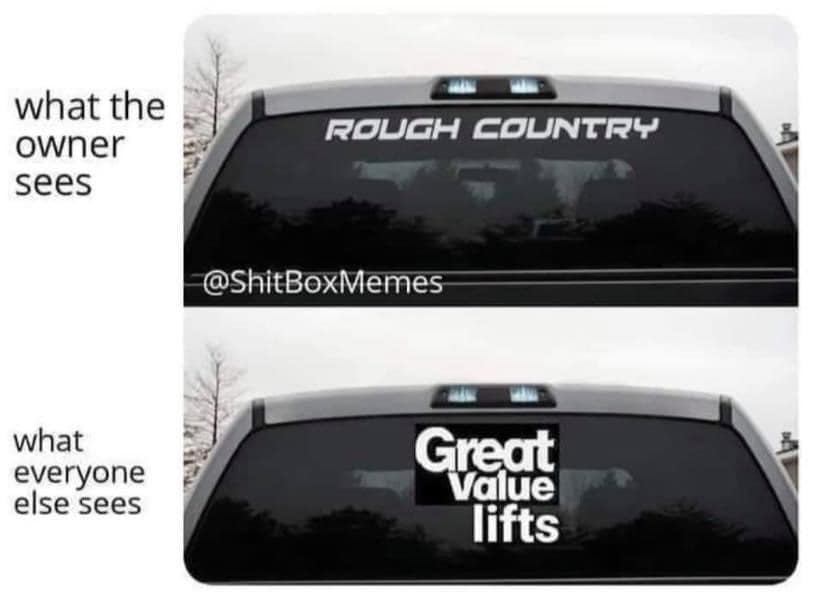
The meme is a play on the contrast between a car's intended audience and its actual users. It shows a car with a "Rough Country" sticker, implying it's meant for off-road enthusiasts, but the reality is that it's being driven by someone who's just trying to look tough. The text "I'm not a truck, I'm a truck" is a humorous commentary on this disconnect.
detailed-analysis (gemma3-27b-vision)
Okay, let's break down this meme using the requested theoretical frameworks. It's important to note that memes are inherently complex, and multiple perspectives can apply. I'll provide analysis where it's relevant, and indicate when a framework isn't strongly applicable.
Visual Description
The image is a two-panel meme. Both panels depict the rear window of a lifted pickup truck. The top panel is labeled "what the owner sees," and shows a decal saying "Rough Country." The bottom panel, labeled "what everyone else sees," shows a decal saying "Great Value lifts." The overall aesthetic is purposefully ironic, contrasting the owner’s self-perception with an outside, more cynical/humorous perspective. The lighting suggests a rural or outdoor setting.
---
Foucauldian Genealogical Discourse Analysis
This meme lends itself well to a Foucauldian reading. The "lifted truck" itself functions as a site of power/knowledge production. Here's how:
- Discourse of Masculinity: Lifted trucks, historically and contemporarily, have become heavily associated with a particular performative masculinity—ruggedness, independence, dominance, and often rural or working-class identity. The "Rough Country" decal is a brand contributing to this discourse, signaling a commitment to these ideals.
- Power/Knowledge: The owner believes they are embodying this "Rough Country" ideal. They see the truck as an extension of their self-constructed identity. However, the "Great Value lifts" decal disrupts this, revealing the constructed nature of that identity. It suggests the performance of masculinity isn’t authentic, but rather a product of consumer culture and manufactured identity.
- Genealogy: Tracing the genealogy of “lifts” for trucks reveals a shift from functional modification (utility, off-road capability) to a symbolic gesture. The lift has become less about doing and more about appearing. The "Great Value" brand exposes the commodification of this symbolism. It says that even the appearance of ruggedness can be purchased cheaply.
- Disciplinary Power: The meme implicitly critiques how individuals are disciplined into desiring and performing certain roles within societal norms. The owner's desire to project an image of ruggedness is a response to, and reinforcement of, societal expectations.
---
Critical Theory
The meme operates as a mini-critique of consumer culture and its impact on identity formation.
- Commodification of Identity: The meme highlights how aspects of identity—ruggedness, masculinity, even a perceived lifestyle—can be commoditized and purchased. The "Great Value" decal points to the irony of attempting to buy authenticity or a sense of self.
- Culture Industry: This meme can be seen as responding to the “culture industry” as described by Adorno and Horkheimer. The meme implicates brands like “Rough Country” in the creation of standardized and mass-produced ideals, and “Great Value” reveals how those ideals can be cheaply replicated.
- False Consciousness: The owner, in believing their vehicle reflects authentic self-expression, might be seen as operating under a form of "false consciousness." They haven't recognized the constructed nature of their desire and the ways it's been shaped by external forces.
---
Marxist Conflict Theory
While the primary focus isn’t on class struggle, there are elements that can be interpreted through a Marxist lens:
- Commodity Fetishism: The meme implies a disconnect between the value of the truck (as a material object) and the social relations of its production. The emphasis is on the symbolic value of the lift, masking the labor and resources involved in its creation.
- Cultural Capital: The "Rough Country" decal might be seen as an attempt to signal "cultural capital"—a non-economic form of social status. The owner is attempting to display a certain lifestyle/identity. "Great Value lifts" devalues this attempt by highlighting its affordability and artificiality.
- Class and Consumption: The meme could be read as a subtle commentary on class differences. The owner’s desire to project an image of ruggedness may stem from a desire to identify with a particular working-class aesthetic, while the “Great Value” aspect highlights a tension between aspiration and economic reality.
---
Postmodernism
This meme embodies many postmodern characteristics:
- Irony and Parody: The meme relies heavily on irony and parody. It playfully subverts the owner’s self-perception.
- Simulacra and Simulation: The "lifted truck" is arguably a simulacrum—a copy without an original. It's a performance of a lifestyle that may not be genuinely lived. The "Great Value" decal further emphasizes the artificiality.
- Deconstruction of Meaning: The meme deconstructs the meaning of "ruggedness" and "masculinity," revealing them as socially constructed and fluid concepts.
- Meta-Commentary: The meme comments on the act of presenting oneself through material possessions.
---
Queer Feminist Intersectional Analysis
This framework is the least directly applicable, but potential connections can be made:
- Performance of Gender: Lifted trucks and the associated “masculinity” are deeply tied to traditional gender roles. The meme implicitly critiques this performative masculinity.
- Subversion of Norms: The “Great Value” decal slightly subverts the hyper-masculine image, introducing an element of humor and questioning the need to conform to strict gender expectations.
- Intersectionality: The owner’s self-presentation is likely tied to other intersecting identities (class, race, regional identity). Analyzing the meme through an intersectional lens could reveal how these identities are being performed and negotiated through the vehicle.
---
In Summary:
The meme is a deceptively rich piece of social commentary. It is strongest when analyzed through Foucauldian, Critical Theory, and Postmodern frameworks, as it deals with power, identity, and the constructed nature of reality. The Marxist and Queer Feminist lenses can also offer valuable insights, though they are less central to the meme’s core message.
simple-description (llama3.2-vision)
This meme is a humorous comparison between two images of the same truck, one with a "Liberal" sticker and the other with a "Conservative" sticker. The text "I'm not liberal or conservative, I'm just a truck" appears below the two images, implying that the owner of the truck is apolitical and just wants to enjoy their vehicle.
tesseract-ocr
— eae =| Oe e sees a \ @ShitBoxMemes & J = what =e Be everyone a pCa | else sees ~ ais