First Seen
2026-02-13T21:40:26.213529+00:00
simple-description (qwen3.5_2b-q8_0)
This urban meme plays on a visual of San Francisco's downtown district being largely empty or unfinished in the center, suggesting that leaving the area as-is is actually the smarter economic choice. While traditional "urban renewal" would likely prioritize filling this void with expensive new towers, this humor argues that the city is so profitable (an "economic engine") that it doesn't need constant rebuilding. It frames the current lack of construction as a necessary failure, implying that we should focus on high-end business rather than low-cost infrastructure.
detailed-analysis (gemma3_27b-it-q8_0)
Okay, let's break down this image and text from the perspective of the "Urbanism - Anti-Renewal" category. This is a complex subject, so we'll proceed with sections as appropriate, acknowledging that overlaps exist between these frameworks.
Understanding the Category: Urbanism - Anti-Renewal
This perspective is fundamentally critical of large-scale urban redevelopment projects that displace communities, prioritize economic growth over social needs, and erase historical and cultural character. It often emphasizes the destructive forces of “renewal” and views such projects as tools of dispossession. Advocates for this viewpoint generally emphasize preservation, community-led planning, and equitable access to urban spaces. They are skeptical of pronouncements about “economic engines” and prioritize human well-being.
Visual Description
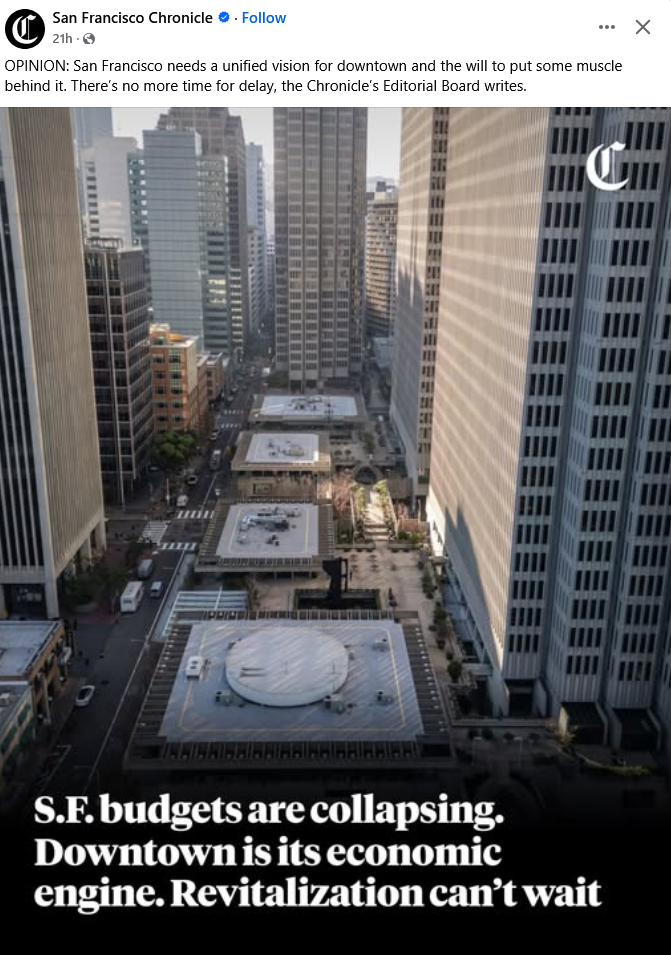
The image is a high-angle shot looking down a canyon-like street in San Francisco, flanked by towering modern skyscrapers. There’s a noticeably empty, flattened space in the middle ground, covered with white roofing material. This looks like a site cleared for redevelopment. Traffic is visible on the street, but the overall impression is one of a sterile, imposing environment. The light is dramatic, creating strong shadows, which could be interpreted as ominous. The visual contrast is stark between the glass and steel towers and the more "grounded" (but still urban) elements below. It emphasizes the verticality and perceived dominance of the skyscrapers. The lack of greenery or public space in the immediate foreground is notable.
Foucauldian Genealogical Discourse Analysis
From a Foucauldian perspective, this image and accompanying text reveal a discourse of urban "improvement" that is deeply tied to power. The claim that San Francisco "needs" revitalization, and that budgets are "collapsing" implying a crisis, isn’t a neutral statement of fact, but an active production of a certain reality.
Here's how:
- The Production of Crisis: The language of crisis ("collapsing budgets," "can't wait") functions to create a sense of urgency. This urgency is not inherent, but produced by the discourse to justify specific interventions (i.e., redevelopment).
- "Revitalization" as Discipline: The term "revitalization" itself is a powerful normalizing force. It implies that the current state is deficient, requiring correction. It establishes a norm - a desirable state of the city - against which the present is measured as inadequate. This is a form of discipline, shaping perceptions and behaviors.
- The Role of Expertise: The reference to "The Chronicle’s Editorial Board" lends authority to this discourse. It positions "experts" as arbiters of what the city needs, further reinforcing the power structures at play.
- Genealogy of "Renewal": A genealogical investigation would reveal how this discourse of “revitalization” has a history rooted in previous waves of urban renewal (like in the mid-20th century) that often involved displacement, segregation, and the destruction of marginalized communities. The current framing repackages these older power dynamics.
Critical Theory
The image/text speaks to key themes in Critical Theory, particularly regarding the instrumentalization of reason. The emphasis on the "economic engine" represents a purely rationalized view of the city, where human experience and community well-being are subordinated to the demands of capital.
- Commodification of Space: The cleared land in the image is not seen as a potential space for community gathering, affordable housing, or public amenities. It’s envisioned as a site for further economic activity, essentially a commodity to be developed.
- Loss of Authenticity: The sterile, glass and steel landscape represents a homogenization of urban space. The unique character of San Francisco (which once drew people there) is being eroded in favor of a globally recognizable, financially-driven aesthetic.
- The Culture Industry: The message (and the image itself, as a media product) could be seen as part of a “culture industry” that promotes consumerism and justifies the relentless pursuit of economic growth. It’s selling an idea of "progress" that benefits a select few while potentially harming many.
Marxist Conflict Theory
From a Marxist perspective, this image is a clear demonstration of class conflict in the urban environment.
- Capital Accumulation: The push for “revitalization” isn’t about improving the city for all residents, but about creating conditions for further capital accumulation. The focus on the "economic engine" is a direct appeal to the interests of the capitalist class.
- Displacement and Gentrification: Redevelopment projects inevitably lead to increased property values and rents, displacing lower-income residents and small businesses. This is a form of class warfare, where the interests of the wealthy are prioritized over the needs of the working class.
- The State as an Instrument of the Ruling Class: The Chronicle’s Editorial Board, while appearing to be independent, often reflects the interests of the dominant economic forces in the city. Their advocacy for "revitalization" can be seen as a manifestation of the state acting as an instrument of the ruling class.
- Exploitation of Labor: The construction and maintenance of these skyscrapers require the labor of workers, often under exploitative conditions. The "economic engine" is built on the backs of these workers.
Postmodernism
A postmodern reading would challenge the grand narratives of "progress" and "revitalization."
- Deconstruction of Meaning: The term “revitalization” is open to multiple interpretations and lacks a fixed meaning. It can be used to mask potentially harmful policies or to justify the imposition of a particular vision of the city.
- Fragmentation and Simulacra: The image could be seen as representing a fragmented urban landscape, where the original authenticity of the city has been replaced by simulations and copies (the glass towers, the homogenized spaces).
- Rejection of Universal Truths: There is no objective "need" for revitalization. It's a socially constructed concept that is shaped by power relations and subjective values.
- The Death of the Author: The message's authority is questioned, since the editorial board’s perspective is just one amongst many.
In conclusion:
From the perspective of "Urbanism - Anti-Renewal," this image and text are a textbook example of the forces that threaten to erode the social fabric of San Francisco. It is a stark warning about the dangers of prioritizing economic growth over community well-being, and a call to resist the continued dispossession of vulnerable populations. The discourse surrounding "revitalization" is seen as a manipulative tool used to justify the interests of capital and maintain existing power structures.
simple-description (llama3.2-vision_11b)
This meme is a commentary on the urban planning and economic development of San Francisco. The image features a cityscape with a large, empty square in the center, surrounded by tall buildings. The text at the top reads "S.F. budgets are collapsing. Downtown is its economic engine. Revitalization can't wait." The meme is likely criticizing the city's lack of investment in its downtown area, and the need for a more efficient and effective approach to urban development.