First Seen
2024-12-30T16:43:33.673183+00:00
detailed-analysis (gemma3_27b-it-q8_0)
Okay, let's analyze this meme ("We should refer to this period in history simply as 'The Circumstances'") through the lens of "The Jackpot" category – meaning, understanding it as a moment of systemic instability, unexpected consequences, and a realization of inherent risk. Here's a breakdown, incorporating relevant theoretical perspectives where applicable:
Understanding "The Jackpot" Category
Before diving into the analysis, it's important to define the category. "The Jackpot," as a framework, refers to a situation where complex systems (economic, political, social, ecological) become so interwoven and reliant on specific, often fragile, conditions that a seemingly small disruption can trigger a cascade of unforeseen and often negative outcomes. It's a realization that "winning" (in the form of efficiency, growth, or dominance) often comes at the cost of increasing vulnerability. It's about the inherent risk within complex systems and the inevitability of something breaking down, and a sense of helplessness around it.
Visual Description
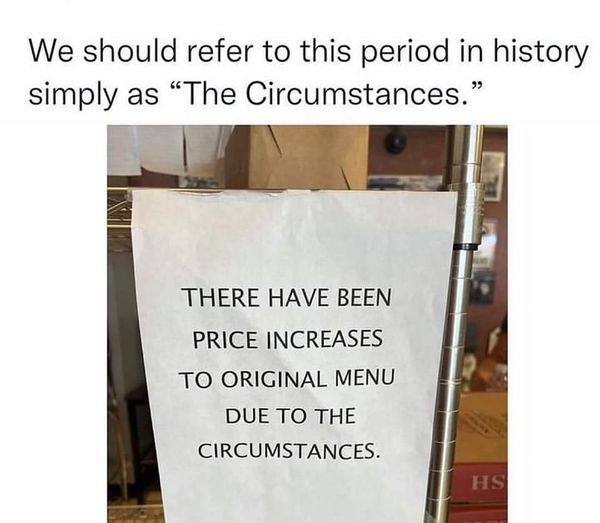
The image shows a handwritten sign, seemingly taped to a metal post inside a business (likely a restaurant or cafe). The sign reads:
“THERE HAVE BEEN PRICE INCREASES
TO ORIGINAL MENU
DUE TO THE
CIRCUMSTANCES."
The paper is wrinkled, suggesting it's a quickly-made, temporary solution. The plain font and lack of specific details contribute to a sense of vagueness. The background is blurred, but hints at a typical, rather unremarkable business interior. The framing of the shot – looking up at the sign – can imply a feeling of being subjected to the news.
Foucauldian Genealogical Discourse Analysis
This meme is rich in potential for a Foucault-inspired analysis. The term "The Circumstances" is the key here. Foucault argued that power isn't simply repressive, but productive. It operates through discourse – the ways we talk about things – to create realities.
- Erosion of Specificity: "The Circumstances" deliberately obscures the actual causes of the price increases. It’s a linguistic move that depersonalizes the decision and avoids accountability. Instead of naming specific factors (e.g., supply chain issues, inflation, geopolitical events, corporate profit margins), it invokes a nebulous, all-encompassing “Circumstances.”
- Discipline and Normalization: The sign disciplines customers by presenting the price increases as inevitable, a natural consequence of forces beyond anyone's control. It normalizes economic hardship by framing it as a passive experience, not a result of active choices. This is a form of governmentality – the ways power operates to shape conduct.
- Genealogy of "The Circumstances": Tracing the history of this phrase reveals it's a convenient tool for avoiding responsibility. It’s a way to manage a crisis narrative. The power lies in the ability to define the terms of the situation, to say what can be discussed and how.
The power dynamic here isn't about direct control, but about shaping perception. "The Circumstances" is a discursive practice that solidifies existing power structures (those who set prices, those who absorb the increases) while obscuring the underlying mechanisms.
Marxist Conflict Theory
From a Marxist perspective, this sign is a perfect example of the inherent contradictions of capitalism.
- Exploitation & Value Extraction: The price increases represent an attempt to maintain or increase profit margins in the face of economic pressures. This reflects the core Marxist concept of surplus value – the difference between the value of a worker's labor and the wage they receive. The "Circumstances" are used to justify extracting more surplus value from consumers.
- Class Struggle (Subtle Manifestation): While not explicit, the sign highlights the ongoing conflict between capital (business owners) and labor (workers and consumers). The "Circumstances" mask the reality that the burden of economic hardship is disproportionately borne by those with less power.
- Alienation: The lack of transparency and specificity reinforces a sense of alienation. Consumers are treated as passive recipients of economic forces beyond their comprehension or control.
- Ideology: The very phrase "The Circumstances" functions as ideology – a set of beliefs that justify the existing social order. It naturalizes capitalist instability and obscures the underlying class relations that drive it.
Postmodernism
Postmodernism emphasizes the rejection of grand narratives and the embracing of relativism and fragmentation.
- Rejection of Totalizing Explanations: The term "The Circumstances" actively rejects any attempt to provide a comprehensive explanation for the price increases. It's a refusal to locate the problem within a larger, coherent system. This fits with postmodern skepticism towards meta-narratives (like capitalism, globalization, or even specific economic theories).
- Simulacra and Simulation: The sign itself can be seen as a simulacrum – a copy without an original. The "Circumstances" are a stand-in for a complex reality that is increasingly divorced from concrete experience.
- Deconstruction of Language: The phrase's emptiness is intentional. It's a deconstruction of the idea that language can accurately represent reality. "The Circumstances" is a deliberately vague and uninformative signifier.
"The Jackpot" Synthesis
The meme encapsulates the feeling of being trapped in “The Jackpot.” The “Circumstances” aren’t a one-off event, but a symptom of a complex, brittle system straining under its own weight. It’s a recognition that things are fundamentally unstable, that the rules have changed, and that attempts to explain or fix the problem with traditional means (detailed explanations, targeted solutions) are futile. The sign isn't just about price increases; it's a tacit admission that we're living through a period of profound and unpredictable disruption. The handwritten, temporary nature of the sign emphasizes the feeling of precarity and the sense that everything is subject to change at any moment. It’s the feeling of having “won” – having a functioning economy, a certain level of prosperity – but now realizing the price of that “win” is an ever-present threat of collapse.
simple-description (llama3.2-vision_11b)
This meme is from the "The Jackpot" category, which is a collection of humorous and relatable memes that poke fun at everyday situations. The meme features a photo of a restaurant sign that says "There has been a price increase due to circumstances" and is captioned "We should refer to this period in history simply as 'The Circumstances'".
detailed-analysis (gemma3-27b-vision)
Okay, here's an analysis of the image, broken down into sections based on the requested theoretical frameworks, only including sections where those frameworks meaningfully apply.
Visual Description
The image is a snapshot of a handwritten or printed notice, taped to what appears to be a mirrored wall in a restaurant or bar. The notice states: "THERE HAVE BEEN PRICE INCREASES TO ORIGINAL MENU DUE TO THE CIRCUMSTANCES." The handwriting is straightforward and functional. The background suggests a somewhat vintage or traditional establishment. The overall aesthetic is unremarkable and utilitarian, yet the odd phrase is striking.
Foucauldian Genealogical Discourse Analysis
This notice is a fascinating example of how power operates through discourse. Michel Foucault's genealogy focuses on tracing the historical construction of concepts and how they are embedded within power relations. The phrase "The Circumstances" is key.
-
Discourse and Power: The notice doesn't name the circumstances. It leaves them vague, amorphous. This is not accidental. By avoiding specificity, the notice exercises power through obscuring. It deflects accountability, preventing a detailed examination of the factors driving price increases. It creates an implicit expectation of acceptance, as naming would open up possibilities for debate or challenge. The power resides in the ability to define reality and control the narrative.
-
Genealogical Trace: We can trace a lineage of similar phrases used to justify economic or political actions without direct explanation. Think of historical invocations of "national security," "economic imperatives," or "unforeseen events." These phrases operate as a kind of shorthand for complex systems of power.
-
Disciplinary Effect: The lack of specific explanation exerts a subtle disciplinary effect. It discourages questions and encourages passive acceptance of the change. Those who do question are potentially framed as disruptors of an unavoidable reality ("The Circumstances").
Critical Theory
The notice exemplifies key concepts in Critical Theory, particularly the Frankfurt School’s concern with the manipulation of information and the suppression of critical thought.
-
Reason and Domination: The notice appears reasonable – it states a change (price increases) and provides a justification ("due to the circumstances"). However, the vague justification actively prevents a rational assessment of the situation. It’s an appeal to a pre-existing but unnamed "common sense" that reinforces the power dynamics at play.
-
Instrumental Rationality: The notice prioritizes the outcome (maintaining profitability despite increasing costs) over a transparent explanation of the underlying factors. It embodies a kind of instrumental rationality focused solely on efficiency and control, ignoring ethical or social considerations.
-
Culture Industry: We can see a connection to the “culture industry” concept. The notice functions as a small-scale example of how information is packaged and disseminated to manage public perception. It's a deliberate strategy to shape understanding and minimize resistance.
Marxist Conflict Theory
From a Marxist perspective, this notice embodies the inherent conflicts within a capitalist system.
-
Class Struggle: Price increases are a direct consequence of the drive for profit maximization. While the notice doesn't explicitly mention "profit," it obscures the fact that the owners/management are passing increased costs onto the consumers. It represents an imbalance of power between those who control the means of production (the restaurant) and those who consume.
-
Exploitation: The vagueness of "The Circumstances" effectively hides the process of exploitation. The increased costs are likely due to factors such as increased cost of ingredients or wages, but the notice does not indicate where the burden falls or how profit margins are being maintained.
-
Ideology: The phrase “The Circumstances” itself functions as an ideological tool. It naturalizes the economic realities of capitalism, presenting price increases as an inevitable consequence of external factors rather than as a deliberate strategy to maintain profit.
Postmodernism
The notice can be seen through a postmodern lens as an example of the breakdown of grand narratives and the embrace of ambiguity.
-
Deconstruction of Meaning: The phrase “The Circumstances” is deliberately open-ended and lacking in concrete meaning. It resists any attempt to fix a stable definition, allowing for multiple interpretations. This challenges the idea of a single, objective truth.
-
Simulacra and Simulation: The notice is a kind of "simulacrum"—a copy without an original. It simulates a justification without providing actual substance. It's about creating the impression of transparency rather than achieving it.
-
Loss of Grand Narratives: The notice implicitly rejects any attempts to explain the economic situation through overarching systems of thought. Instead, it presents it as a series of vague, contingent “circumstances.”
Queer Feminist Intersectional Analysis
While less directly applicable than the other frameworks, we can consider this notice through an intersectional lens.
- Economic Precarity: The increased prices disproportionately affect those with lower incomes and marginalized communities. This intersection of economic status with other forms of marginalization (gender, race, sexual orientation) creates greater vulnerability.
- Silencing of Voices: The ambiguity of "The Circumstances" can also represent a broader silencing of voices—particularly those of marginalized groups who are often most impacted by economic changes. The lack of specific explanation reinforces existing power imbalances.
Let me know if you'd like me to delve deeper into any of these theoretical frameworks or explore another angle!
simple-description (llama3.2-vision)
This meme is a humorous take on the concept of "the times they are a-changin'". It features a sign that is typically used to indicate a price increase, but instead of listing a new price, it says "There has been a change in the price of history". The text is a play on the phrase "there has been a change in the price of..." which is typically followed by a new price, but in this case, it's followed by "history".