First Seen
2025-09-29T16:39:15+00:00
simple-description (qwen3.5_2b-q8_0)
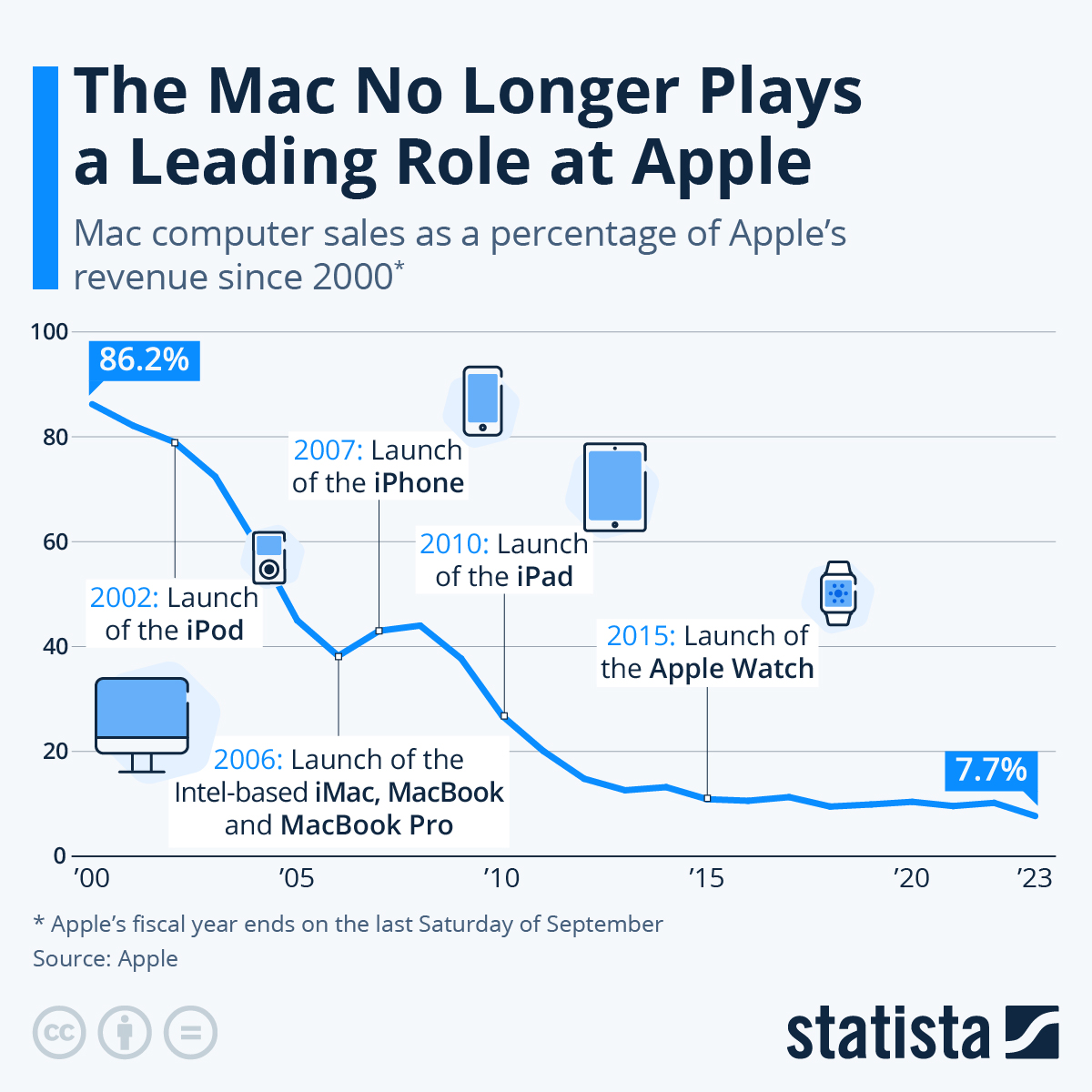
This infographic satirizes the internet meme that Macs are no longer the dominant product at Apple. It illustrates how the company's revenue from computers plummeted from over 86% in 2000 down to just 7.7% by 2023, visually mocking the industry's long-held belief that desktops would continue to lead the company's financial performance. The chart specifically highlights this decline starting with the iPod launch and continuing past the iPhone.
detailed-analysis (gemma3_27b-it-q8_0)
Okay, let's break down this chart from a technology-focused perspective, applying the theoretical lenses you've requested where applicable.
Visual Description
The image is a line graph from Statista illustrating the changing revenue contribution of Mac computer sales (iMac, MacBook, Mac Pro) to Apple's overall revenue from 2000 to 2023. The y-axis represents percentage of revenue (0-100%), while the x-axis shows years.
Key features:
* Initial Dominance (2000-2005): The graph starts at 86.2% in 2000, indicating Macs were overwhelmingly the primary source of Apple’s revenue.
* Declining Trend: A consistent and dramatic decline in the percentage of revenue from Macs is evident across the period.
* Inflection Points (Product Launches): The graph annotates four key Apple product launches and their dates: the iPod (2001), Intel-based Macs (2006), the iPhone (2007), the iPad (2010), and the Apple Watch (2015). Each launch correlates with a steeper decline in the Mac's percentage contribution.
* Final Position (2023): The line ends at 7.7%, demonstrating a massive shift in Apple’s revenue stream, where Macs have become a much smaller component.
* Color Scheme: The graph uses a clear blue line against a white background, making it easy to see the trend. The annotations are in a complementary color scheme of black.
Foucauldian Genealogical Discourse Analysis
This chart reveals a fascinating discourse about what constitutes "Apple" itself. Michel Foucault’s genealogical method asks us to examine the historical emergence of knowledge and power structures.
- Shifting "Truths" of Apple: In 2000, the "truth" of Apple was intimately tied to the personal computer, to desktop computing and a specific design philosophy. The discourse of Apple was about Macs. The chart shows how that "truth" was destabilized and replaced.
- Power/Knowledge: The launches of the iPod, iPhone, and iPad weren't simply product introductions; they were acts of power. They redefined what "Apple" meant. Each launch brought a new discourse (portable music, mobile communication, tablet computing) into dominance, pushing the Mac discourse to the periphery. The discourse of "Apple as a mobile, service-based company" gained power over the previous discourse of "Apple as a computer manufacturer."
- Discipline and Normalization: The Mac was initially "normalized" as the core of Apple. The new devices disciplined the company to focus on different areas.
- Genealogy of the Mobile: The chart effectively traces the genealogy of the mobile device within Apple's strategy. It shows how the mobile device became the normalizing force, displacing the Mac.
Critical Theory
From a Critical Theory perspective (drawing from the Frankfurt School and thinkers like Adorno and Horkheimer), this graph can be interpreted as an illustration of the "culture industry" at work.
- Commodification and Reification: Apple, initially known for innovation in computing, has increasingly focused on the commodification of experience – music, communication, convenience, and fashion (Apple Watch). The Mac, a tangible product linked to productivity and creative work, has been somewhat sidelined in favor of these experiential commodities. The value shifts from the object (the computer) to the experience (being part of the Apple ecosystem).
- False Consciousness: The constant push towards new devices can be seen as creating a form of false consciousness. Consumers are led to believe they need the latest iPhone or Apple Watch to be complete, distracting from potential issues with technological dependency, surveillance capitalism, or the environmental cost of constant upgrades.
- Instrumental Reason: The chart demonstrates a shift from a focus on the means (powerful computers) to the ends (profit and market share) driven by instrumental reason. The Mac became less important as a tool and more as a line item in the financial statement.
Marxist Conflict Theory
Applying Marxist Conflict Theory highlights the inherent class struggles embedded in this technological shift.
- Capital Accumulation: Apple's move away from Mac-centric revenue signifies a drive for greater capital accumulation. The iPhone and iPad are more easily mass-produced and sold globally, creating larger profit margins. The shift embodies the capitalist imperative for endless growth.
- Labor and Value: The manufacturing of iPhones and iPads is largely outsourced to factories (often in developing countries) where labor is exploited to keep costs down. The value created by workers is appropriated by Apple as profit, further exacerbating class inequality. The Mac, while also manufactured externally, has historically been associated with a more skilled, and likely better-compensated, labor base.
- Proletarianization of the User: As Apple focuses on consumer goods and services, users become increasingly reliant on (and controlled by) the technology, essentially being "proletarianized" as consumers rather than empowered creators (historically associated with the Mac).
Postmodernism
From a postmodern perspective, this chart illustrates the fragmentation of grand narratives and the rise of simulacra.
- Death of the Master Narrative: The "grand narrative" of Apple as a computer company has been dismantled. There is no longer a central, unifying story. Instead, there are multiple, fragmented narratives surrounding various products and services.
- Simulacra and Simulation: The iPhone, iPad, and Apple Watch have become simulacra – copies without originals. They are not simply tools to achieve something; they are the experience. The devices create their own reality, blurring the lines between real and simulated.
- Deconstruction of Identity: Apple has strategically constructed and deconstructed its brand identity over time. Initially a countercultural force (challenging IBM), it has become a mainstream luxury brand. This continual reshaping reflects the postmodern emphasis on fluidity and the rejection of fixed meanings.
In conclusion:
This seemingly simple chart reveals a complex story about technological change, corporate strategy, and the evolving relationship between technology, culture, and power. It highlights Apple’s transformation from a computer manufacturer to a diversified technology and service provider, with significant implications for the future of the computing industry and the role of technology in our lives. The theoretical lenses used above provide a framework for understanding this evolution from multiple angles, allowing for a deeper, more nuanced interpretation.
simple-description (llama3.2-vision_11b)
The meme is a chart showing the decline of Apple's Mac sales as a percentage of the company's overall revenue. The chart is titled "The Mac No Longer Plays a Leading Role at Apple" and shows that Mac sales have decreased from 86.2% of Apple's revenue in 2000 to 7.7% in 2023. The chart is accompanied by a text that says "Mac computer sales as a percentage of Apple's revenue since 2000".