First Seen
2026-04-16T09:15:28+00:00
simple-description (qwen3.5_2b-q8_0)
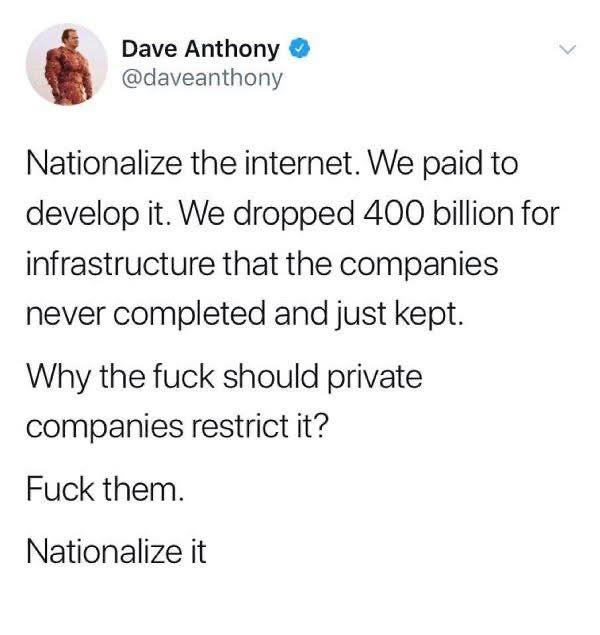
This meme humorously argues for the government taking back control of the internet by suggesting it should be "nationalized." Since taxpayers built the technology with billions of dollars and left many major projects unfinished by private companies, the joke implies that tech giants should be restricted from owning or controlling access to the system. Essentially, it is a call to use public regulations rather than corporate profit motives because the infrastructure was paid for by the state without the developers expecting to reap all the benefits.
detailed-analysis (gemma3_27b-it-q8_0)
Okay, let's break down this tweet – functioning as a meme – through the lens of various theoretical frameworks, focusing on its context within the realm of technology.
Visual Description
The "meme" is actually a tweet from Dave Anthony (presumably a public figure, though the image is just his profile picture). It’s a straightforward text post – no images, GIFs, or typically "meme-like" visual elements. The impact relies solely on the blunt language and the underlying arguments made. The repeated phrases ("Nationalize it," "Fuck them") and the use of strong emotional language contribute to the overall rhetorical effect, giving it a tone akin to a frustrated, urgent call to action. The blue checkmark indicates verification on Twitter, lending the tweet some degree of perceived authority.
Marxist Conflict Theory
This tweet is deeply rooted in Marxist Conflict Theory. Here’s how:
- Means of Production: The internet’s underlying infrastructure (fiber optic cables, servers, data centers) represents the “means of production” in the digital sphere. Historically, these were largely funded by public money – as the tweet explicitly points out with the "$400 billion" figure (presumably referencing DARPA and other government funding for the initial internet development).
- Bourgeoisie vs. Proletariat: The “companies” being criticized (implicitly referring to massive tech corporations like Google, Facebook/Meta, Amazon, etc.) represent a modern-day bourgeoisie. They have capitalized on publicly funded infrastructure and transformed it into privately owned, profit-generating entities. The "we" (the public) can be seen as the proletariat – we paid for the creation of something now controlled by a few for their benefit.
- Exploitation and Alienation: The argument implies exploitation. The public invested in the internet with a certain expectation (open access, equitable development), but that expectation has been subverted by private interests. The "restricting" mentioned is a form of alienation; the public is being denied full access to something it helped create.
- Call for Revolution (of sorts): The demand to “nationalize it” isn't just a policy proposal; it’s a demand to fundamentally shift ownership and control of the means of production from the private sector back to public ownership, echoing a core Marxist principle. The aggressive language ("Fuck them") intensifies the call for this change.
Critical Theory
Critical Theory builds on Marxist thought but adds layers of analysis. In this context:
- Critique of Instrumental Reason: The tweet subtly critiques the "instrumental reason" (Max Horkheimer and Theodor Adorno) that drives capitalist enterprises. The internet was originally envisioned as a tool for communication and knowledge sharing, but it has been reduced to a means of maximizing profit, potentially at the expense of these original goals.
- Power Dynamics & Ideology: The tweet exposes power imbalances. The companies aren't simply providing a service; they wield significant ideological power by controlling access to information and shaping online discourse. The critique implies that their restrictions aren’t necessarily based on technical necessity but on maintaining their control and profitability.
- Commodification of the Public Sphere: The internet, initially a potential space for a robust public sphere, has been largely commodified. Access and participation are mediated by corporate platforms, subject to their terms of service and monetization strategies.
Foucauldian Genealogical Discourse Analysis
While less direct than the Marxist and Critical Theory angles, a Foucauldian analysis can be applied:
- Power/Knowledge: The companies, by controlling the internet infrastructure, control access to knowledge and, therefore, wield power. They define the rules of engagement, monitor user behavior, and curate information flows.
- Discipline and Surveillance: (Implicitly) The "restrictions" could be interpreted as forms of digital discipline. Algorithms, terms of service, and data collection practices all contribute to a system of surveillance that shapes user behavior.
- Genealogy of Control: One could trace the historical "genealogy" of how control over the internet shifted from a relatively open, publicly funded system to one dominated by private interests. How did the rhetoric around "innovation" and "free markets" justify this transfer of power?
- Discourse: The blunt language in the tweet disrupts a normalized discourse that often presents tech companies as benevolent innovators.
Postmodernism
Elements of postmodernism are present in the underlying anxieties expressed:
- Distrust of Grand Narratives: The tweet implicitly rejects the narrative of tech companies as drivers of progress and democratization. It exposes the darker side of technological advancement.
- Deconstruction of Authority: By questioning the legitimacy of private control over the internet, the tweet deconstructs the authority of these corporations.
- Fragmentation: The internet is no longer a unified, open space but a fragmented landscape controlled by competing platforms with their own rules and agendas.
Note: Queer Feminist Intersectional Analysis isn’t directly applicable without additional context or specific claims in the tweet. One could apply it by examining how restrictions on the internet disproportionately affect marginalized communities (e.g., censorship of LGBTQ+ content, algorithmic biases), but that would require further exploration.
In essence, this tweet functions as a concise, impassioned critique of the current state of the internet, framing it as a case of public resources being exploited for private gain. It uses potent language to challenge the dominant narrative of tech companies as innovators and calls for a radical shift in ownership and control.
simple-description (llama3.2-vision_11b)
The meme is a tweet from Dave Anthony that critiques the idea of nationalizing the internet. He states that he paid to develop the internet and dropped 400 billion for infrastructure that companies never completed and just kept. He questions why private companies should be allowed to restrict the internet, using profanity to express his frustration. The tweet is meant to be humorous and satirical, rather than a serious call to action.