First Seen
2023-11-10T21:29:41+00:00
simple-description (llama3.2-vision_11b)
The meme is a humorous commentary on the evolution of technology and human interaction. The image juxtaposes two quotes, one from the 1960s and one from 2020, to highlight the changing nature of work and human relationships. The text reads: "1960s: 'The job of the computer programmer is to glue the machines together so that you can tell them what to do.' 2020: 'I have to write 3k lines of code by the end of the week or I'll be fired. My boss is breathing down my neck.'"
detailed-analysis (gemma3-27b-vision)
Here's a breakdown of the image, analyzing it through the lenses you requested. Note that some categories apply more strongly than others, and the interpretation is inherently subjective.
Visual Description
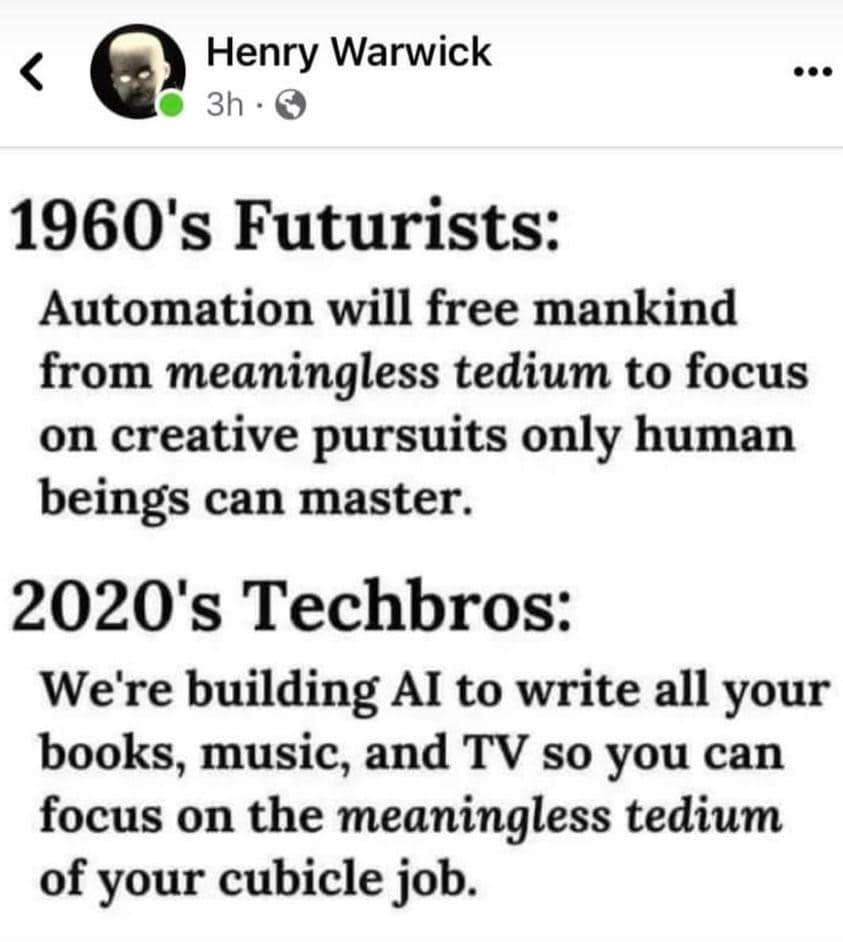
The image is a screenshot of a Facebook post by "Henry Warwick." The post is black text on a white background. It presents a comparative statement framed as a contrast between the aspirations of "1960s Futurists" and the reality of "2020s Techbros." The content is purely textual, utilizing a direct, ironic juxtaposition. There is a profile picture beside the name.
---
Foucauldian Genealogical Discourse Analysis
This image is ripe for Foucauldian analysis. Foucault would be interested in how discourses around automation and technology have changed over time, and what power relations underpin those shifts.
- Discursive Formation: The initial 1960s discourse (presented here) emphasizes liberation and human flourishing. Automation is framed as a tool to free individuals from drudgery, enabling higher-level "creative pursuits." This frames “creativity” as inherently valuable and a “higher” pursuit, establishing a hierarchy.
- Shift in Discourse: The 2020s “Techbro” discourse completely inverts this promise. Rather than eliminating meaningless work, AI is being developed to produce the content that fills the void, leaving people stuck in the same mundane jobs. This isn’t about liberation; it’s about extending control and commodification.
- Power/Knowledge: The shift reveals how "knowledge" about technology isn’t neutral. The narrative of “progress” and “innovation” has been co-opted to serve capitalist interests. The Techbros have the power to define what automation means, and they’re defining it in a way that reinforces existing power structures.
- Genealogy: Tracing the “genealogy” of this idea would reveal how early hopes for automation were gradually reshaped by economic and political forces, ultimately leading to the current, cynical situation.
---
Critical Theory
This image embodies core themes of Critical Theory, particularly related to the culture industry and instrumental rationality.
- The Culture Industry: The Techbros' pursuit of AI-generated content represents a hyper-extension of the culture industry. Instead of creating art for people, they're aiming to automate the creation of art, turning even creativity into a commodity. This diminishes the intrinsic value of art and reinforces a system where everything is produced for profit.
- Instrumental Rationality: The focus is solely on how to achieve a goal (efficient content production), without any consideration of why or what the broader societal implications are. The techbros are rational in their pursuit of profit, but this rationality is divorced from ethical or humanistic concerns.
- Loss of Authenticity: AI-generated content contributes to a sense of alienation and the loss of authenticity. If everything can be created by an algorithm, what does it mean to be human, or to create something meaningful?
---
Marxist Conflict Theory
This image is a potent illustration of class conflict and the exploitation of labor.
- Capitalism and Alienation: The original promise of automation aimed to alleviate workers from repetitive, alienating tasks. However, the "Techbro" version perpetuates those conditions. AI isn't liberating workers; it's being used to maximize profits while keeping people trapped in meaningless jobs.
- Commodification of Creativity: The attempt to automate creative processes transforms creativity into another commodity, subject to the laws of supply and demand. This devalues the labor of artists and writers, and further concentrates wealth in the hands of tech companies.
- Proletarianization of the Creative Class: The Techbros are essentially attempting to "proletarianize" the creative class – turning artists and writers into wage laborers whose work is replaced by algorithms.
- Surplus Value: The profit generated by the use of AI-generated content represents surplus value extracted from the labor (and potentially the intellectual property) of others.
---
Postmodernism
The image reflects a key postmodern preoccupation with simulacra and the erosion of meaning.
- Hyperreality: The idea that AI can create “books, music, and TV” blurs the line between the “real” and the simulated. If an algorithm can produce something indistinguishable from human-created content, what constitutes “authenticity”?
- Loss of Grand Narratives: The contrast between the utopian vision of the 1960s and the cynical reality of the 2020s highlights the postmodern rejection of “grand narratives” – overarching stories about progress and liberation. The promise of technology as a force for good has been shattered.
- Deconstruction: A deconstructionist reading would focus on the inherent contradictions within the image itself. The image deconstructs the idea of progress, revealing how technological advancements can be used to reinforce existing power structures.
---
Queer Feminist Intersectional Analysis
While not the primary focus, a queer feminist intersectional lens can add nuance.
- Reinforcement of Existing Hierarchies: The Techbro ethos often perpetuates patriarchal structures within the tech industry and reinforces traditional notions of "productive" labor. Automation in this form ignores the value of care work, emotional labor, and other traditionally feminized forms of labor.
- Marginalization of Creative Voices: The dominance of algorithms and automated content creation risks silencing marginalized voices and perspectives. AI algorithms are often trained on biased data, which can perpetuate harmful stereotypes and further marginalize already vulnerable groups.
- Commodification of Self-Expression: The commodification of creativity can be particularly harmful to queer and feminist artists, whose work often challenges dominant norms and explores themes of identity and liberation. The pressure to produce commercially viable content can stifle artistic expression and reinforce existing power structures.
In conclusion, the image is a powerful statement about the unfulfilled promises of technology and the ways in which capitalist forces can co-opt even the most utopian visions. It offers rich material for analysis from a variety of critical perspectives.
simple-description (llama3.2-vision)
This meme is a humorous comparison between two generations, the 1960s and the 2020s. The text reads: "In 1960s: Free love, free speech, free music, free dope. In 2020s: Free Wi-Fi, free streaming, free games, free everything." The meme pokes fun at the idea that the 1960s were all about freedom and rebellion, while the 2020s are all about getting things for free.
tesseract-ocr
< ©) Henry Warwick a @ 3h-@ 1960's Futurists: Automation will free mankind from meaningless tedium to focus on creative pursuits only human beings can master. 2020's Techbros: We're building AI to write all your books, music, and TV so you can focus on the meaningless tedium of your cubicle job.