First Seen
2025-07-29T14:23:10+00:00
simple-description (qwen3.5_2b-q8_0)
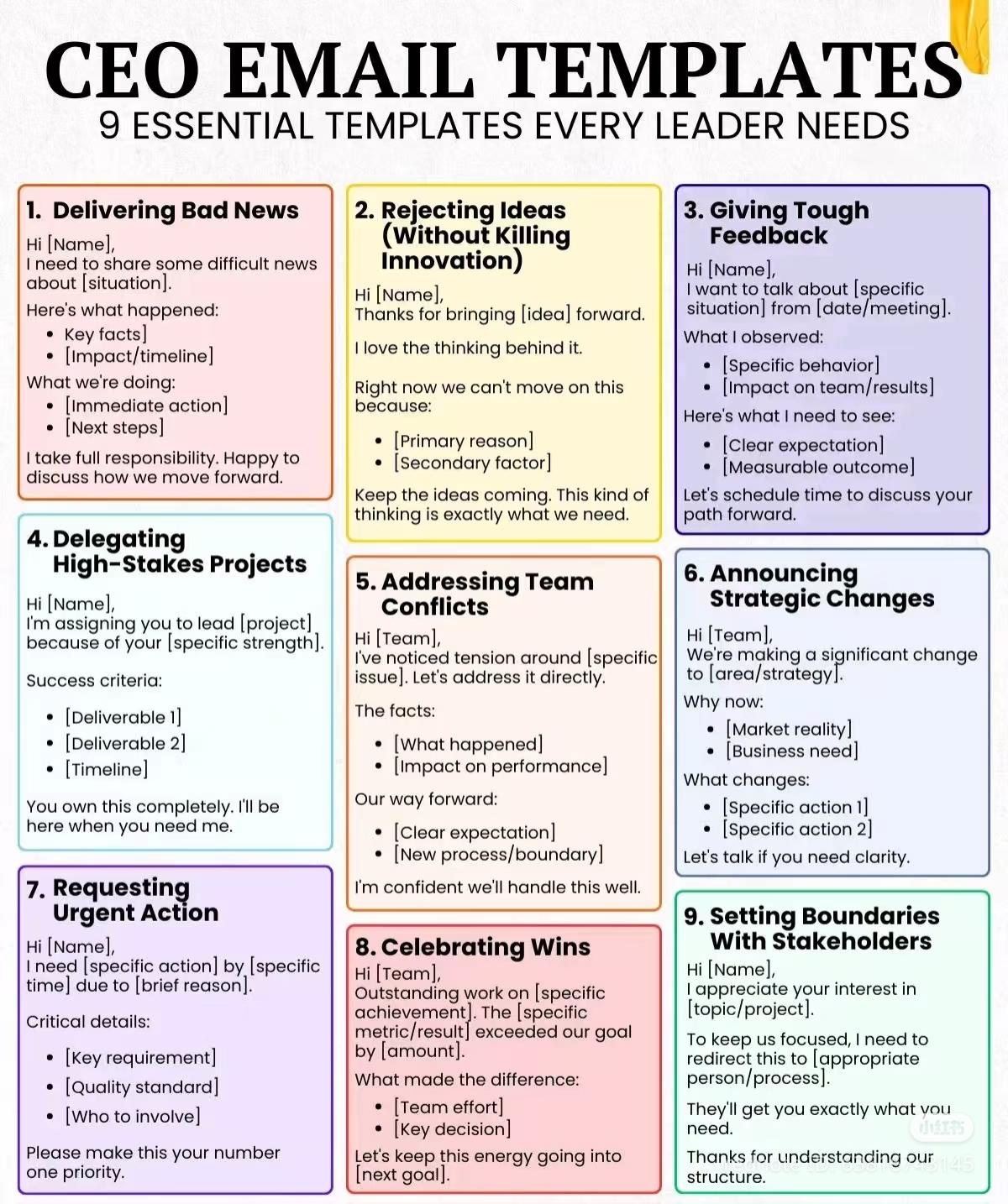
This infographic serves as a strategic guide for executives by organizing 9 essential email templates designed for high-stakes business communication. The text within these boxes, such as "Delivering Bad News" and "Announcing Strategic Changes", provides ready-to-use copy for leaders to negotiate resources or manage team conflicts directly. By focusing on clear action items like "What I need to see" or "I'm confident we'll handle this well," the meme illustrates how strategy is communicated through decisive, structured messaging rather than casual discussion.
detailed-analysis (gemma3_27b-it-q8_0)
Okay, let's break down this meme of "9 Essential Email Templates Every CEO Needs" through the lens of Strategy as its primary category, and explore relevant theoretical frameworks where applicable.
Visual Description
The image is a grid of nine ostensibly helpful email templates targeted toward CEOs. Each template is framed as addressing a common, but potentially fraught, managerial situation. The templates themselves are standardized, formulaic, and aimed at efficient communication – covering topics like delivering bad news, rejecting ideas, providing feedback, delegating tasks, addressing conflict, announcing strategy shifts, requesting urgent action, celebrating wins, and setting boundaries. The overall aesthetic is clean and corporate, suggesting a utilitarian focus on operational efficiency. It's presented as a toolkit for controlling communication and maintaining a certain level of authority.
Foucauldian Genealogical Discourse Analysis
This meme is ripe for a Foucauldian reading. Michel Foucault’s work on power/knowledge is central here. The provision of these pre-written templates isn’t simply about "good management"; it’s about disciplining the CEO’s discourse.
- Power/Knowledge: The templates present a pre-defined "right" way to communicate in these situations. They represent a body of knowledge that claims to be authoritative and effective. By adopting these templates, the CEO participates in a power structure that dictates acceptable managerial language and modes of interaction.
- Discursive Formation: The existence of these templates suggests a “discursive formation” around leadership. A set of rules, practices, and assumptions have coalesced to define what constitutes "strategic" or "effective" leadership communication. Deviation from these templates could be seen as "ineffective" or even "bad" leadership.
- Panopticism (Extended): The very idea that a CEO “needs” these templates implies a constant monitoring (self-imposed or otherwise) of communication style. The CEO is subtly encouraged to internalize the standards encoded within the templates, regulating their own behavior as if under constant observation.
The genealogy would trace how these templates came to be considered necessary. What historical shifts in management thinking led to this emphasis on standardized, risk-averse communication? Who benefits from this standardization – and at whose expense?
Critical Theory (Frankfurt School)
Critical Theory examines how power structures perpetuate domination. This meme is a good example of what the Frankfurt School would call "instrumental reason".
- Instrumental Reason: The templates prioritize efficiency and control over genuine communication or fostering authentic relationships. The goal isn't understanding or collaboration, but achieving a pre-defined outcome (e.g., delivering bad news without inciting rebellion). Communication is treated as a tool for manipulation.
- Reification: The templates reify managerial practice – turning complex, nuanced situations into standardized procedures. This reduces human interaction to formulaic exchanges, obscuring the underlying power dynamics and potential for alternative approaches.
- Domination: The templates ultimately reinforce the CEO’s power. By controlling the narrative, the CEO maintains authority and minimizes challenges to their decisions.
Marxist Conflict Theory
From a Marxist perspective, this meme highlights the class dynamics at play within an organization.
- Capital & Labor: The CEO, representing the owning class, uses these templates to manage and control the labor force. The pre-written scripts ensure that messaging is aligned with the interests of capital, potentially minimizing worker resistance to management decisions.
- Ideology: The templates embody an ideology of managerialism – a belief that efficient management is the key to success. This ideology justifies the CEO’s power and the hierarchical structure of the organization.
- False Consciousness: The templates can contribute to a “false consciousness” among employees. By presenting managerial decisions as rational and inevitable, they mask the underlying power relations and prevent employees from recognizing their own collective interests.
Postmodernism
A postmodern reading would question the very notion of "essential" templates.
- Deconstruction of Grand Narratives: The idea that there are "essential" templates for leadership implies a belief in a single, objective truth about effective communication. Postmodernism rejects such grand narratives, arguing that meaning is always contextual and subjective.
- Simulation & Simulacra: The templates are a simulation of authentic communication. They create the appearance of empathy or transparency, but ultimately lack genuine substance. They become a simulacrum – a copy without an original.
- Relativism: Postmodernism would highlight that there are countless ways to respond to these managerial situations, and that the templates represent just one (power-laden) perspective.
Queer Feminist Intersectional Analysis
This is where the critique becomes especially pointed. These templates are likely to perpetuate existing power imbalances and exclude marginalized voices.
- Intersectionality: The templates are not neutral. They are likely written from a position of privilege (e.g., cisgender, heterosexual, white) and may not adequately address the needs or concerns of employees from diverse backgrounds.
- Silencing & Exclusion: The rigid format of the templates can silence dissenting voices and discourage open dialogue. Employees who don't conform to the expectations encoded in the templates may be marginalized or punished.
- Reinforcing Hierarchies: The emphasis on CEO-centric communication reinforces hierarchical power structures, potentially making it more difficult for employees to challenge authority or advocate for their own needs.
In conclusion, while seemingly innocuous, this meme reveals a complex network of power relations, ideological assumptions, and potential for domination. It’s not simply a set of helpful tools; it’s a reflection of the broader structures that shape managerial practice and organizational life. The templates become symbolic of the pressures CEOs face to conform to dominant norms and maintain control.
simple-description (llama3.2-vision_11b)
The meme is a humorous email template for a CEO to respond to a crisis, using a playful and sarcastic tone. The template includes various email responses, such as "Delivering Bad News" and "Requesting Urgent Action," to help the CEO respond to a crisis in a way that is both humorous and professional.