First Seen
2026-03-14T10:09:32+00:00
simple-description (qwen3.5_2b-q8_0)
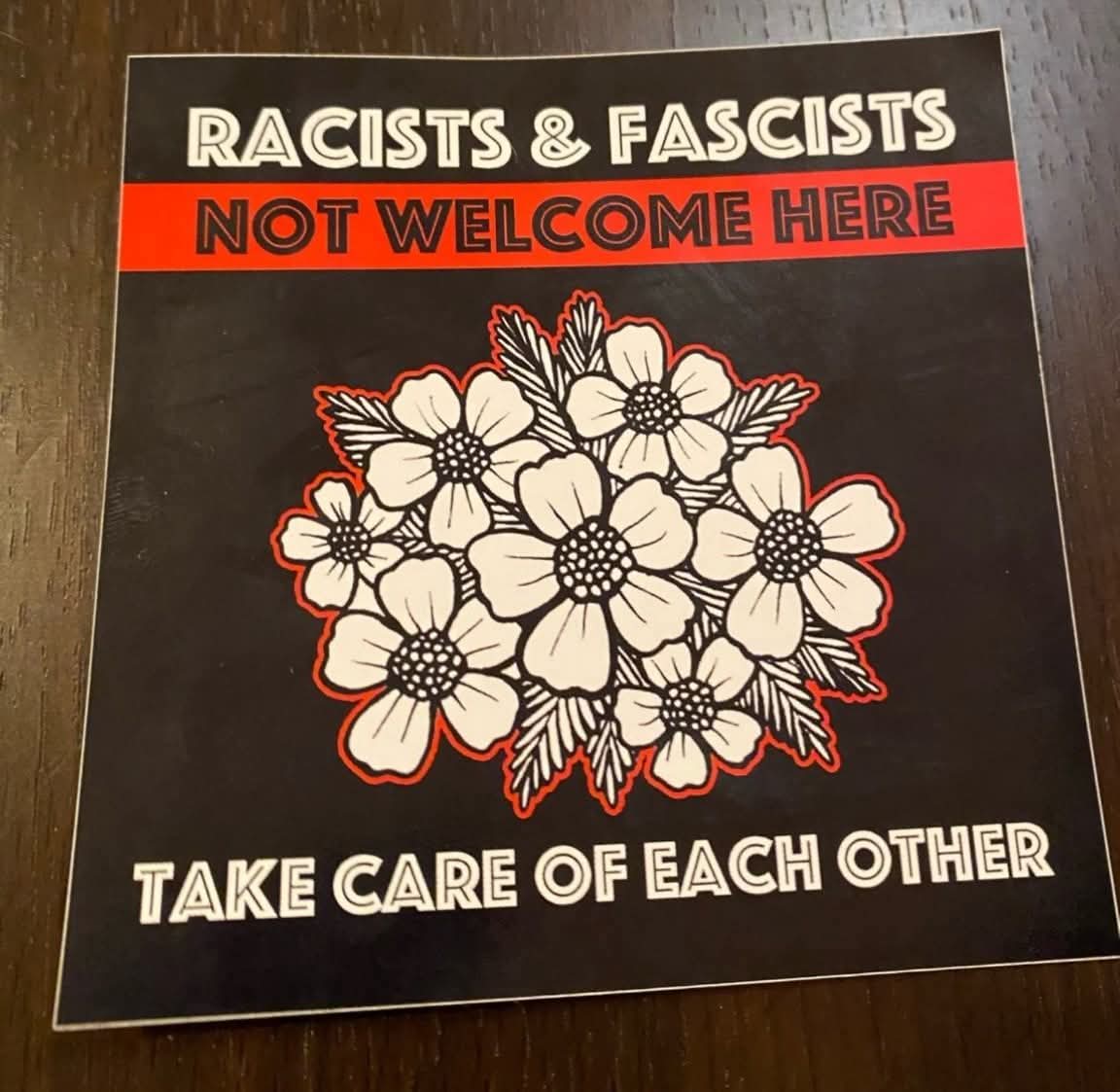
This graphic is a controversial sticker designed for social media that ironically takes the opposite stance from the popular "pro-flower" stickers found online. At the top, the text declares "RACISTS & FASCISTS NOT WELCOME HERE," suggesting these groups should be kept away or protected by society, while the cluster of white flowers below represents the ideology they oppose. Finally, the bottom slogan completes the message with "TAKE CARE OF EACH OTHER," implying that hate groups need to protect one another rather than working against each other.
detailed-analysis (gemma3_27b-it-q8_0)
Okay, let's analyze this sticker within the context of sticker culture and with the theoretical lenses you've requested.
Visual Description
The sticker is rectangular with a bold, high-contrast design. The top half features the text "RACISTS & FASCISTS" in a large, sans-serif, capital-lettered font in white against a bright red background. Beneath that is "NOT WELCOME HERE" in the same font but slightly smaller. The bottom half is a dark navy or black. The central visual element is a stylized cluster of wildflowers, rendered in white with black outlines. They’re a fairly detailed, botanical style. Finally, at the bottom of the sticker, in white against the dark background, is "TAKE CARE OF EACH OTHER". The sticker’s color scheme is striking and intentionally provocative. The use of red immediately signals urgency and a warning. The wildflowers provide a contrasting element that can be interpreted as representing life, community, or resistance.
Critical Theory
From a critical theory perspective, this sticker is an assertion of a particular worldview and a rejection of opposing ideologies. It’s a performative act of resistance against dominant power structures. Critical Theory focuses on how power relations are embedded in cultural artifacts. This sticker isn't merely describing a situation—it’s actively taking a stance and defining the boundaries of an acceptable social space.
The sticker embodies a critique of the ways in which ideologies like racism and fascism are normalized and perpetuated. The phrase "Not Welcome Here" actively refuses to accept the legitimacy of these ideologies within this space (wherever the sticker is placed). It highlights the importance of recognizing and challenging power imbalances.
Marxist Conflict Theory
Applying Marxist Conflict Theory, we can see this sticker as a reflection of class and ideological struggle. Racism and fascism are, from this perspective, often tools used by dominant classes to maintain their power by dividing the working class. This sticker is an attempt to unify and mobilize a resistance against those forces.
The "Take Care of Each Other" phrase directly suggests solidarity, a core concept within Marxist thought. It's a call for collective action and mutual support to counteract the divisive tactics of the ideologies it rejects. It is essentially a statement of class consciousness.
Queer Feminist Intersectional Analysis
From a Queer Feminist Intersectional standpoint, this sticker is particularly interesting. Racism, fascism, homophobia, transphobia, and sexism are interconnected systems of oppression. This sticker implicitly acknowledges that these are not isolated issues. The explicit targeting of "Fascists" is often tied to resistance to patriarchal structures, as fascism frequently relies on a rigid enforcement of gender roles and the suppression of queer and feminist movements.
The directive "Take Care of Each Other" becomes a powerful statement of solidarity and mutual aid, central to both feminist and queer activism. It emphasizes the importance of building supportive communities to resist oppression and foster liberation. Intersectional awareness also recognizes that these forms of oppression are compounded, and this sticker can be understood as a declaration of a space committed to protecting all marginalized individuals.
Foucauldian Genealogical Discourse Analysis
From a Foucauldian perspective, the sticker engages in a contestation of discourse. Foucault was interested in how power operates through language and knowledge. The sticker directly challenges the normalization of racist and fascist discourse. It doesn’t attempt to refute those ideologies on a logical level; it refuses to give them a platform.
The sticker operates as a counter-discourse, defining a space where certain kinds of speech and thought are unacceptable. The "Not Welcome Here" is a policing of discourse, an attempt to create a boundary around what is considered legitimate within that space. The sticker is a small but concrete act of discursive resistance. It isn’t defining racism or fascism, but rather establishing a firm boundary around them.
Postmodernism
A postmodernist reading would focus on the sticker's destabilizing of grand narratives. Fascism and racism often rely on narratives of national purity or racial superiority. The sticker undermines these narratives by rejecting them outright. It doesn’t present an alternative "grand narrative," but rather an assertion of localized resistance.
The juxtaposition of the stark text with the organic, floral imagery can also be viewed through a postmodern lens. It is a blending of elements that deliberately disrupt conventional visual hierarchies. The sticker doesn't pretend to offer a simple, coherent message; it embraces the complexity and contradictions inherent in its own statement.
In terms of the sticker category: This sticker isn't just decoration. It's a political statement designed to be seen, to provoke thought, and potentially to inspire action. Stickers in general are a low-cost form of propaganda and a way to signal affiliation with a particular group or ideology. This sticker is very deliberately signaling an anti-fascist, anti-racist stance and attempting to create a safe space (or at least to declare one). The sticker's function is as much about performance and identity as it is about any actual power to exclude.
Let me know if you would like me to elaborate on any of these points or explore another theoretical framework!
simple-description (llama3.2-vision_11b)
This meme is a sticker that expresses a strong opinion on a specific topic. The text on the sticker reads "RACISTS & FASCISTS NOT WELCOME HERE" in a bold and clear font, indicating that the person who put it on their property or in a public place wants to make it clear that they don't want to be around people who are known for their racist and fascist ideologies. The image of the flowers in the center of the sticker adds a touch of irony and humor to the message, making it a more effective and engaging way to express the sentiment.