First Seen
2023-05-10T21:03:41+00:00
simple-description (llama3.2-vision_11b)
This meme is a play on the Star Wars character Darth Vader, with a twist on his iconic "I find your lack of faith disturbing" line. The meme replaces Vader's words with "I find your lack of socialism disturbing" and pairs it with a image of a red star, a symbol of communism. The text is meant to poke fun at the idea of socialism and communism, implying that the speaker is somehow disturbed by the lack of these ideologies in the Star Wars universe.
detailed-analysis (gemma3-27b-vision)
Okay, here's an analysis of the image, broken down into sections based on the theoretical lenses you requested, only where applicable. As you'll see, some of these frameworks simply don't fit well with the content of this meme.
Visual Description
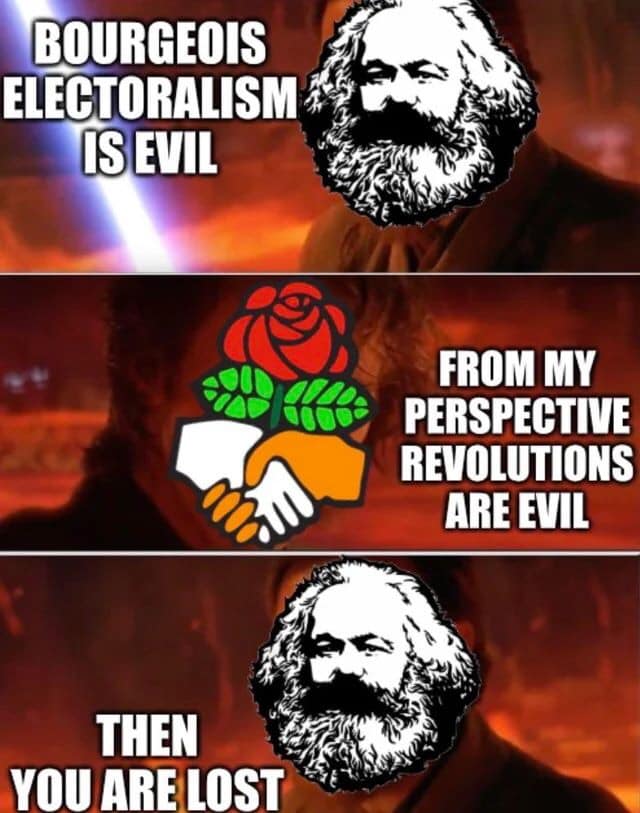
The image is a three-panel meme featuring Karl Marx.
- Panel 1: Shows a close-up of Karl Marx with the text "BOURGEOIS ELECTORALISM IS EVIL" superimposed. A bright light beam is projected from a point in the frame.
- Panel 2: Depicts a handshake between a white hand and a hand of color, offering a flower. The text says, "FROM MY PERSPECTIVE REVOLUTIONS ARE EVIL."
- Panel 3: Returns to the portrait of Karl Marx with the text "THEN YOU ARE LOST." The image has a reddish color palette and appears to be a deliberately low-quality digital image, characteristic of internet memes.
Marxist Conflict Theory
This meme is deeply rooted in Marxist conflict theory. It’s an explicit declaration from the perspective of Marx himself, presenting a rejection of bourgeois electoralism (the idea of change occurring solely through capitalist democracy).
- Class Struggle: The core argument is a critique of electoral systems as a component of the bourgeois system, and a validation of revolution. The meme positions elections as a mechanism to reinforce the dominance of the bourgeoisie.
- Revolution as a Solution: The meme implies that systemic change requires more than simply voting within the existing system. It champions revolution—the overthrow of the existing order—as the only viable path to true liberation.
- Critique of Liberal Democracy: The meme can be interpreted as a direct critique of liberal democratic principles. By rejecting bourgeois electoralism, it rejects the notion that political change can be achieved through participation in the capitalist state.
- Alienation: The final panel ("THEN YOU ARE LOST") suggests that those who believe in electoralism are alienated from the true source of change, and are therefore lost and directionless.
Foucauldian Genealogical Discourse Analysis
The meme’s use of Marx’s image and the assertion of “EVIL” creates a discourse around power.
- Power/Knowledge: The meme leverages Marx's established authority and philosophical power. The very act of speaking from the position of Marx confers a certain legitimacy and force on the claim. The designation of "EVIL" is not an objective truth, but a construct within a particular discourse—the discourse of Marxist thought.
- Genealogy of Concepts: We can trace the genealogy of the concept of “revolution” as presented in the meme. The meme presents a specific definition of revolution, one that is inherently anti-bourgeois and rejects electoral mechanisms. This definition is not universal or natural, but a product of historical and ideological struggles.
- Disciplinary Power: The final panel is a subtle assertion of disciplinary power. It positions those who disagree with the meme’s message as "lost," implying a correct and incorrect way of understanding the world.
Critical Theory
The meme aligns with the spirit of Critical Theory.
- Critique of Ideology: The meme challenges the ideology that electoral participation is sufficient for achieving social change. It reveals how this ideology can serve to maintain the status quo.
- Emancipation: Underlying the critique of electoralism is a desire for emancipation—a desire to overcome the oppressive structures of capitalism and achieve a more just and equitable society.
- Reflection of Social Realities: The meme reflects a growing disillusionment with traditional political institutions and a sense that the system is rigged against the working class.
**Why these lenses don't fit:**
- Postmodernism: While the meme is an example of a postmodern cultural form (a meme), it does not engage with core postmodern ideas like the deconstruction of grand narratives, the rejection of objective truth, or the celebration of difference. The meme is a fairly straightforward assertion of a particular ideology, rather than a playful or critical dismantling of it.
- Queer Feminist Intersectional Analysis: There is nothing in the image itself that directly engages with queer, feminist, or intersectional issues. While a Marxist analysis can certainly be combined with these frameworks, the meme itself does not offer any specific insights into these areas.
Let me know if you'd like me to elaborate on any of these points or explore a different theoretical lens.
simple-description (llama3.2-vision)
The meme is a humorous take on the phrase "I see dead people" from the movie The Sixth Sense. In this version, the phrase is replaced with "I see 19th century ideologies" and features a cartoon image of a red rose (symbol of communism) with a hammer and sickle (symbol of socialism) merged together, implying that the speaker is seeing a blend of two historically opposing ideologies.
tesseract-ocr
SHUTS > TTT TS ea ay ve age ; GO eS YA tins eee a Wd) ore YOUARELOST 7