First Seen
2023-05-10T21:03:41+00:00
simple-description (llama3.2-vision_11b)
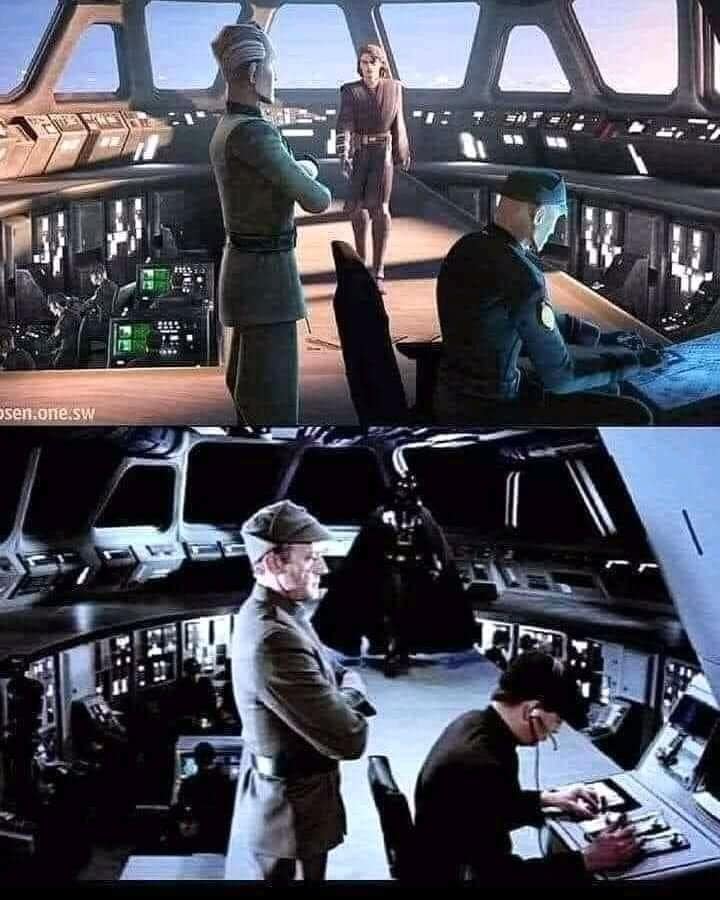
The meme is a humorous comparison between two scenes from the Star Wars franchise. The top image shows a stern-looking Admiral Thrawn from the animated series Star Wars Rebels, while the bottom image shows a similar-looking character from the original 1977 film Star Wars, also named Thrawn. The text "Thrawn, you have passed. You have passed. You have passed" appears in the bottom image.
detailed-analysis (gemma3-27b-vision)
Okay, let's break down the images from Star Wars: Revenge of the Sith using the frameworks you've requested. I'll omit sections if a framework doesn't strongly apply to the visuals.
Visual Description
The images depict a scene inside a control room aboard a Separatist ship during the Battle of Coruscant. The space is dominated by large, angled windows overlooking a chaotic cityscape of other ships engaged in combat. The control room itself is filled with consoles and holographic displays.
- Top Image: Darth Sidious (Palpatine) stands with his back turned, observing the battle. He is flanked by a Devaronian officer and Anakin Skywalker. Anakin is at a console, seemingly monitoring the situation.
- Bottom Image: Darth Sidious stands, now with his back firmly to Anakin and the console and overlooking the chaotic battle, and Darth Vader sits at the same console, engrossed in his work.
The lighting is dark and dramatic, emphasizing the power and intensity of the situation. The composition suggests a shifting dynamic between the characters. The transition from Anakin to Vader is visually clear, highlighting a transformation in his position and allegiance.
Foucauldian Genealogical Discourse Analysis
This scene is ripe for a Foucauldian reading. Foucault’s idea of power/knowledge is central. The control room isn't just a physical space, but a site of power.
- Discipline and Panopticism: The layout of the control room, with its large windows and consoles, can be seen as a form of control. While not a direct implementation of the panopticon, the ability of Sidious to observe Anakin (and Anakin’s later absorption into his tasks as Vader) creates a dynamic of surveillance. He controls the narrative and flow of knowledge, and even though Anakin is physically present, Sidious controls his access to information.
- Genealogy of Power: The scene illustrates a historical shift in the discourse around power within the Republic/Galactic order. The old Jedi order, based on altruism and defense, is supplanted by a new order – the Sith – that embraces control and domination. Sidious’s manipulation of Anakin isn't just a personal act; it’s part of a broader restructuring of power relations.
- Truth and Power: Sidious defines the 'truth' of the situation. The battle isn't presented as a desperate fight against tyranny (which is how the Jedi framed it), but as a necessary step towards order. His narrative becomes the dominant one, and Anakin, now Vader, internalizes it.
The transformation from Anakin to Vader, as symbolized in the images, represents the internalization of this new discourse. Vader is no longer a seeker of truth, but an instrument of power, acting upon the terms defined by Sidious.
Critical Theory
Applying a broad Critical Theory lens (drawing on thinkers like Adorno and Horkheimer), we can examine the scene's representation of the dialectic of enlightenment.
- Instrumental Reason: The Separatist battle, and Sidious's manipulation, can be seen as examples of instrumental reason gone awry. The pursuit of order and control (goals that, in themselves, aren't negative) are achieved through ruthless means, sacrificing individual autonomy and moral principles.
- Domination and Control: The scene emphasizes the overarching theme of domination. Sidious dominates Anakin, and the Sith seek to dominate the galaxy. The "enlightened" goal of bringing order is used to justify the suppression of dissent and the exercise of power.
- Loss of Authenticity: Anakin's transformation into Vader represents a loss of authenticity. He's stripped of his individuality and becomes a tool of the Sith's agenda. This speaks to the Critical Theory concern with the commodification and alienation of the self.
Marxist Conflict Theory
From a Marxist perspective, the images vividly represent class struggle and the shifting dynamics of power.
- Exploitation: Anakin, once a powerful Jedi, is exploited by Sidious, who manipulates him for his own ends. Anakin’s potential is used not for the good of the Republic, but for the advancement of the Sith's agenda.
- Base and Superstructure: The battle itself is a manifestation of the underlying economic and political conflicts within the galaxy. The Separatist movement, driven by economic grievances and political dissent, challenges the established order (the Republic).
- False Consciousness: Anakin initially believes he is fighting for the right cause. Sidious effectively instills false consciousness in him, obscuring the true nature of the conflict and convincing him to serve the Sith's interests.
- Shift in Class Structure: The transition from the Jedi-led Republic to the Sith-dominated Empire represents a fundamental shift in the galactic class structure. The Sith, as the new ruling class, consolidate their power and suppress any opposition. The scene visually showcases the ascension of the Sith over the Jedi.
Postmodernism
While not the most central framework, a postmodern reading can highlight the instability of truth and the deconstruction of grand narratives.
- Meta-Narratives: The traditional "good vs. evil" narrative of Star Wars is deliberately undermined. Sidious presents a complex and ambiguous rationale for his actions, challenging the notion of a simple, overarching moral code.
- Simulation and Hyperreality: The chaotic battle depicted in the scene can be seen as a simulation of conflict, divorced from any genuine underlying values. The Sith’s actions are motivated by a desire for power, not by a commitment to any specific ideology.
- Deconstruction: The transformation of Anakin into Vader deconstructs the traditional heroic archetype. Vader isn't a symbol of good, but a figure of fear and oppression. This disruption of established categories challenges the notion of a fixed and stable identity.
Queer Feminist Intersectional Analysis
This framework is the most difficult to apply directly to these images without stretching the interpretations. However, we can explore the dynamic through the lens of power imbalances and control.
- Power Dynamics: Sidious exerts complete control over Anakin, manipulating him into a subservient role. This power dynamic can be understood as a form of domination, echoing patriarchal structures where men historically wielded power over women.
- Loss of Agency: Anakin's transformation results in a loss of agency and self-determination. He is robbed of his ability to make independent choices and becomes a mere instrument of the Sith's agenda. This aligns with feminist critiques of patriarchal systems that deny women autonomy.
- Intersectionality (Potential): While the images do not explicitly depict intersections of identity, the concept can be applied to the broader Star Wars universe. The Jedi Order, historically led by men, maintained a hierarchical structure that could be seen as mirroring patriarchal power dynamics.
It’s important to note that this analysis requires a degree of extrapolation and interpretation, as the Star Wars universe doesn’t explicitly address issues of gender or sexuality in these scenes.
Hopefully, this detailed analysis provides a robust exploration of the images through the requested theoretical lenses. Let me know if you'd like me to elaborate on any specific point or framework.
simple-description (llama3.2-vision)
The meme is a play on the iconic "I find your lack of faith disturbing" line from the Star Wars movie, but with a humorous twist. It shows a screenshot of the character Grand Moff Tarkin from the movie, but with a caption that says "I find your internet connection disturbing". The image is meant to poke fun at the frustration of slow internet speeds.
tesseract-ocr
ie Sen eit ie a ae a ee me ( NN ar |, ao he ‘ a poe sy ae) 5 at 4 a J si