First Seen
2023-05-10T21:03:41+00:00
simple-description (llama3.2-vision_11b)
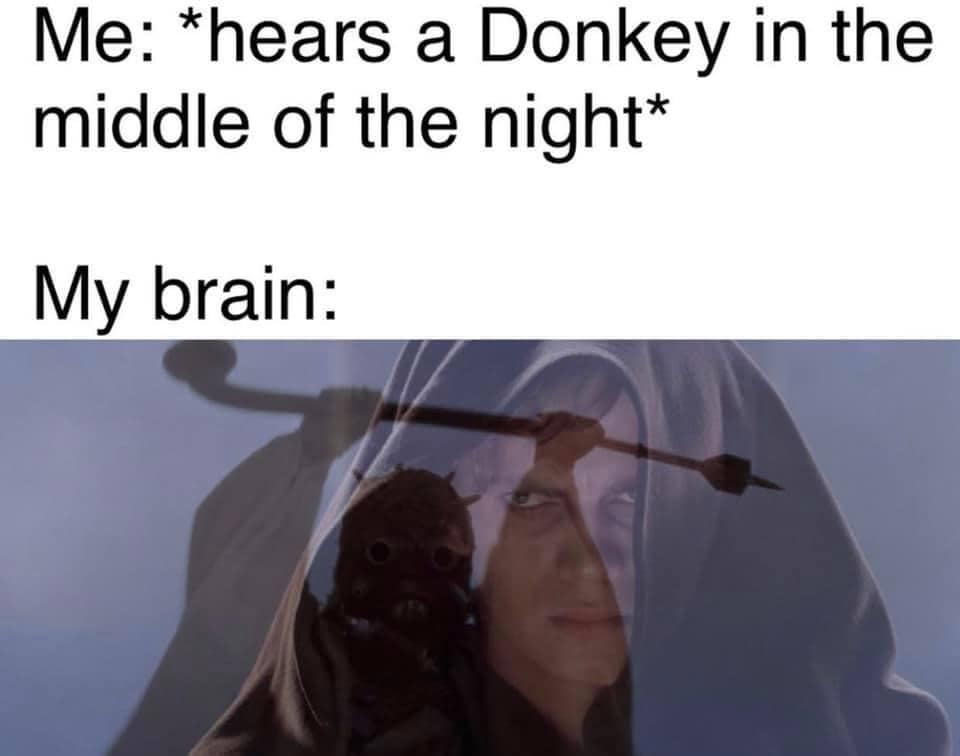
In the context of Star Wars, this meme is a play on the iconic scene where Darth Vader says "When I left you, I was but the learner. Now I am the master." The meme takes this phrase and applies it to a situation where someone is startled by the sound of a donkey braying at night, implying that their fear of the sound is so intense that it has become their master. The image is likely a humorous representation of this concept, with a person in a dark room looking up in fear as a donkey is visible in the background.
detailed-analysis (gemma3-27b-vision)
Okay, let's break down this meme through several theoretical lenses. It's a deeply odd meme, so some lenses will be more applicable than others.
Visual Description
The meme is a two-panel format. The top panel sets up a simple scenario: a person hears a donkey braying at night. The bottom panel shows a close-up, dramatically lit portrait of the character Puss in Boots from the Shrek franchise. He’s wearing his plumed hat and boots, but the image is dark and shadowy, giving a sense of seriousness or even menace. The lighting casts deep shadows on his face, highlighting his exaggerated features and giving him an intense gaze. He appears to be in the middle of a swashbuckling pose with a sword over his shoulder. The overall effect is a dramatic juxtaposition of mundane auditory stimulus (hearing a donkey) and a hyperbolic, and slightly unsettling, visual response.
Foucauldian Genealogical Discourse Analysis
This meme is ripe for a Foucauldian analysis. The seemingly innocuous "donkey" acts as a site where discourses clash.
- Discourse and Power/Knowledge: The meme implies a historically constructed association between "donkeys" and a particular discourse of heroism, adventure, and even existential dread embodied by Puss in Boots. The simple sound triggers not a logical, rational response, but a plunge into this established framework. The power dynamic lies in how this discourse shapes subjective experience.
- Genealogy of Puss in Boots: A genealogical analysis would trace the "truth" of Puss in Boots – how he was constructed as a figure within the Shrek universe, and then circulated in popular culture. His presentation as a swaggering, romantic hero creates the expectation of dramatic, overblown responses. The meme plays on this established narrative.
- The Subject's Formation: The "My brain" panel illustrates how the subject (the person hearing the donkey) isn’t operating from a position of neutral rationality. Instead, their brain is already pre-programmed by the discourses of popular culture, automatically activating a fantastical, cinematic response.
Critical Theory
This meme operates effectively within the framework of Critical Theory, specifically around the concept of the culture industry.
- Commodification of Experience: The meme suggests that our responses to everyday stimuli are increasingly shaped by commodified images and narratives. Hearing a donkey doesn’t lead to practical thought (e.g., wondering where it came from); it leads to instantaneous association with a blockbuster film character. The "donkey" is merely a trigger for a pre-packaged narrative.
- False Consciousness: The meme could be interpreted as highlighting a form of "false consciousness." The individual isn’t responding to reality directly, but rather to a mediated, distorted version of reality created by the culture industry. The brain is “distracted” by the spectacle, preventing any critical engagement with the actual sound of the donkey.
- Critique of Spectacle: The meme is a sarcastic commentary on the over-the-top nature of contemporary entertainment. It demonstrates how easily we are drawn into spectacle, even in the most mundane situations.
Postmodernism
The meme is inherently postmodern in its playful deconstruction of meaning and its embrace of irony.
- Simulacra and Simulation: Puss in Boots is a simulacrum – a copy without an original. The image has become divorced from its original context in the film and now functions as a signifier in its own right. The meme suggests that we are increasingly living in a world of simulacra, where representations have replaced reality.
- Intertextuality: The meme relies heavily on intertextuality – the relationship between texts. It draws upon our knowledge of Shrek, Puss in Boots, and the conventions of swashbuckling adventure films.
- Irony and Parody: The meme is inherently ironic, juxtaposing the mundane with the absurd. It parodies our tendency to overthink and to project grand narratives onto everyday experiences.
Queer Feminist Intersectional Analysis
This lens is the weakest fit for the meme, but we can still extract some potential readings.
- Masculinity and Performance: Puss in Boots is a deliberately exaggerated performance of masculinity—a hyper-confident, swashbuckling archetype. The meme can be read as critiquing this performance, highlighting its artificiality and its reliance on spectacle.
- Disruption of Normative Expectations: The meme subverts the expectation that a mundane stimulus would elicit a rational response. This disruption can be seen as a form of queer transgression—challenging the boundaries of what is considered "normal" or "appropriate."
- Power Dynamics: While subtle, the meme touches upon power dynamics by illustrating how cultural narratives can dominate individual thought processes. The "My brain" panel suggests a loss of agency, as the individual is passively bombarded with pre-packaged imagery and narratives.
In conclusion, this meme is surprisingly rich in theoretical potential. While some lenses are more applicable than others, it consistently invites us to question the ways in which power, culture, and language shape our perceptions of reality.
simple-description (llama3.2-vision)
This meme is a play on the classic "I can see your face" phrase, but with a twist. The image shows a person's face with a donkey's head superimposed over it, implying that someone is seeing a donkey in their mind. The text at the top reads "I can see your face" and the text at the bottom reads "I can see a donkey".
tesseract-ocr
Me: *hears a Donkey in the middle of the night* My brain: