First Seen
2023-05-10T21:03:41+00:00
simple-description (llama3.2-vision_11b)
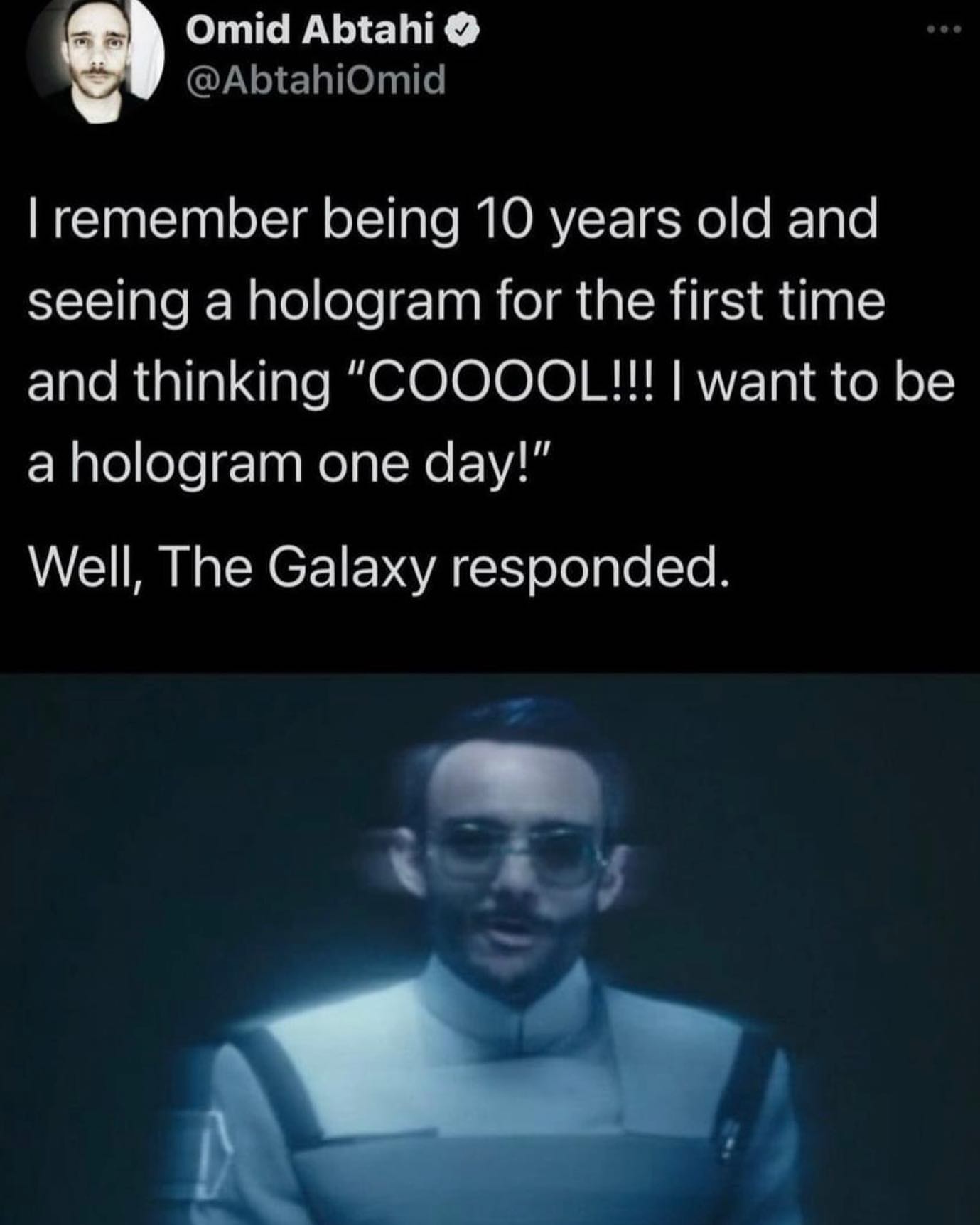
The meme is a screenshot of a Star Wars character's reaction to being a hologram, with the text "I remember being 10, I wanted to be a hologram, now I'm a hologram" written above it. The image is a humorous take on the character's sentiment, poking fun at the idea of being a hologram in the Star Wars universe.
detailed-analysis (gemma3-27b-vision)
Okay, let's break down this Twitter post and the accompanying image through the lenses you've requested. I'll organize it by section, only including sections where the theoretical framework genuinely applies. I'll also explain why certain frameworks might not be relevant.
Visual Description
The image is a still from what appears to be the Star Wars franchise. It shows a holographic projection of a character, specifically Grand Moff Tarkin, seemingly mid-statement. The holographic projection is blue-toned, highlighting the artificial nature of the character's representation. Tarkin has a serious expression, looking slightly down with his lips pursed. The background is a dark, out-of-focus spaceship interior, emphasizing the contrast between the solid, physical space and the ethereal digital presence. The quality of the image is consistent with that of a mid-2000s digital capture.
---
Foucauldian Genealogical Discourse Analysis
This post offers interesting fodder for a Foucauldian reading. The "desire to be a hologram" isn't a statement about a longing for technological possibility, but a yearning for a specific discourse of power and representation.
- Power/Knowledge: The hologram, as presented in Star Wars and broader science fiction, is inextricably linked to power. It represents a control over image, information, and space. The ability to project an image, to be present without physical embodiment, is a form of dominance. The tweet, therefore, reveals a childhood fascination with this power dynamic.
- Genealogy of the Hologram: Tracing the concept of the hologram within culture reveals a shift in our understanding of reality and the self. Historically, representation demanded physical presence (painting, sculpture). The hologram disrupts this – it offers a non-material, mediated presence. The tweet can be interpreted as a desire to escape the limitations of a corporeal existence, to exist as pure information.
- Discursive Formation: The desire to be a hologram isn’t a natural feeling, but a product of specific discourses – science fiction, technological utopianism, the celebration of visual culture. Star Wars constructs a narrative where holograms aren't just technology, but a symbol of authority and control. The tweet is a symptom of that discursive formation.
---
Postmodernism
This post is very much in line with postmodern themes, particularly the blurring of reality and simulation.
- Simulacra and Simulation (Baudrillard): The tweet speaks to a desire to become a simulation—to exist as a constructed image. This aligns perfectly with Baudrillard’s idea that we’ve moved into an era where simulations have become more real than the "real." The child isn't longing for a technological upgrade; they are embracing the idea of a hyperreality where the distinction between original and copy has collapsed.
- Deconstruction of the Self: The longing to be a hologram suggests a rejection of the limitations of the physical body and the traditional notion of the unified self. The hologram isn't embodied; it's data, information. The desire to become it points towards a fragmented, fluid understanding of identity.
- Meta-Narratives: Star Wars itself is a grand, overarching narrative (a meta-narrative). The child’s reaction to the hologram demonstrates an engagement with this narrative, but also a desire to inhabit its symbolic order.
---
Why other frameworks aren't as relevant:
- Critical Theory: While the post touches on themes of representation, it doesn’t center on the critique of social structures or the pursuit of emancipation in the same way traditional Critical Theory does.
- Marxist Conflict Theory: This framework focuses on class struggle and economic disparities, which are not central to the content of the tweet or the image.
- Queer Feminist Intersectional Analysis: While representation always has implications for identity, the primary focus of this post is on the relationship between the self and technology/simulation, rather than specifically on gender, sexuality, or intersectional oppression.
I hope this detailed breakdown is helpful. Let me know if you'd like me to expand on any of these points or explore other theoretical angles.
simple-description (llama3.2-vision)
The meme is a photo of a character from the movie "Star Wars" (specifically, a young Anakin Skywalker) with a caption that says: "I remember being 10 and seeing Star Wars for the first time. I remember being 10 and seeing Star Wars for the first time. I remember being 10 and seeing Star Wars for the first time... I remember being 10 and seeing Star Wars for the first time." The text is followed by a quote from the movie: "I remember being 10 and seeing Star Wars for the first time. I remember being 10 and seeing Star Wars for the first time. I remember being 10 and seeing Star Wars for the first time... I remember being 10 and seeing Star Wars for the first time."
tesseract-ocr
: OCW ek’ tse ) @AbtahiOmid | remember being 10 years old and seeing a hologram for the first time and thinking “COOOOL!!! | want to be a hologram one day!” Well, The Galaxy responded. oa > y