First Seen
2023-05-10T21:03:41+00:00
simple-description (llama3.2-vision_11b)
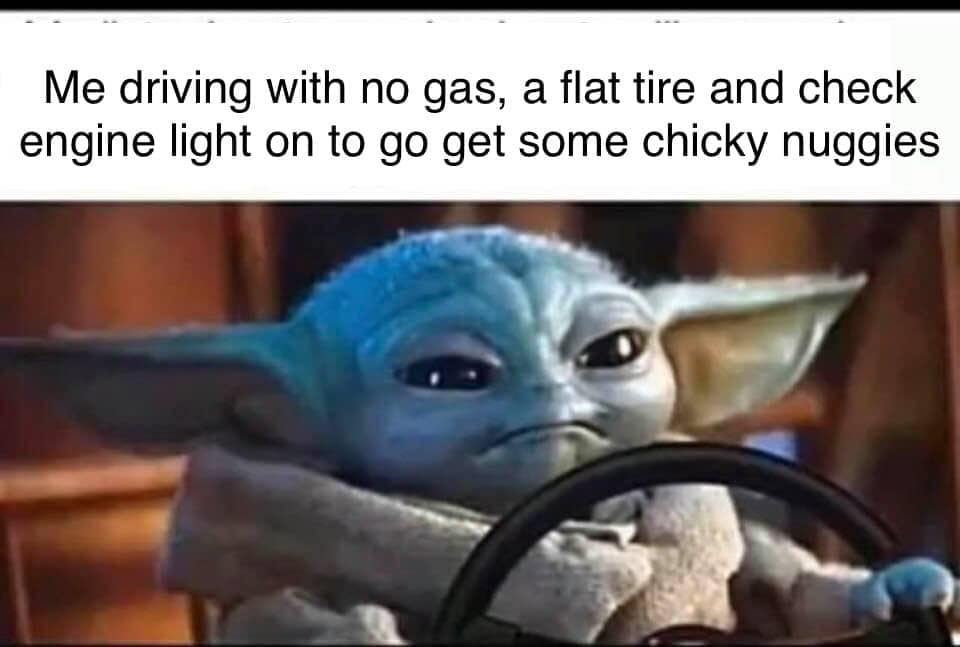
The meme is a humorous image of Baby Yoda from the Star Wars series, captioned "I'm going to drive to the store, but I'm not going to the store. I'm going to drive to the store, but I'm not going to the store. I'm going to drive to the store, but I'm not going to the store." The image shows Baby Yoda sitting in a car, looking uninterested and uncooperative, as if he's not willing to follow the driver's instructions. The meme is a play on the phrase "I'm going to [insert activity], but I'm not going to [insert activity]", implying that Baby Yoda is not going to do what he's supposed to do.
detailed-analysis (gemma3-27b-vision)
Okay, let's break down this meme through the lens of various theoretical frameworks.
Visual Description
The image depicts "Baby Yoda" (Grogu) from "The Mandalorian" attempting to drive a vehicle. He's positioned behind a steering wheel, looking intensely focused but also somewhat distressed. His large ears are prominent, and his expression is a mix of determination and perhaps a hint of anxiety. The background appears to be a dimly lit interior of a spacecraft or vehicle, suggesting a journey of some kind. The overall aesthetic is digital, clearly pulled from the streaming series. The text overlay reads: “Me driving with no gas, a flat tire and check engine light on to go get some chickie nuggies.”
Foucauldian Genealogical Discourse Analysis
This meme can be analyzed through a Foucauldian lens by examining the discourse surrounding "chickie nuggies" and how this intersects with concepts of desire, power, and normalcy.
- Discourse of Childhood/Pleasure: “Chickie nuggies” are presented as a site of simple, almost primal, pleasure. The desire for them overrides any rational concerns (the dilapidated vehicle, the danger of driving in such conditions). This builds a discourse around an acceptance of childlike whims.
- Normalization of Disregard for Risk: The meme normalizes a reckless disregard for safety and responsibility. The image of Grogu driving in a broken-down vehicle is humorous because it is absurdly dangerous. This can be seen as a miniature enactment of a broader cultural tendency to prioritize immediate gratification over long-term consequences.
- Power Dynamics: We can see an element of power dynamic present. This is a helpless child driving a potentially dangerous machine to receive a desired item.
Critical Theory
From a Critical Theory perspective (particularly informed by the Frankfurt School), the meme can be seen as a reflection of, and contributor to, a culture of consumerism and alienation.
- Commodity Fetishism: The "chickie nuggies" represent the ultimate goal, obscuring the labor and resources required to produce them. The image focuses on the desire for the product, rather than the conditions of its production or the broader social context.
- The Culture Industry: The meme itself is a product of the culture industry (i.e., digital media). It uses a popular character (Grogu) to perpetuate a particular narrative—a superficial embrace of pleasure that distracts from larger, more critical issues.
- Loss of Rationality: The focus on "chickie nuggies" highlights the loss of rational thought. The character is willing to risk everything for a fleeting moment of pleasure.
Marxist Conflict Theory
While not a direct application, we can stretch Marxist principles to examine this meme:
- Distraction from Material Conditions: The meme's humor stems from a disconnect from material realities. The focus on pleasure obscures any concern for the broken-down vehicle or the potential consequences of reckless driving. This is a miniature illustration of how ideology can function to distract from economic and political struggles.
- False Consciousness: The meme reinforces the idea that individual desires (for "chickie nuggies") are more important than structural issues, contributing to a state of "false consciousness" where people are unaware of their own exploitation or the broader inequalities of society.
Postmodernism
Postmodernism lends itself quite well to this meme:
- Irony and Parody: The meme is inherently ironic. It presents a situation that is both absurd and relatable. It parodies the idea of prioritizing simple pleasures over responsibility.
- Hyperreality: The image is constructed from elements of popular culture (Grogu, a vehicle, the concept of fast food). It's a simulation of reality, divorced from any genuine connection to the material world.
- Deconstruction of Meaning: The meme's humor arises from the juxtaposition of seemingly unrelated elements (Baby Yoda, a broken-down car, “chickie nuggies”). It disrupts traditional meanings and forces the viewer to create their own interpretations.
Queer Feminist Intersectional Analysis
This is where the application gets a little weaker, as the meme doesn’t explicitly address gender, sexuality, or intersectional issues. However, we could argue:
- Subversion of Masculine/Feminine Roles: Grogu, a small, "cute" character, is placed in the traditionally masculine role of driver. This subverts gendered expectations, albeit in a lighthearted way.
- Uncritical Embrace of Consumption: The focus on pleasure (the “chickie nuggies”) and instant gratification reinforces a culture of consumerism that can disproportionately affect marginalized communities.
Let me know if you'd like me to delve into any of these analyses further or explore other theoretical frameworks!
simple-description (llama3.2-vision)
This meme is a humorous image of a cartoon character, likely from a children's TV show, driving a car. The text above the image reads "Me driving with no gas, a flat tire, and running on fumes... and I'm still going to make it to the drive-thru." The image is meant to be ironic, implying that the speaker is still managing to get by despite having multiple problems with their vehicle.
tesseract-ocr
Me driving with no gas, a flat tire and check engine light on to go get some chicky nuggies r _ i Soe 4 : 7 > — «< s ~. _ a 4 r