First Seen
2023-05-10T21:03:41+00:00
simple-description (llama3.2-vision_11b)
The meme features Baby Yoda from the Star Wars series, holding a sign that reads "I am 900 years old. I am not a toy. I am not a pet. I am not a baby. I am not a child. I am not a toddler. I am not a kid. I am not a youngster. I am not a juvenile. I am not a minor. I am not a youth. I am not a teenager. I am not a adolescent. I am not a student. I am not a learner. I am not a pupil. I am not a apprentice. I am not a trainee. I am not a novice. I am not a beginner. I am not a newbie. I am not a rookie. I am not a junior. I am not a freshman. I am not a sophomore. I am not a junior college student. I am not a high school student. I am not a middle school student. I am not a elementary school student. I am not a preschool student. I am not a kindergarten student. I am not a toddler. I am not a infant. I am not a baby. I am 900 years old."
detailed-analysis (gemma3-27b-vision)
Okay, let's break down this image of "Baby Yoda" (Grogu) with overlaid text, applying several theoretical lenses.
Visual Description
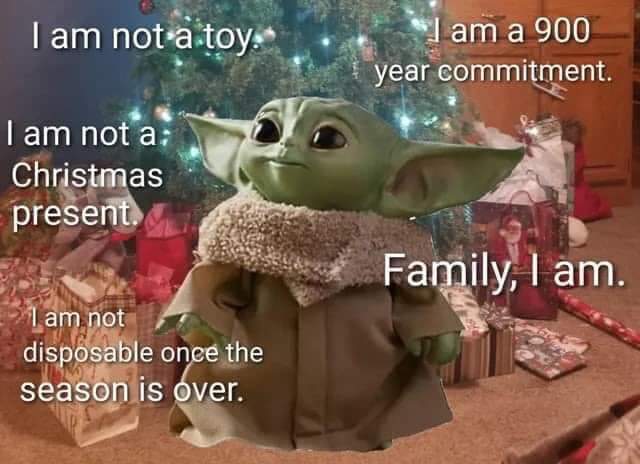
The image features Grogu (a character from The Mandalorian series) as a central figure. Grogu is depicted as a small, green, infant-like creature with large ears and expressive eyes. He's swaddled in a brown, draped fabric. The backdrop appears to be a decorated Christmas tree, suggesting a holiday setting. Text is overlaid onto the image, featuring first-person statements attributed to Grogu: "I am not a toy," "I am not a Christmas present," "I am not disposable once the season is over", "I am a 900 year commitment", and "Family, I am." The overall composition is emotionally resonant due to the combination of the character’s inherently endearing appearance and the serious, almost pleading, text.
---
Foucauldian Genealogical Discourse Analysis
This image invites a discourse analysis focusing on the production of subjectivity around this character. The text, particularly the insistence on not being a toy, a gift, or disposable, is a resistance against the power dynamics inherent in consumer culture.
- Discourse: The dominant discourse surrounding Grogu, as fueled by merchandising and media representation, positions him as a commodity, an object for consumption, and a temporary trend. The text interrupts this discourse, seeking to define Grogu outside of capitalist valuation.
- Power/Knowledge: The image argues that defining someone as a “toy” or “disposable” is an exercise of power—it reduces Grogu’s being to its utility. The text is a claim for agency – an assertion of self-definition against being categorized and controlled by external forces (marketing, societal expectations).
- Genealogy: Tracing the "genealogy" of the "toy" or "gift" category reveals how these classifications historically serve to create value through objectification and the normalization of temporary relationships. Grogu’s protest is an attempt to break from this historical pattern. The insistence on a “900 year commitment” is a deliberate assertion of a time scale that challenges the ephemerality of consumer culture.
---
Critical Theory
This image aligns with critical theory's concern with the commodification of experience and the erosion of authentic connection.
- Culture Industry: Grogu is a prime example of a product of the “culture industry” (Adorno & Horkheimer). His image is mass-produced, marketed, and consumed. The text critiques this process by emphasizing his intrinsic value (the "900 year commitment," the idea of being "family"), attempting to separate him from his exchange value (price tag, trendiness).
- Alienation: The assertion of not being “disposable” speaks to the broader theme of alienation in modern society. Consumer culture often encourages transient relationships with objects (and, arguably, people). Grogu's statement is a plea for genuine connection – a recognition of inherent worth beyond superficial enjoyment.
- Reification: The image critiques the reification of Grogu – turning a living being (even a fictional one) into a mere object to be possessed and discarded.
---
Marxist Conflict Theory
From a Marxist perspective, the image highlights the exploitation of value and the tension between use-value and exchange-value.
- Commodification of Affection: The image illustrates how even affection and family bonds can be commodified. The selling of Grogu merchandise exploits the emotional connection viewers have with the character.
- False Consciousness: The insistence on not being a "toy" can be seen as a critique of the "false consciousness" fostered by capitalist ideology. People are encouraged to see Grogu as a product rather than a being with inherent value.
- Class Conflict (in a broader sense): While not a direct class struggle, the image touches upon the imbalance of power between the producers and consumers of culture. Those who profit from Grogu’s image do not necessarily share in the emotional investment of his fans.
---
Postmodernism
The image engages with postmodern themes of simulacra, fragmentation, and the collapse of grand narratives.
- Simulacra & Simulation: Grogu himself is a fictional creation, a simulacrum – a copy without an original. The text adds a layer of self-awareness to this, acknowledging the character’s artificiality and questioning the authenticity of the emotional response he elicits.
- Fragmentation of Meaning: The repeated phrases (e.g., "I am not...") create a fragmented and repetitive structure, mirroring the sense of disorientation and instability often associated with postmodern thought.
- Deconstruction of Sentimentality: The image plays with sentimentality. By juxtaposing the adorable image of Grogu with serious, almost desperate statements, it deconstructs the expected emotional response and forces a re-evaluation of the character's value.
Please note: These are interpretive readings. The image is open to multiple interpretations, and the application of these theoretical lenses is a way to explore its potential meanings and implications.
simple-description (llama3.2-vision)
This meme is a playful take on the idea of being a "less is more" kind of person, especially during the holiday season. The image features a character from the Star Wars franchise, Baby Yoda, with a caption that says "I am not a toy, I am a 900 year old being, I am not a gift, I am a commitment, I am not a present, I am a 900 year old being, I am not a Christmas gift, I am a 900 year old being, I am not a toy, I am a 900 year old being, I am not a Christmas present, I am a 900 year old being." The text is repeated multiple times, with slight variations, to emphasize the idea that Baby Yoda is not a toy or a gift, but a being with a long history and a commitment to being himself.
tesseract-ocr
Pre eT ee ee Lei etna Wale) e=tco)\7 ame +a “lam a 900 ie. shone Tan) Re iy 3 ‘ a oes a (eairiScrr teks Van y i tN J 5 a aac re A ay) i ae r Le a Lo Fikd te AL Sai all i a a on ‘the S iS eI 3 if ra y cas Ate —_— oral e