First Seen
2023-05-10T21:03:41+00:00
simple-description (llama3.2-vision_11b)
The meme is a still image from the Star Wars: The Mandalorian series, specifically a scene with Baby Yoda (also known as "The Child") from the show. The image shows Baby Yoda looking at something with a curious expression, and the text "I know" is written above it. The meme is a humorous take on the character's innocence and curiosity, implying that Baby Yoda is surprised by something that the viewer is not privy to.
detailed-analysis (gemma3-27b-vision)
Okay, let's break down this meme through the lenses of various theoretical frameworks. It's a surprisingly rich image for what appears to be a simple expression of emotional dependence.
Visual Description
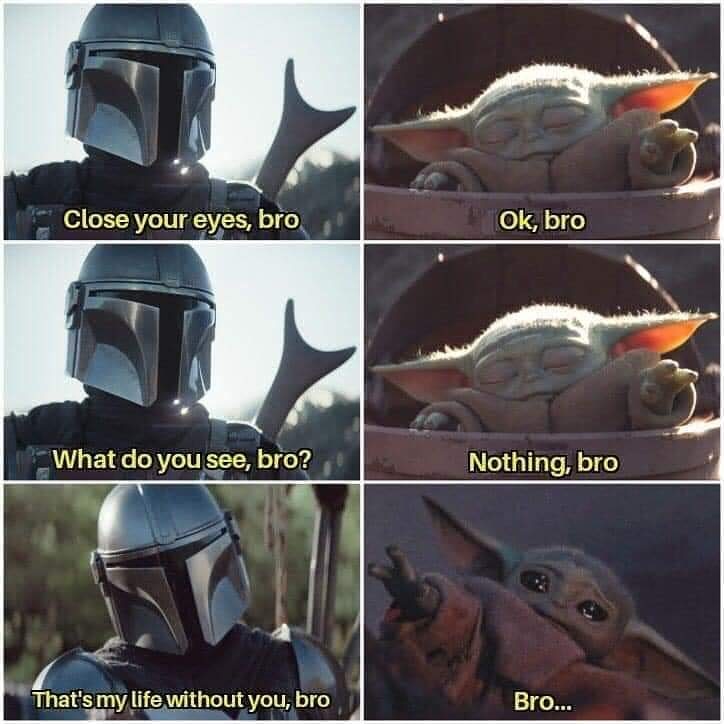
The meme is a four-panel arrangement utilizing screencaps from The Mandalorian. It features Din Djarin (the Mandalorian) and Grogu (Baby Yoda). The first panel shows the Mandalorian looking intently at Grogu. The second panel shows Grogu closing its eyes. The third panel repeats the Mandalorian’s intense gaze. The final panel shows Grogu’s sad, closed eyes. Each panel is accompanied by a colloquial, informal phrase ending with “bro.” The visual style is typical for a meme – high contrast screengrabs with overlaid text. The entire arrangement suggests a dialogue, a game or test being conducted, with emotional buildup to a melancholic resolution.
Foucauldian Genealogical Discourse Analysis
This meme can be analyzed through a Foucauldian lens by looking at the discourse around “masculinity,” “protection,” and “dependence” as constructed through media like The Mandalorian. The Mandalorian's imperative "Close your eyes, bro" establishes a power dynamic, a command meant to control and define Grogu’s sensory experience. It’s a miniature, playful re-enactment of the larger relationship – the Mandalorian assumes the role of protector, a role historically tied to traditional notions of masculinity.
The “What do you see, bro?” question functions as a test. Not a test of sight, but a test of dependence. The answer, “Nothing, bro” isn't a literal description of visual experience, but rather a performative act of affirming reliance on the Mandalorian. The final line, "That’s my life without you, bro…” underscores the constructed nature of this dependence. The Mandalorian isn’t inquiring about actual vision, but asserting his own constructed role and eliciting a confirmation of Grogu’s emotional dependence.
Through this miniature discourse, the meme exposes how power operates not through direct command, but through the shaping of relationships and the elicitation of responses. The entire exchange is a performance of a particular narrative about care and control, subtly reinforcing the idea that vulnerability equals dependence, and protector-protege relationships define value.
Critical Theory
This meme is ripe for a Critical Theory reading, especially concerning the Frankfurt School’s critique of culture. It’s a demonstration of the way mass media (like The Mandalorian) can normalize specific emotional relationships. The Mandalorian-Grogu dynamic, presented as a heartwarming narrative of guardianship, obscures underlying power imbalances.
The meme, as a consumer artifact, participates in this normalization. It reduces complex emotional dynamics to a simple, easily digestible format ("bro" language) reinforcing a passive reception of the The Mandalorian's emotional narratives. The meme isn’t critiquing this dynamic, but repeating it, spreading a simplified and potentially problematic representation of care and control as emotional fulfillment.
The "bro" language is also significant. It’s a form of colloquial leveling, reducing the complexity of the relationship to a superficial, masculine expression. This further reinforces the idea that emotional connection is best expressed through simplicity and directness, potentially obscuring the subtleties and nuances of real emotional connections.
Marxist Conflict Theory
While not immediately obvious, a Marxist reading could frame the dynamic as a subtle representation of class/dependency. The Mandalorian represents a figure of power (a bounty hunter, a warrior, possessing skills and resources) and Grogu represents a figure of vulnerability and reliance. The dynamic isn’t about direct economic exploitation, but about a structural power imbalance where one entity depends entirely on the other for survival.
The Mandalorian’s "protection" isn’t purely altruistic. It’s a performance of power, a way to assert dominance and establish a relationship of control. Grogu’s dependence, while presented as heartwarming, reinforces this power structure. The meme, therefore, can be seen as subtly reproducing the dynamics of class stratification and dependency.
Postmodernism
The meme exemplifies key Postmodern themes. It's an intertextual piece – relying on pre-existing knowledge of The Mandalorian to gain meaning. It's also a form of pastiche, taking screencaps from the show and remixing them into a new context.
The "bro" language is crucial here. It's a self-aware, ironic deployment of colloquialism, signaling that this isn't a serious philosophical statement but a playful appropriation of cultural material. The meme doesn’t claim to offer a profound truth. It acknowledges its own artificiality and constructed nature.
The fragmentation of the screencaps and the focus on isolated moments contribute to the Postmodern aesthetic of deconstruction and fragmentation. The meme isn’t trying to tell a complete story; it’s presenting isolated fragments of emotion and interaction, leaving it to the viewer to interpret the underlying meaning.
Queer Feminist Intersectional Analysis
This is the trickiest lens to apply, but arguably present. While the figures are male, the underlying emotional dynamic is interesting. The overwhelming dependence expressed, while seemingly within a protective context, could be deconstructed as performing a traditionally feminized vulnerability. Grogu, as the dependent figure, occupies a position of emotional need, which, historically, has been coded as feminine. This, ironically, may be a subtle performance of gender norms through the masculine figures.
Further, the power dynamic is not simply about dominance. It’s about care and emotional labor. The Mandalorian is performing the emotional labor of providing security and affection, while Grogu is positioned as the recipient of that labor. This dynamic can be analyzed through a feminist lens, questioning the gendered expectations of caregiving and the emotional burdens often placed on those providing care.
The concept of "intersectionality" doesn't come into play strongly given the specific characters, but it could be expanded if viewed in the context of The Mandalorian’s larger universe and the diverse characters within it. The meme itself, however, is focused on this singular, albeit subtly gendered, dynamic.
In Conclusion:
This seemingly simple meme is surprisingly layered. It reveals complex dynamics of power, dependence, and emotional connection, all subtly reinforced through media representations and consumer culture. Its strength lies in its ability to evoke a recognizable emotional response, while simultaneously reinforcing potentially problematic social narratives. The theoretical lenses outlined above help unpack these hidden layers, revealing the meme’s multifaceted meaning.
simple-description (llama3.2-vision)
This meme is a screenshot of a scene from the TV show "The Mandalorian" where a character says "This is the way" and is followed by a child (Grogu) who responds with "I am done" in a funny and ironic way. The meme is often used to express that someone has had enough of a situation or is feeling overwhelmed.
tesseract-ocr
a P p Close your eyes, bro, Ok, bro : t og i) aaa a P What do yousee, bro? Nothing, bro y iis A te ( , \ : zs } j 5 we 2 ae my life without you, bro Bro...