First Seen
2023-05-10T21:03:41+00:00
simple-description (llama3.2-vision_11b)
The meme is a humorous take on the Star Wars: The Mandalorian character Baby Yoda, where he says "I am not a show, I am a babysitter" in a sarcastic tone. The image features Baby Yoda holding a sign with this phrase, implying that he's not just a cute and cuddly character, but also a responsible caregiver. The meme pokes fun at the idea that Baby Yoda is more than just a cute character, but also a babysitter, which is a humorous twist on his character.
detailed-analysis (gemma3-27b-vision)
Okay, let's break down this meme through several critical theory lenses. It's a surprisingly rich meme for its simplicity!
Visual Description
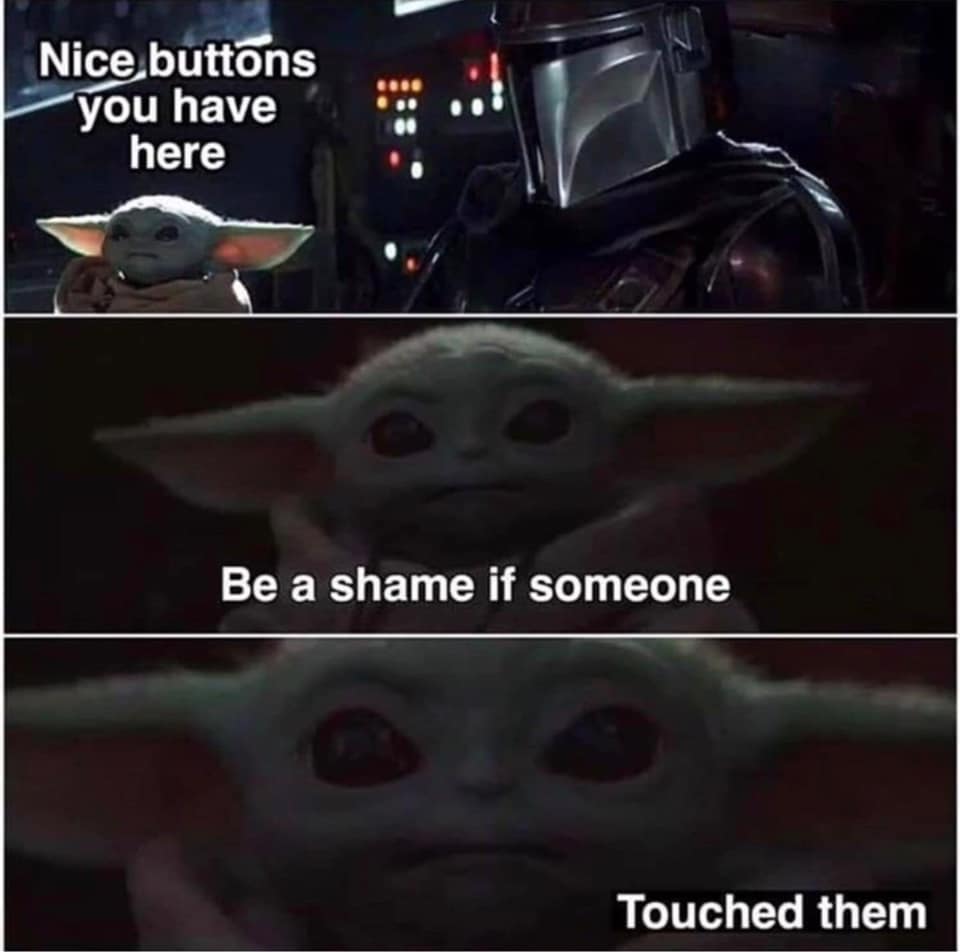
The meme consists of three panels featuring imagery from The Mandalorian.
- Panel 1: Din Djarin (The Mandalorian) is pictured from the chest up, gazing down at Grogu (Baby Yoda). Text overlay reads: "Nice buttons you have here." The lighting is dramatic, highlighting the Mandalorian's armor.
- Panel 2: A close-up of Grogu's face against a black background. Text overlay reads: "Be a shame if someone…"
- Panel 3: A further close-up of Grogu's face, even darker than panel 2. Text overlay reads: "Touched them."
The meme is designed to be darkly humorous, relying on the implied threat behind the seemingly innocent setup. Grogu is positioned as an object of potential harm.
---
Foucauldian Genealogical Discourse Analysis
This meme is ripe for a Foucauldian reading. Foucault focused on power dynamics and how they operate through discourse and institutions.
- Discourse of Protection/Vulnerability: The Mandalorian’s words, while seemingly innocuous, initiate a discourse around Grogu's body. He establishes Grogu as something to be watched over, implicitly positioning him as vulnerable and in need of protection. This establishes a power imbalance.
- The Panoptic Gaze: The implied threat ("Be a shame if someone touched them") suggests a system of surveillance and control. The viewer is drawn into a position of being a potential “protector” and implicitly complicit in this control. It is reminiscent of the Panopticon – the idea that if you know you might be observed, you will self-regulate your behavior.
- Normalization of Violence/Threat: The meme normalizes the idea of threat and control as a means of protection. The humorous framing subtly obscures the underlying power dynamic and potential for violence. It is not a direct threat, but a veiled implication.
- Genealogy of Care: The meme can be considered to establish a genealogy of care. By focusing on "touch" as a means to harm, the meme draws attention to the act of care as protective and defensive.
---
Critical Theory
This meme speaks to core tenets of Critical Theory, particularly the concept of domination and the subject/object relationship.
- Objectification: Grogu is treated as an object of care and protection. His agency is diminished, and he is defined by his vulnerability and the need for others to keep him safe.
- Power Imbalance: The Mandalorian, as the protector, holds all the power. The implied threat suggests that any unwanted touch is met with an implicit willingness to use force.
- Ideology of Protection: The meme reflects a broader ideology of protection, often used to justify control and domination. The idea of protecting the vulnerable can be a mask for asserting control over their bodies and lives.
- Deconstruction of Innocence: The meme plays with the notion of Grogu’s perceived innocence. The dark undertone hints at the potential for violation, disrupting the image of pure, defenseless cuteness.
---
Marxist Conflict Theory
While not the most directly applicable lens, we can identify some class/power dynamics.
- Control of Resources/Value: Grogu, as a unique individual with special abilities, can be seen as a "resource" or form of “capital” in the Star Wars universe (and a source of emotional "capital" for the viewer). The Mandalorian’s possessive stance (“Nice buttons you have here”) reflects a desire to control this resource.
- Power & Ownership: The implication of protecting Grogu by any means necessary points to a system of ownership/control. The Mandalorian establishes a claim over Grogu, and the threat is used to enforce that claim.
- Underlying Struggle: While the meme is light-hearted, it hints at a larger struggle for control and resources within the Star Wars universe and the power dynamics associated with protecting the vulnerable.
---
Postmodernism
- Irony and Playfulness: The meme employs irony – a seemingly innocent observation followed by a dark implication. This playfulness is characteristic of postmodern humor.
- Deconstruction of Narrative: The meme deconstructs the typical "protector" narrative. It highlights the darker, potentially controlling aspects of protection.
- Intertextuality: The meme relies on viewers’ knowledge of The Mandalorian to understand the implicit threat. It is a playful remix of existing cultural material.
---
Queer Feminist Intersectional Analysis (This is where it gets really interesting and nuanced)
This lens provides the most profound, and perhaps unsettling, interpretation.
- Bodily Autonomy: The entire meme revolves around the control of a body. The implication of violence/threat in response to touch is a violation of bodily autonomy. Grogu is rendered powerless in the face of potential harm.
- Vulnerability and Infantilization: Grogu is explicitly positioned as vulnerable and dependent, relying on another for protection. This infantilization is often used to justify control over individuals, and it disproportionately affects marginalized groups.
- Power Dynamics and Consent: The meme sidesteps the issue of consent entirely. The implied threat means that Grogu's wishes or desires are irrelevant.
- The Gaze and Objectification: The Mandalorian's gaze, and the meme’s framing, objectifies Grogu. His body becomes a site of control, and the threat is a way of enforcing that control.
- Intersectional Reading: Consider how this dynamic echoes real-world power imbalances, particularly in cases of abuse and exploitation. The vulnerability of the “other” is often used to justify control and violence. The meme subtly highlights these power dynamics.
Important Note: The meme's humor relies on these uncomfortable dynamics. Recognizing these theoretical interpretations doesn't necessarily mean the meme is "bad" – but it does mean we can see the complex power dynamics it subtly reinforces.
Let me know if you'd like me to delve deeper into any of these analyses!
simple-description (llama3.2-vision)
The meme is a screenshot from a 2019 Star Wars film, "The Mandalorian." It features a character, "The Child" (also known as Baby Yoda), with a disapproving expression. The text at the top of the image reads "When someone tells you to 'be the adult in the room' but you're still a child" and at the bottom, "In space, no one can hear you scream... but your parents can hear you whine."
tesseract-ocr
me a rs = Bt) TT els | | eS ie \e Tete) i | ella _ ' 4 ; _— e) A OO Be a shame if someone Touched them