First Seen
2023-05-10T21:03:41+00:00
simple-description (llama3.2-vision_11b)
The meme features Baby Yoda from the Star Wars series, playing a piano and singing a song. The text "I can sing" appears on the screen, but the lyrics are actually a series of awkward and nonsensical phrases, such as "I can sing, I can sing, I can sing, I can sing, I can sing, I can sing, I can sing, I can sing". The meme is humorous because it pokes fun at the idea that Baby Yoda is trying to sing, but is actually just making strange noises.
detailed-analysis (gemma3-27b-vision)
Okay, let's break down this image/meme through several theoretical lenses, as requested. I'll flag where a section doesn't really fit well but I'll still attempt it briefly to demonstrate an attempt to apply the theory.
Visual Description
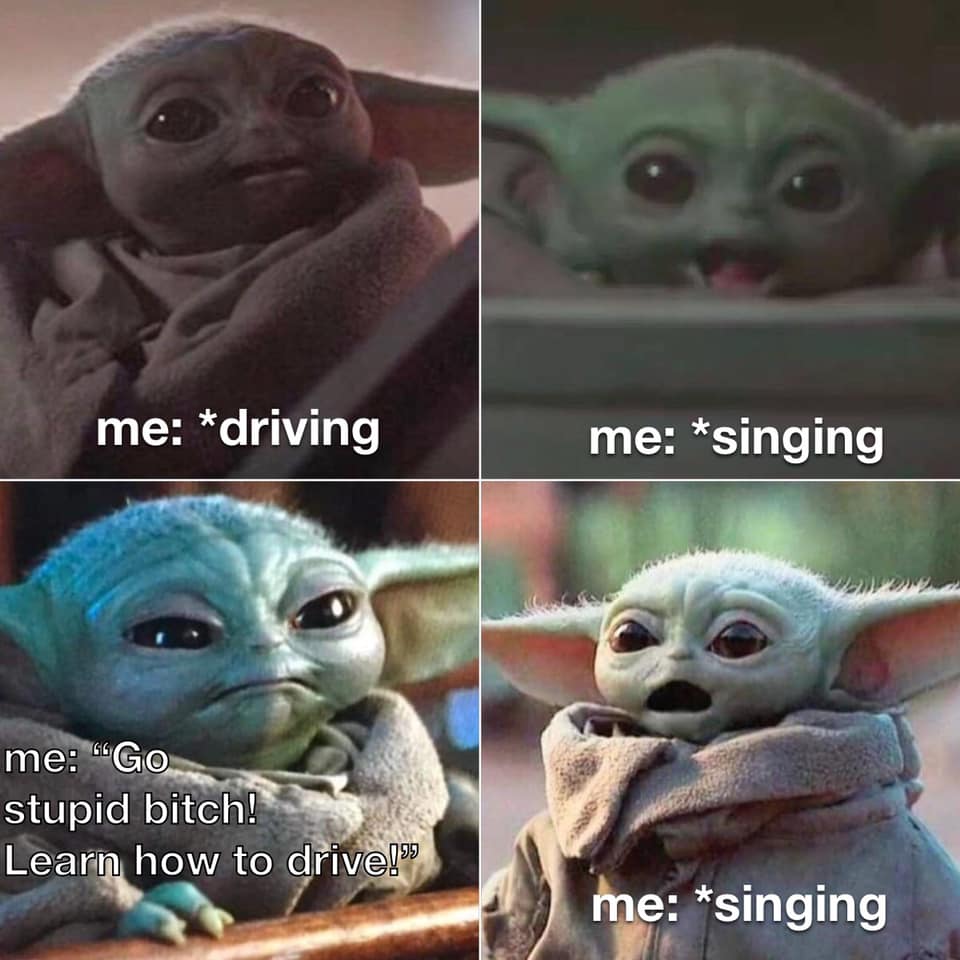
The image is a four-panel meme featuring different expressions of "Baby Yoda" (Grogu) from The Mandalorian. Each panel is labeled with an action/internal state.
- Top Left: Grogu looks intensely frustrated, eyes narrowed, and mouth slightly downturned. Label: “me: driving”
- Top Right: Grogu appears calm and serene, eyes open, and a small, neutral expression. Label: “me: singing”
- Bottom Left: Grogu looks absolutely furious, eyes widened, and mouth in a near snarl. A speech bubble reads: “Go stupid bitch! Learn how to drive!”
- Bottom Right: Grogu maintains a calm, serene expression like the top right panel. Label: “me: singing”
The overall style is humorous, utilizing the contrast between Grogu’s typically adorable appearance and the aggressive text in one panel to create comedic effect. The meme relies on the relatable frustration of driving (and potentially, projecting that frustration onto other drivers).
Foucauldian Genealogical Discourse Analysis
This meme reveals a discourse around skill, control, and subjectivity as it relates to driving. Foucault would ask: how has the concept of "good driving" been constructed through historical power dynamics? Driving is not a neutral activity. It's heavily regulated (licenses, laws, insurance) – meaning, power operates through its control of mobility and risk. The aggressive speech bubble ("Go stupid bitch! Learn how to drive!") represents a disciplinary power, attempting to enforce conformity to the perceived “correct” way to drive (i.e., competent driving that does not hinder others).
The contrast with singing suggests an escape from this disciplinary regime. Singing represents a realm of self-expression where the subject is not subject to the same rules of performance and control. The genealogy of this discourse would trace how driving became associated with responsibility, and conversely, how artistic/expressive activities like singing became associated with freedom and self-actualization. The speaker positions themselves as a subject exercising disciplinary power.
Critical Theory
The meme can be analyzed through a Critical Theory lens as a critique of modern societal pressures and the performance of competence. The frustration expressed while driving, and the aggressive projection of that frustration, is a symptom of alienation. The "driver" feels pressured to perform (drive competently), and when this performance is disrupted (by another driver), it triggers an outburst of rage.
This can be linked to the concept of a "culture of acceleration," where speed, efficiency, and control are highly valued. Any disruption to this flow is met with hostility. Singing, in contrast, represents a moment of respite from these pressures, a retreat into a more authentic, less performative space. The meme reveals how these pressures are internalized and manifested as interpersonal aggression.
Marxist Conflict Theory
This is a stretch, but we can try. From a Marxist perspective, the conflict could be interpreted as a microcosm of class struggle. The “bad driver” represents the working class – potentially seen as lacking the privilege of time, resources, or a well-maintained vehicle (all tied to capital). The enraged driver is a symbol of the bourgeoisie, feeling entitled to smooth, efficient travel (the fruits of their labor/privilege) and frustrated when this entitlement is disrupted by someone "below" them.
The singing represents a detachment from this class-based conflict, a temporary escape from the struggle for resources and control. This is a weak application, as the meme doesn’t explicitly address economic systems, but it attempts to frame the frustration as a manifestation of broader societal inequalities.
Postmodernism
The meme is a prime example of postmodern playfulness and irony. It deconstructs the seriousness of driving by juxtaposing it with the cute, innocent image of Grogu. The aggressive speech bubble is an intentionally jarring disruption of Grogu’s typical persona, creating a humorous and self-aware effect.
The meme also acknowledges the fragmented, subjective nature of experience. The contrast between driving and singing highlights how the same “self” can manifest different emotions and behaviors in different contexts. There's a meta-awareness in the meme – it knows it's silly and deliberately plays with expectations. The lack of a coherent narrative or moral message reinforces its postmodern sensibility.
Queer Feminist Intersectional Analysis
This is the most difficult application. While not explicitly addressing queer or feminist concerns, one could stretch the analysis by considering how societal expectations around performance and control are gendered. The rage expressed while driving could be linked to societal pressures on men to be assertive and in control, particularly in traditionally “masculine” spaces like roads. The aggressive speech (“Go stupid bitch!”) is a particularly hostile and potentially misogynistic outburst.
The singing, as a more vulnerable and expressive act, could be seen as a rejection of these rigid gender roles. However, it’s important to note that this reading is speculative and relies on an imposition of queer feminist concepts onto a meme that doesn’t explicitly address them. A true intersectional analysis would benefit from more context.
Hopefully, this detailed breakdown through various theoretical lenses provides a comprehensive analysis of the meme. Please let me know if you'd like me to elaborate on any particular section or theoretical framework.
simple-description (llama3.2-vision)
The meme is a humorous image featuring a character from the Star Wars franchise, Baby Yoda, with a shocked expression on its face. The text above the image reads "me: driving" and below it says "me: singing". The implication is that the person is shocked by their own singing, implying that they are a bad singer and are embarrassed by their own voice.
tesseract-ocr
ats seato LAA Ls) me: *singing he a i ig, OOO ae meee (ClO : 2 Yer , — ae: | TUTTI . List Ysa to drivel aia ay ate *singing ail nas | le