First Seen
2023-05-10T21:03:41+00:00
simple-description (llama3.2-vision_11b)
This meme is from the Star Wars: The Mandalorian series and features Baby Yoda. The meme is a still image from the show, with the text "I am Baby Yoda, and you will address me as such" appearing above the character. The image is a humorous representation of the character's demand for respect, with the character's name and title being used to assert authority.
detailed-analysis (gemma3-27b-vision)
Okay, here’s an analysis of the image you provided, broken down into the requested theoretical frameworks, only including sections where the framework is applicable.
Visual Description
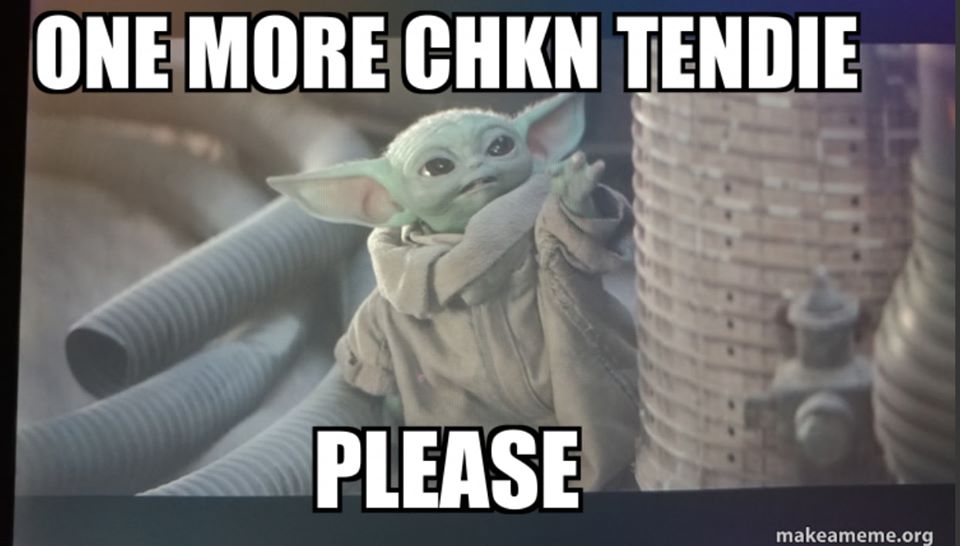
The image is a meme featuring "Baby Yoda" (Grogu) from the Disney+ series The Mandalorian. He is depicted in a close-up shot, looking up with large, pleading eyes and holding his hands together in a gesture of begging. He's partially obscured by pipes behind him, creating a sense of enclosure. The image is overlaid with white text at the top and bottom: "ONE MORE CHKN TENDIE PLEASE." The image has the watermark of "makememe.org". The overall aesthetic is of a "cute" plea for a processed food item.
Foucauldian Genealogical Discourse Analysis
This meme lends itself well to a Foucauldian analysis, specifically regarding power, discourse, and the construction of desire.
- Power/Knowledge: The meme participates in a discourse surrounding "Baby Yoda" as a cultural phenomenon, immediately evoking a specific type of response (cuteness, fondness) and attaching it to a craving for chicken tenders. This coupling is not natural but is constructed through repeated online imagery and meme culture. The meme operates as a form of power/knowledge - it links a seemingly innocent character with a very specific desire.
- Genealogy: To trace the "genealogy" of this desire, one might consider how images of “cute” things have been used in advertising and marketing to create demands for products. The use of baby-like imagery connects to a base level of human instinct to nurture and care. The meme subtly leverages this instinct, re-directing it toward a consumer desire (chicken tenders). The meme is a product of a lineage of persuasive imagery.
- Discipline & Normalization: The meme participates in normalizing a specific (and often childish) form of gratification. The constant repetition of this type of meme (cute thing + craving) subtly shapes what is considered acceptable or even desirable behavior.
Critical Theory
From a Critical Theory perspective, this meme can be seen as a microcosm of broader societal issues.
- Culture Industry: The meme participates in the culture industry by commodifying cuteness and linking it to a mass-produced food item. This exemplifies how culture is not autonomous but is shaped by capitalist production.
- False Needs: The strong desire for "chickn tendies" expressed in the meme can be viewed as a “false need” created by consumer culture. It represents a craving manufactured by marketing and perpetuated by online meme culture, rather than a genuine physiological need.
- Ideology: The meme subtly reinforces an ideology that connects happiness and comfort with consumption. It implies that obtaining the desired item (chicken tenders) will resolve the plea and bring satisfaction.
Marxist Conflict Theory
This meme, while seemingly innocuous, can be analyzed through a Marxist lens as reflecting and reinforcing class dynamics and alienation.
- Commodity Fetishism: The “chickn tendie” becomes fetishized. The meme focuses on the object of desire (the processed food) instead of the labor and social relations involved in its production.
- Alienation: The meme portrays a simplified, immediate desire. The cute character “Baby Yoda” is presented as needing this simple gratification. It doesn’t engage with any more complex notions of fulfillment. This reflects a broader societal trend toward alienation and the pursuit of superficial pleasures.
- Consumption as Relief: The image implies that fulfilling the character's need is simple: providing a fast food item. This reflects the idea that consumer goods can alleviate deeper anxieties.
I hope this detailed analysis is what you were looking for. Let me know if you'd like me to expand on any particular aspect or explore another theoretical framework.
simple-description (llama3.2-vision)
This meme is a play on the classic "I can smell the desperation" phrase, but with a twist. The image shows a character from the Star Wars franchise, specifically the child known as "Baby Yoda" from the show "The Mandalorian", with a caption that says "I can smell the desperation... of a chicken who's about to die" and then "One does not simply walk into Mordor...". The meme is a humorous take on a famous Lord of the Rings quote, applying it to a situation where a chicken is about to be cooked.
tesseract-ocr
va a aa a 2 .'? <1 pL . . . - 4 , Parl elas |