First Seen
2023-05-10T21:03:41+00:00
simple-description (llama3.2-vision_11b)
The meme is a humorous image of Baby Yoda from the Star Wars series, with a caption that pokes fun at Disney's financial success. The image shows Baby Yoda looking at a stack of money with a greedy expression, implying that the character is obsessed with wealth. The caption reads: "The CEO of Disney: 'We're making a lot of money from Baby Yoda, but I'm still not satisfied...'"
detailed-analysis (gemma3-27b-vision)
Okay, here's an analysis of the meme, broken down by the theoretical frameworks you requested. I will note where a framework doesn't meaningfully apply.
Visual Description
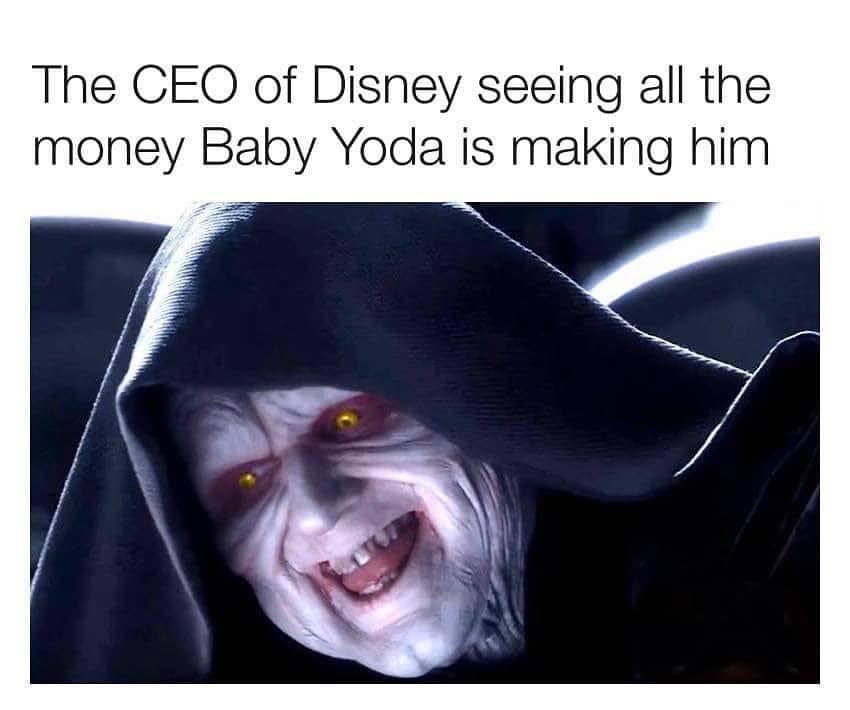
The image depicts Palpatine (Darth Sidious) from Star Wars. He is in a close-up shot, angled upwards, with his face partially obscured by the hood of his dark cloak. His skin is heavily wrinkled and pale, and his eyes glow a menacing yellow. He is displaying a disturbing, wide, toothy grin. The lighting is dark and dramatic, emphasizing his villainous appearance. Above the image is text reading, “The CEO of Disney seeing all the money Baby Yoda is making.” The composition deliberately evokes a sense of power, greed, and perhaps even predatory enjoyment.
---
Foucauldian Genealogical Discourse Analysis
This meme can be read through a Foucauldian lens by examining the discourse surrounding the production and consumption of “cuteness” and “nostalgia” in late-capitalist society, and how these discourses contribute to power structures.
- Genealogy: A genealogical approach would trace the history of “merchandise” and “branded character” back to early forms of commercialization. Disney, specifically, has a history of successfully building and controlling narratives around characters and monetizing nostalgia. Baby Yoda (Grogu) is a continuation of this tactic.
- Power/Knowledge: The meme suggests that Disney’s power isn’t just about having money but about the knowledge of how to manipulate consumer desire. They "know" how to manufacture cultural phenomena (like Baby Yoda) and then profit from the resulting "cuteness aggression." The CEO’s grin isn't simply about financial gain; it’s about the exercise of power over consumer culture.
- Discipline: Disney utilizes branding and a curated media presence to "discipline" consumer behavior, creating a need for products based on the Star Wars franchise.
The meme's effectiveness lies in its recognition of this dynamic: everyone understands that Disney is exploiting Grogu's popularity, and the meme finds humor in the intentionality of this exploitation.
---
Critical Theory
This meme aligns with critical theory, specifically relating to the culture industry.
- Commodification of Culture: The meme highlights how culture itself (in this case, a character from a beloved science fiction series) is commodified and used to generate profit. The CEO's grin can be seen as a representation of the ruthless logic of late capitalism, where everything, even “cuteness,” is reduced to exchange value.
- Mass Deception: The meme hints at the idea that Disney is perpetuating a form of mass deception by presenting narratives (like The Mandalorian) while simultaneously exploiting the emotional connection audiences have to those narratives for financial gain.
- Ideology: Disney’s control over this character and its marketing contribute to the reinforcement of consumerist ideology. The meme exposes this by implying that even the CEO finds a dark pleasure in the exploitation.
---
Marxist Conflict Theory
This meme is directly applicable to Marxist Conflict Theory.
- Class Struggle: The meme can be interpreted as a subtle commentary on class struggle. The CEO (representing the ruling class/capitalist class) is depicted as gleefully profiting from the labor (of those who created the show and merchandise) and the consumer desire (of the working class).
- Exploitation: The CEO's grin symbolizes the exploitation of both creative labor and consumer desire. Disney leverages the emotional investment of fans to generate massive profits.
- Commodity Fetishism: The meme subtly alludes to commodity fetishism – the attribution of value to the object (Grogu merchandise) rather than the labor that produced it. The meme invites the viewer to focus on the profit being made, highlighting the disconnect between value and labor.
---
Postmodernism
The meme exhibits aspects of postmodernism, but it isn't a strong fit.
- Hyperreality & Simulacra: Baby Yoda (Grogu) has become a simulacrum - a copy without an original. The character exists as much in the form of merchandise, memes, and internet culture as it does within the actual Mandalorian series.
- Irony and Parody: The meme itself is a form of ironic commentary on Disney's commercialization strategy. It simultaneously acknowledges the appeal of Baby Yoda while critiquing the corporation’s exploitation of that appeal.
- Deconstruction: The meme implicitly deconstructs the image of Disney as a benevolent storyteller, revealing the underlying economic motivations.
However, the meme isn't fully postmodern because it doesn’t necessarily question the existence of “truth” or meaning; it just critiques a specific economic practice. It's a critique within a recognizable context.
---
Queer Feminist Intersectional Analysis
This framework doesn’t meaningfully apply to the meme. While one could potentially read it through a lens of capitalism's impact on gendered labor, the meme itself doesn’t address issues of gender, sexuality, or intersectional oppression. There's no inherent aspect of the image or text that requires or lends itself to this particular analysis.
I hope this detailed breakdown is helpful! Let me know if you'd like me to expand on any particular aspect.
simple-description (llama3.2-vision)
This meme is a humorous image that juxtaposes the idea of a powerful and intimidating figure, Darth Sidious (also known as Emperor Palpatine), with the idea of being a "boss" who is only in it for the money. The text above the image reads, "The CEO of Disney: 'I'm not in this for the fans, I'm in it for the merchandising'". The image shows Darth Sidious from the Star Wars franchise, but with a Disney-themed twist, implying that the CEO of Disney is motivated by financial gain rather than a love for the fans or the art of filmmaking.
tesseract-ocr
The CEO of Disney seeing all the money Baby Yoda is making him /\ ame ee