First Seen
2023-05-10T21:03:41+00:00
simple-description (llama3.2-vision_11b)
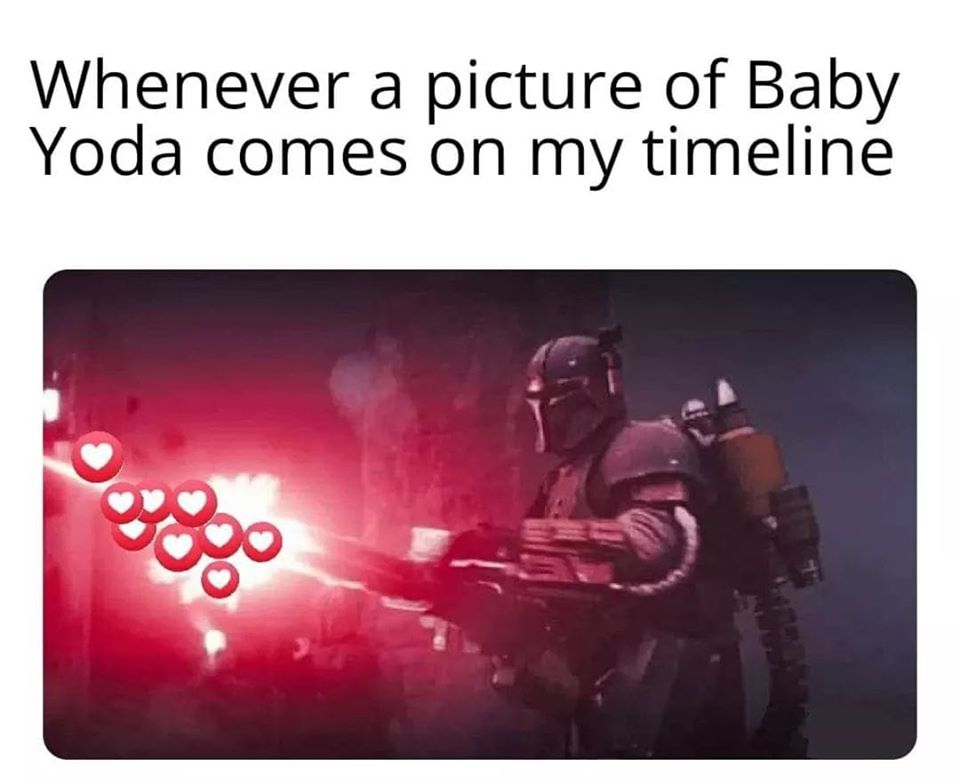
The meme is a screenshot from the Star Wars series "The Mandalorian" showing a character holding a small creature, nicknamed "Baby Yoda" or "The Child." The image is captioned "When you're trying to watch a show but it's just Baby Yoda this whole time" and includes a playful GIF of the character making a cute face.
detailed-analysis (gemma3-27b-vision)
Okay, let's break down this meme – a screenshot from The Mandalorian with a superimposed string of heart emojis – using the lenses you've provided. It's important to note that meme analysis is inherently multi-layered. Some lenses will be more relevant than others, and interpretations can be subjective.
1. Visual Description
The image is a screenshot from the Disney+ series The Mandalorian. It depicts the titular Mandalorian (Din Djarin) in a dynamic action pose. He is wielding a blaster rifle, likely in the midst of combat. The background is blurred and appears to be an interior space with reddish/orange lighting suggesting a firefight or conflict situation. Crucially, a string of bright pink/red heart emojis is digitally superimposed over the left side of the image, creating a stark contrast with the dark, gritty aesthetic of The Mandalorian. The juxtaposition is intentional, and the visual tension is part of the meme's humor. The screenshot showcases the Mandalorian protecting "Baby Yoda" (Grogu), who is out of view in this particular image.
2. Foucauldian Genealogical Discourse Analysis
This meme highlights the discourse surrounding "Baby Yoda" (Grogu) and its evolution. A Foucauldian approach would examine how the image of Grogu became so intensely beloved and its relationship to power.
- Genealogy: The initial 'cuteness' factor of Grogu drew attention. This was amplified by the way Disney/Lucasfilm strategically released images and focused on Grogu's expressions in marketing materials, creating a deliberate regime of visibility. This created a strong emotional response, effectively "weaponizing" cuteness.
- Discourse & Power: The heart emojis represent the overwhelming, often hyperbolic, emotional response. This response isn't natural; it's produced by a network of media, social media algorithms, and collective fan behavior. The meme acknowledges this production, presenting it as almost inescapable—"Whenever a picture of Baby Yoda appears…" This suggests a certain power dynamic: we think we're freely expressing affection, but are participating in a pre-structured, commercially-driven discourse.
- Normalization: The meme suggests a normalization of this intense, even obsessive, fandom. It's become expected, almost a default reaction.
3. Critical Theory
Applying Critical Theory (drawing from Frankfurt School thinkers like Adorno & Horkheimer) reveals how the meme is connected to the "culture industry" and the manipulation of emotion:
- Commodification of Affect: The heart emojis represent a commodification of emotion. Disney/Lucasfilm effectively sell the feeling of connection/protectiveness associated with Grogu. The meme points to the relentless bombardment of this imagery, creating a manufactured need for emotional fulfillment through consumption.
- Mass Culture & False Consciousness: The meme subtly critiques the ways mass culture can create a "false consciousness," where individuals accept pre-packaged emotional responses without critical reflection. We're so accustomed to being told what to feel about Grogu that the meme highlights the lack of genuine, independent emotional experience.
- Distraction: The intense focus on something as seemingly harmless as a cute character can be seen as a distraction from larger societal issues, reinforcing the status quo.
4. Marxist Conflict Theory
While not a central focus, Marxist analysis can identify elements of class and labor:
- The "Labor" of Fandom: The intensive emotional investment and engagement with Grogu can be seen as a form of cultural labor. Fans are actively producing content (memes, fan art, discussions) that contributes to the profitability of the Star Wars franchise.
- Commodification of Culture: The entire phenomenon of "Baby Yoda" and the associated merchandise reinforces the capitalist system by turning cultural phenomena into commodities. The heart emojis highlight the emotional investment that drives consumption.
5. Postmodernism
Postmodern themes are strongly present:
- Hyperreality & Simulation: The meme suggests that our experience of Grogu is increasingly mediated and simulated. The hearts aren’t about a genuine connection to a real being, but rather to an image of an image, constantly replicated and circulated online.
- Irony & Parody: The meme itself is inherently ironic. It acknowledges the absurdity of the overwhelming emotional response to a fictional character. The juxtaposition of the gritty, action-oriented image with the saccharine hearts creates a playful subversion.
- Fragmentation & Loss of Authenticity: The constant stream of images and the proliferation of memes contribute to a fragmented cultural landscape. The original meaning of the character is lost in a sea of reproductions.
6. Queer Feminist Intersectional Analysis
This is the least directly applicable lens, but some connections can be drawn:
- Performance of Affection: The display of heart emojis can be seen as a performance of affection, potentially aligning with queer theories of performativity (Judith Butler). The meme could be read as a commentary on the ways we publicly signal affection and the pressures to conform to certain emotional norms.
- Challenging Traditional Narratives of “Protectiveness”: The emphasis on protecting “Baby Yoda” may reflect larger discourses around caregiving and protection, and could be examined through a feminist lens to question traditional gender roles and expectations around care. However, this connection is rather tangential.
In conclusion, this seemingly simple meme is surprisingly rich in layers of meaning. It serves as a commentary on the power of media, the manipulation of emotion, the nature of fandom, and the fragmentation of contemporary culture. The different theoretical lenses offer diverse yet complementary perspectives on its significance.
simple-description (llama3.2-vision)
This meme features an image of a character from the Star Wars franchise, Boba Fett, holding a blaster and giving a thumbs up. The text above the image reads "When you're finally getting around to watching Star Wars". The meme is likely referencing the character's iconic "I am your father" line, but with a humorous twist, implying that Boba Fett is finally getting around to watching the Star Wars movies, which is a common joke among fans.
tesseract-ocr
Whenever a picture of Baby Yoda comes on my timeline x) < , ca