First Seen
2024-02-02T03:21:53.429619+00:00
simple-description (llama3.2-vision_11b)
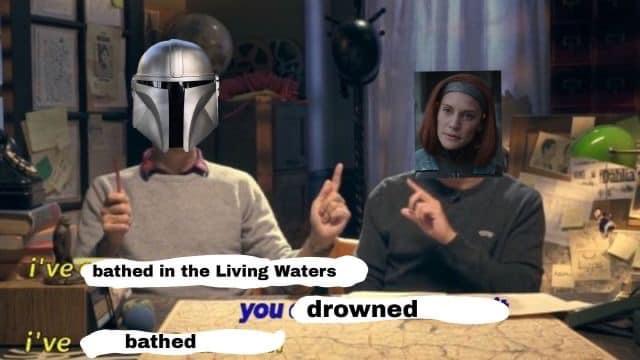
This meme is from the Star Wars - Baby Yoda Show category and is a humorous take on a popular song. The image features two characters from the show, The Mandalorian and Baby Yoda, in a comedic scene, with the caption "I've been bathing in the swamp, but you've been bathing in the swamp, and I've been bathing in the swamp, but you've been bathing in the swamp" referencing the song "Bathwater" by No Digs, but with the lyrics changed to reference the Star Wars character's swampy environment.
detailed-analysis (gemma3-27b-vision)
Okay, let's break down this meme using the requested theoretical lenses.
Visual Description
The image depicts a screenshot from a talk show, likely a podcast or interview setting. On the left is the Mandalorian (Din Djarin) from The Mandalorian TV series, superimposed onto the body of a man seated in a chair. He’s wearing his helmet and a button-up shirt. Opposite him is a talking head of Lizzo, looking directly at the viewer. A text bubble and labels are overlaid onto the image. The text bubble placed between them states "I've bathed in the Living Waters" with a "you drowned" below it. A similar label with only the word "bathed" is below the Mandalorian. The overall effect is a humorous juxtaposition of characters and a clear format for a "this vs. that" meme.
Foucauldian Genealogical Discourse Analysis
This meme presents an interesting point for a Foucauldian analysis. It centers around “Living Waters,” which can be understood as a discourse regarding spiritual or personal rejuvenation. Within the context of the image, a figure representing a strict adherence to a code (the Mandalorian) claims to have engaged with this discourse successfully (“I’ve bathed…”) while positioning another (represented by Lizzo) as failing to truly partake in, or being overpowered by, it (“you drowned”).
The genealogy would explore the historical emergence of this discourse around self-improvement, spirituality, or self-care, and how power relations shaped it. The claim of having "bathed" and the judgment of "drowned" creates a power dynamic where the speaker defines the correct way to engage with this discourse. The Mandalorian, representing a rigid adherence to a traditional belief system, positions himself as an authority on "proper" engagement, implicitly invalidating another’s experience. It's a micro-power struggle expressed through the framework of spiritual or personal growth.
Critical Theory
From a Critical Theory perspective, the meme critiques the often-unacknowledged power dynamics embedded within self-help/spiritual discourses. The meme subtly challenges the idea that personal transformation is a neutral process. Instead, it suggests that these discourses can be used to establish hierarchies and reinforce social norms.
The Mandalorian, as a figure representing tradition and a specific code of conduct, embodies a restrictive form of power. His claim to have "bathed" in the Living Waters, while simultaneously judging another's experience ("drowned"), suggests that true transformation is only possible within a predefined set of rules. Lizzo, often representing body positivity, self-love, and embracing individuality, is positioned as outside those rules, therefore failing to achieve the desired outcome. The meme hints that this judgement is arbitrary and serves to uphold a specific power structure.
Postmodernism
The meme is inherently postmodern. It utilizes pastiche by combining imagery from different sources—The Mandalorian and Lizzo—into a new, unexpected context. It embraces irony and parody by contrasting the stoic Mandalorian with the vibrant Lizzo. It questions grand narratives about self-improvement and spiritual journeys. There's no single, authoritative meaning; the humor arises from the unexpected combination and the subjective interpretation of the contrast. The meme highlights the fragmented and deconstructed nature of contemporary culture. There is no intrinsic meaning, only the meaning that the interpreter gives it.
Queer Feminist Intersectional Analysis
This is where the meme gains another layer of complexity. Lizzo's image is significant. She is a Black, plus-size artist who actively challenges beauty standards, promotes body positivity, and embraces self-love. In contrast, the Mandalorian embodies a historically masculine, rigid, and often militaristic aesthetic.
The meme, viewed through a Queer Feminist lens, can be seen as a micro-aggression or a way of silencing marginalized voices. The "you drowned" comment suggests that Lizzo’s approach to self-care and empowerment is invalid or lesser than the Mandalorian's (implicitly conservative) approach. The implicit message is that to be truly "saved" or "rejuvenated," one must conform to a particular (and often patriarchal) standard.
The meme exposes how discourses around self-improvement are often implicitly shaped by societal biases and expectations. It highlights the ways in which marginalized groups are often held to different standards and are denied the space to define their own experiences of healing and transformation. The intersection of race, gender, body size, and cultural identity all contribute to the power dynamics at play in the meme.
Disclaimer: This is an interpretation, and the meaning of a meme is always open to individual interpretation. However, these theoretical frameworks provide a lens through which we can examine the subtle power dynamics and cultural critiques embedded within this image.
simple-description (llama3.2-vision)
This meme is a humorous take on the "I'd like to thank the Academy" acceptance speech, where a character from the Star Wars franchise, Boba Fett, is shown giving a speech in a parody of the Oscars. The text "I'd like to thank the Academy" is replaced with "I'd like to thank the galaxy" and then "I've... bathed... in the... Living... Waters... you... DROWNED...".
tesseract-ocr
@ ‘ ' : : | < (| f. 1 MM ea Sy ~ mg ‘ g- Nie) Ss b 6 ‘a e val: FRZex bathed in the Living Waters es a ~ os i you drowned ae bathed : =