First Seen
2023-05-10T21:03:41+00:00
simple-description (llama3.2-vision_11b)
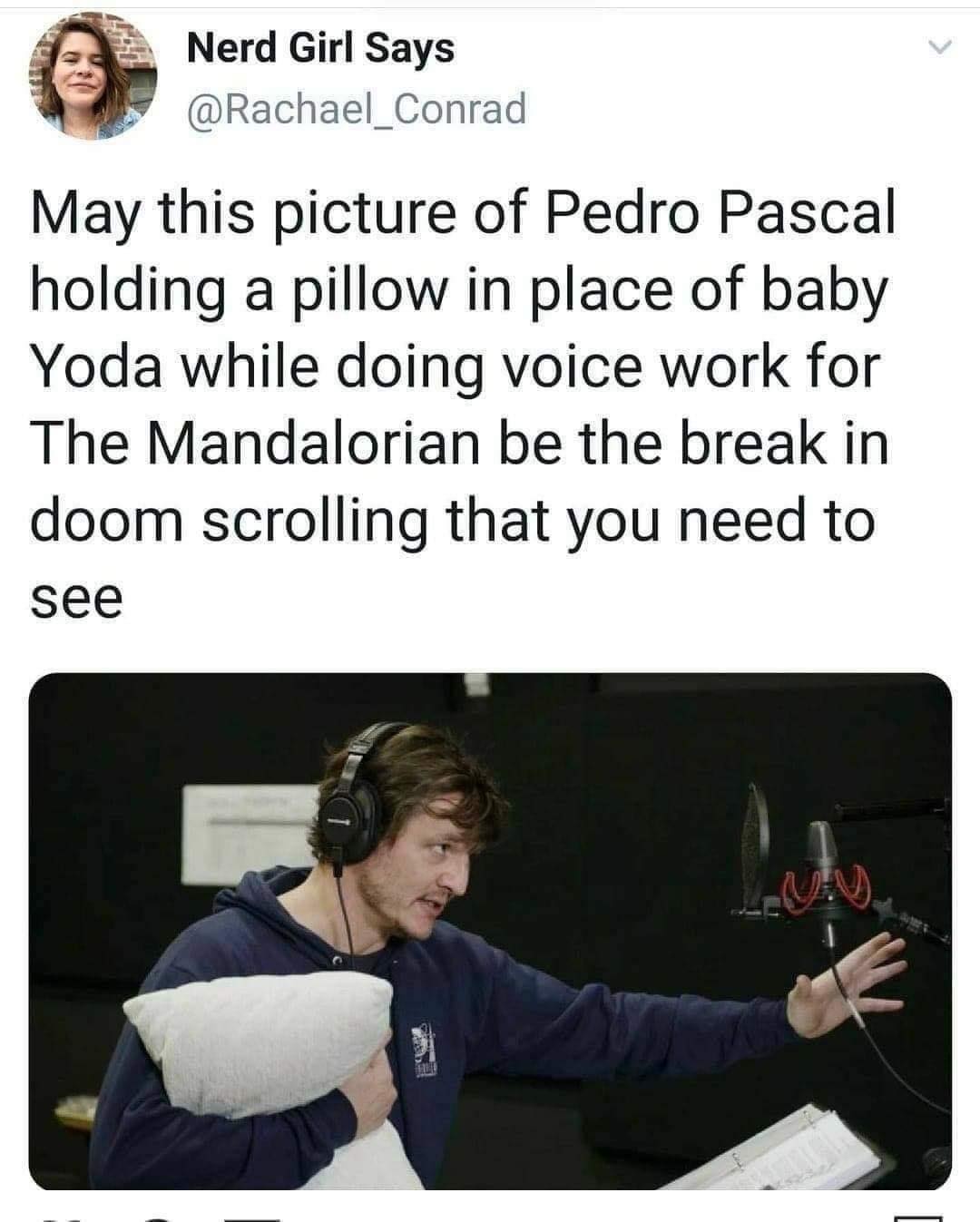
The meme is a screenshot from a Star Wars: The Mandalorian TV show, where a character (The Child, also known as Baby Yoda) is sitting in the lap of The Mandalorian, holding a pillow. The caption reads: "When you're trying to watch The Mandalorian but Baby Yoda is just being Baby Yoda."
detailed-analysis (gemma3-27b-vision)
Okay, here's an analysis of the image and the tweet, broken down into the requested theoretical lenses, only where applicable. It's important to acknowledge that applying these frameworks can sometimes be a stretch, and the strength of the analysis depends on the suitability of the framework to the specific content.
I. Visual Description
The image is a candid shot of actor Pedro Pascal in a recording studio, presumably while voicing the character of "Grogu" (Baby Yoda) for the Disney+ series The Mandalorian. He is wearing a dark hoodie and large studio headphones. His eyes are closed in concentration, and his mouth is open, suggesting vocal exertion. His left hand is holding a small, cream-colored pillow, which seems to be acting as a stand-in for Grogu. The studio setting is visible in the background, including a microphone, monitors, and recording equipment. The lighting is fairly flat, typical for a studio environment. The image is captured mid-action, conveying a sense of authenticity and spontaneity. The tweeter's caption suggests this is a particularly poignant or impactful moment of insight.
II. Foucauldian Genealogical Discourse Analysis
This framework is quite relevant, albeit subtly.
- Discourse & Power: The image itself is a discourse about the production of The Mandalorian and how "cuteness" (Grogu) is manufactured. The power dynamics are interesting. Pascal, the actor, is positioned as performing labor for a digital, commodified “child.” The pillow, functioning as a proxy for Grogu, highlights that the emotional labor of performing the voice is being directed towards a non-existent entity, constructed for audience consumption. The image participates in the wider discourse around Disney's ability to manufacture nostalgia and affection through intellectual property.
- Genealogy: A genealogical approach would ask: How did the idea of an actor needing a "stand-in" for an adorable, digitally created character come about? It's a relatively new phenomenon linked to the rise of CGI/visual effects-heavy productions and the demand for convincing emotional performances even when interacting with non-physical entities. It traces the shift from direct acting against another human to performing for a digital creation.
- Disciplinary Power: While less direct, the expectation that Pascal needs this physical stand-in, even if self-imposed, reflects a form of self-discipline tied to professional standards. He's internalizing the expectation to perform “authenticity” and empathy, even when the object of that empathy is entirely constructed.
III. Postmodernism
This is a strong fit, as the image encapsulates several key postmodern themes:
- Simulacra and Simulation: The pillow is the simulacrum of Grogu. It's a copy without an original, and Pascal is interacting with the copy as if it were real. The image highlights the increasingly blurred lines between reality and representation in modern media production.
- Hyperreality: The experience of watching The Mandalorian itself is hyperreal – it’s more real than real, enhanced through special effects and emotional manipulation. Pascal’s interaction with the pillow is part of that process, contributing to the hyperreal effect.
- Deconstruction of Authenticity: The image deconstructs the notion of an actor’s “authentic” connection with their character. The pillow reveals that the emotional performance is being constructed, aided by a manufactured prop.
IV. Critical Theory
- Commodification of Affect: The image highlights the increasing commodification of emotions in late capitalism. Pascal is performing emotional labor, directed towards a digital character, for the purpose of generating profit for Disney. The "cuteness" of Grogu, facilitated by Pascal's performance, is a commodity sold to audiences.
- Alienation: The image hints at a sort of alienation. The actor is engaging with something that is not a living being. This highlights the separation of the worker from the product of their labor.
V. Queer Feminist Intersectional Analysis
This lens is less directly applicable, but we can explore some angles:
- Care Work and Labor: The act of holding the pillow, of providing a “stand-in” for an infant-like character, speaks to traditionally feminized care work. While Pascal is male, the image touches upon the emotional labor of nurturing and providing comfort—labor that is often undervalued and assigned to women. The image implicitly asks, what emotional labor is being done here, and who benefits from it?
- Deconstructing "Childhood": Grogu is a character designed to evoke maternal/paternal instincts. The pillow is a stand-in for childhood and reliance. This image destabilizes that trope.
VI. Marxist Conflict Theory
- Means of Production: Disney owns the means of production (the studio, the technology, the intellectual property). Pascal is a worker within that system, contributing his labor to create a product that generates profit for the owners of capital.
- Exploitation of Labor: While Pascal is likely well-compensated, the image implicitly highlights the extraction of value from his creative labor. The emotional performance he's providing is being transformed into a commodity sold to consumers.
In conclusion, the seemingly simple image of Pedro Pascal holding a pillow is surprisingly rich in theoretical implications, particularly when viewed through the lenses of postmodernism, Foucauldian discourse, and critical theory. It reveals the complexities of media production, the commodification of emotions, and the blurring lines between reality and representation in the digital age.
simple-description (llama3.2-vision)
The meme is a picture of Pedro Pascal, an actor known for his roles in Game of Thrones and The Mandalorian, but in this image, he's sitting in a chair with a pillow, and a sign on the wall reads "I'm not here, I'm in space".
tesseract-ocr
G-¥= Nerd Girl Says ‘ae’ = @Rachael_Conrad May this picture of Pedro Pascal holding a pillow in place of baby Yoda while doing voice work for The Mandalorian be the break in doom scrolling that you need to see <a \\ “ : _ P