First Seen
2023-05-10T21:03:41+00:00
simple-description (llama3.2-vision_11b)
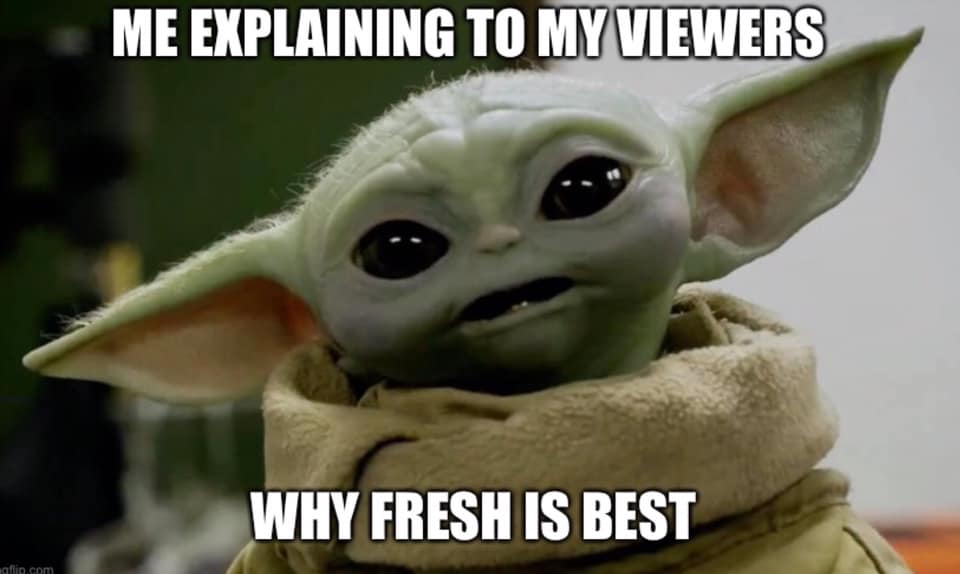
The meme features Baby Yoda from the Star Wars series, looking unimpressed as if to say "I have spoken." The text overlay reads, "I have spoken" in a quote bubble. The image is a humorous take on the character's famous line, implying that even Baby Yoda is tired of explaining things to others.
detailed-analysis (gemma3-27b-vision)
Okay, let's break down this meme through various theoretical lenses.
Visual Description
The image features “Baby Yoda” (Grogu) from the Disney+ series The Mandalorian. He's portrayed in a close-up shot, looking directly at the viewer with a slightly quizzical and somewhat condescending expression. His large eyes and slightly downturned mouth create a sense of “I'm explaining something obvious to you” feeling. The image is captioned with “ME EXPLAINING TO MY VIEWERS WHY FRESH IS BEST”. The visual language leverages a recognizable, and often beloved, pop culture figure to convey a relatable, slightly self-deprecating sentiment about explaining preferences or expertise to an online audience.
Foucauldian Genealogical Discourse Analysis
This meme is fascinating when viewed through a Foucauldian lens. The statement "WHY FRESH IS BEST" isn't inherently about actual freshness (of food, ideas, etc.). Instead, it can be understood as a power dynamic. The meme creator, by aligning themselves with the figure of Grogu (now a cultural icon representing a certain type of knowing/expertise), positions themselves as a discursive authority on what constitutes "best."
The very concept of “freshness” is a discourse – a system of knowledge and practices that creates meaning. Historically, “fresh” has been linked to health, purity, and naturalness, often contrasted with the “stale” or “decayed” – ideas imbued with moral and social valuations. This meme utilizes that pre-existing discourse, but playfully subverts it. It’s not necessarily a serious claim about freshness, but rather a declaration of authority on a subjective preference.
The genealogy would look at how the idea of "freshness" as a marker of quality developed. How did marketing, health movements, and cultural norms come to link "fresh" with value? The meme relies on this historically constructed understanding to operate.
Critical Theory
From a Critical Theory perspective (particularly drawing on the Frankfurt School), the meme points to the culture industry and its role in shaping preferences. The image relies on a mass-produced, hyper-visible pop culture phenomenon (Baby Yoda) to convey a message. This highlights how our tastes, even seemingly personal ones, are increasingly shaped by commercially driven images and narratives.
The "best" here is not determined by inherent quality, but by what is presented as best through media saturation. The meme creator is acknowledging their participation in a cycle of persuasion, playfully acknowledging their power (however small) to influence viewers.
Marxist Conflict Theory
While less direct, there is a subtle reading possible through a Marxist lens. The meme creator's role as an “expert” declaring "WHY FRESH IS BEST" can be seen as a micro-level representation of the broader power structures that dictate value. Who gets to define what is "best" often aligns with those who have access to platforms and audiences.
The meme also implicitly highlights the concept of cultural capital. The creator is leveraging their knowledge of pop culture and internet trends (Baby Yoda, the meme format) to connect with and influence their viewers. Those who don’t understand or appreciate these cultural references might be excluded from the conversation, subtly reinforcing existing social hierarchies.
Postmodernism
This meme embodies several key Postmodern traits.
- Irony & Self-Referentiality: The meme is knowingly playful and acknowledges the absurdity of declaring a subjective preference as objective truth.
- Intertextuality: It relies heavily on pre-existing cultural references (Baby Yoda, meme format) and remixes them.
- Deconstruction of Authority: It subverts the idea of the "expert" by pairing it with a lovable but fundamentally innocent character. The authority is presented as slightly tongue-in-cheek.
- Rejection of Grand Narratives: There’s no underlying universal truth being presented. "Fresh is best" is simply a personal preference, highlighting the rejection of objective standards.
Queer Feminist Intersectional Analysis
This is the hardest lens to apply directly. However, we can consider how online spaces, like those where this meme circulates, can be sites of both empowerment and exclusion. The creator is asserting themselves and their preferences within a digital community, potentially challenging dominant norms (depending on what “fresh” refers to).
The meme, however, could also perpetuate exclusionary practices if “fresh” is a code for certain tastes or aesthetics that marginalize others. Intersectional analysis would require understanding the specific context in which the meme is shared and how it interacts with broader power dynamics related to gender, sexuality, race, and other identity categories.
In a broader sense, the meme can be seen as a commentary on the performativity of expertise online. The creator is performing the role of an expert, and this performance is shaped by gendered expectations and norms related to online self-presentation.
Hopefully, this breakdown provides a thorough analysis of the meme through various theoretical lenses! Let me know if you’d like me to elaborate on any of these perspectives.
simple-description (llama3.2-vision)
The meme is a picture of a cartoon character (Baby Yoda) with a surprised expression. The text at the top of the image reads "I'm trying to explain a complex topic to my audience" and the text at the bottom reads "They just want to know why I'm eating a sandwich."
tesseract-ocr
ME EXPLAINING TO MY|WIEWERS: _ Why STS LAY \