First Seen
2025-05-23T22:39:39.607091+00:00
detailed-analysis (gemma3_27b-it-q8_0)
Okay, let's dissect this meme, deeply rooted in the Andor series of Star Wars, utilizing the lenses you've requested. This is a surprisingly rich image for theoretical analysis!
Visual Description
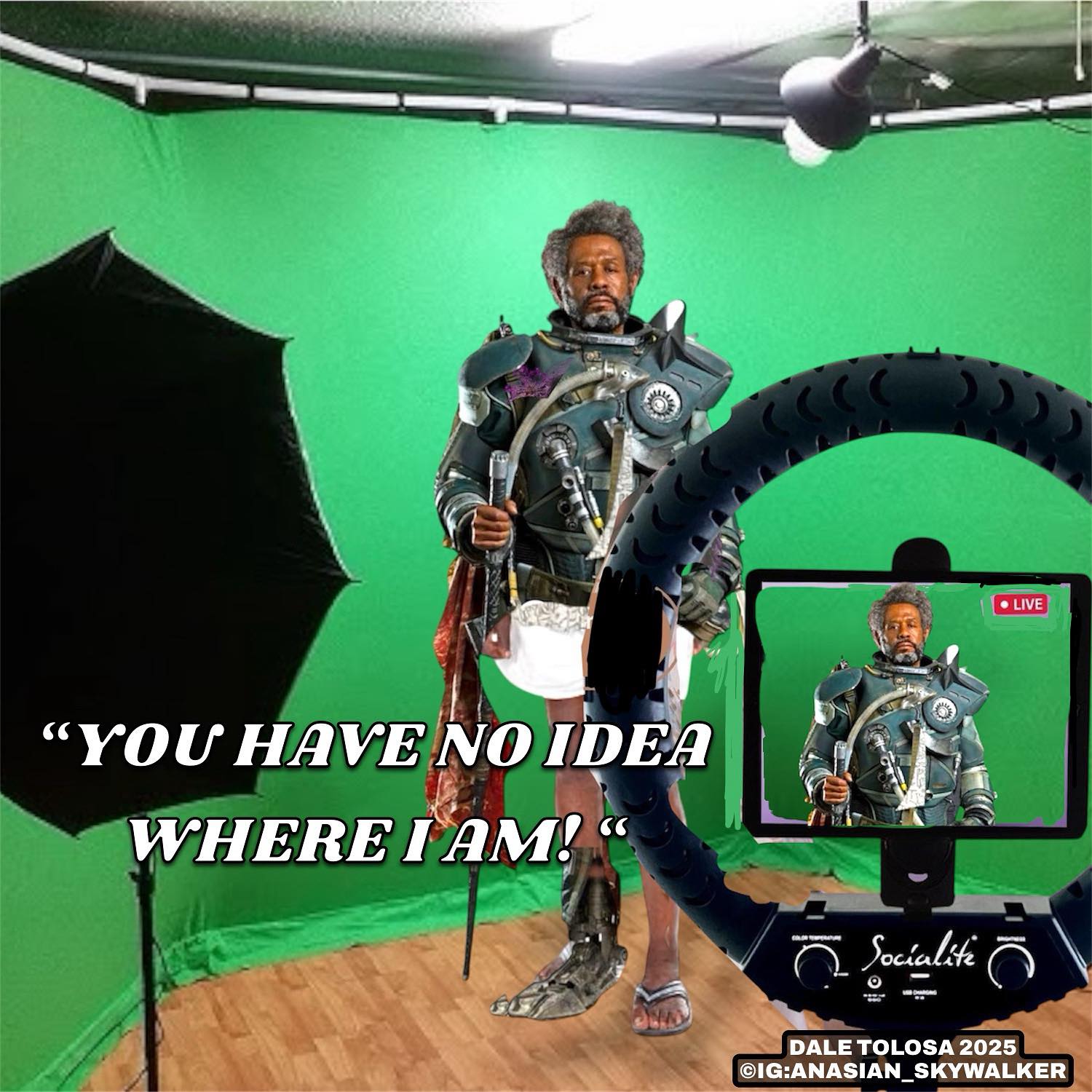
The image depicts Luthen Rael (Stellan Skarsgård), a key character from Andor, standing in what's clearly a green screen/film set environment. He’s dressed in his distinctive, subtly wealthy and imposing attire – a mix of civilian clothes and rebel-affiliated garb. He’s looking directly at the viewer with an intense, almost challenging expression. To his right, a screen displays a mirrored image of himself (presumably a camera feed). Overlaid on the image is the text “YOU HAVE NO IDEA WHERE I AM!” The bottom of the image has branding/watermarks for "Socialite" and an Instagram handle @igianasianskywalker. The entire setup underscores the artifice of filmmaking but more importantly, the character's carefully constructed persona and the layered reality he operates within. The lighting is professional studio lighting, emphasizing the constructed nature of this encounter.
---
Foucauldian Genealogical Discourse Analysis
This meme speaks directly to Michel Foucault's ideas about power, knowledge, and discourse. Luthen’s line ("You have no idea where I am!") isn’t just a geographical statement; it's an assertion of incommensurable power and knowledge.
- Discourse & Power: Luthen operates within a secret network, a complex web of rebellion against the Empire. He controls information, he shapes narratives. The phrase embodies his position as someone who understands the hidden architecture of the galaxy – the true power dynamics – in a way others (including the "viewer" being addressed) simply cannot. His ‘where’ is not just a location, but a position within this discourse of resistance.
- Genealogy of Rebellion: Foucault's genealogical method seeks to trace the historical origins of present-day concepts. The meme highlights the messy, often morally ambiguous origins of the Rebel Alliance. Luthen's character isn't a heroic figure in the traditional sense; he’s a pragmatist who makes deeply uncomfortable choices. The meme's popularity arises because it acknowledges the complexity of rebellion and that the lines are blurred. Luthen is not just fighting against the Empire, he's creating a different kind of power structure through his actions, a discourse that is itself potentially oppressive.
- Panopticism/Surveillance: While not explicit in the image, Andor heavily explores themes of surveillance and control. The film set itself, with the camera feed, is a subtle nod to panoptic power—the idea that the possibility of being watched is enough to self-regulate behavior. Luthen, the master manipulator, is shown within that system, but also controlling aspects of it.
---
Critical Theory (Frankfurt School)
The meme taps into the disillusionment and alienation central to Critical Theory.
- Culture Industry & Authenticity: The image of Luthen in a studio exposes the “manufactured” nature of the Star Wars universe. It breaks the illusion. Critical theorists like Adorno and Horkheimer argued that the culture industry creates standardized products that stifle individual thought. This meme is self-aware of that process. It's a meta-commentary on the commodification of rebellion.
- Instrumental Reason: Luthen embodies instrumental reason – his actions are calculated, driven by strategic goals, not moral ideals. He uses people as tools. The meme’s resonance comes from recognizing the cold, pragmatic logic underlying even seemingly noble causes. He’s willing to sacrifice to achieve his aims, questioning the supposed objectivity and impartiality of ‘good’ vs ‘evil’.
- Loss of Aura: Walter Benjamin’s concept of aura—the unique presence of an artwork—is arguably diminished here. The green screen, the mirroring, and the meme format all strip away the mystique of the character, presenting him as a construction. This loss of aura reflects a broader sense of alienation in modern society.
---
Marxist Conflict Theory
Andor is deeply concerned with class conflict and the economic underpinnings of the Empire’s power. This meme reflects that:
- Class Consciousness: Luthen represents a different kind of rebel than the idealistic young pilots often depicted in Star Wars. He’s wealthy, he’s connected, and he understands how power operates at the highest levels. He is almost a bourgeois rebel, manipulating the revolution to serve his goals. The meme implies he sees those who don’t understand the true workings of the galaxy as naive and unaware of the inherent class structures.
- Ideology and False Consciousness: The Empire maintains its power through ideological control—convincing people that its rule is legitimate. Luthen's statement (“You have no idea where I am!”) suggests he is operating outside that ideological framework, seeing the truth of the Empire's exploitation.
- Material Conditions: The entire rebellion in Andor is predicated on material resources – funding, weapons, intelligence. Luthen, as a financier, is central to this. His power isn’t just ideological; it’s rooted in his control over resources.
---
Postmodernism
Andor and the meme lean into several postmodern tropes:
- Meta-narratives & Deconstruction: Star Wars has traditionally relied on grand, overarching narratives (good vs. evil). Andor actively deconstructs these narratives, revealing the gray areas, the compromises, and the moral ambiguities. The meme is a product of this deconstruction—it challenges the simple heroic narrative.
- Simulacra & Hyperreality: The film set emphasizes the idea of simulacra – copies without originals. The galaxy far, far away itself can be seen as a simulation, a constructed reality. The meme points to this blurring of lines between reality and representation. We’re watching a constructed image of a constructed character, commenting on a constructed narrative.
- Irony and Self-Reflexivity: The image doesn't take itself overly seriously. The meme format adds a layer of irony, acknowledging the artificiality of the entire enterprise.
In conclusion:
This seemingly simple meme is a powerful encapsulation of Andor’s thematic depth. It's not just a celebration of a cool character, but a statement about power, knowledge, representation, and the complexities of resistance. The meme's popularity stems from its ability to tap into these themes in a concise and readily shareable format. It's a testament to the show's success in moving beyond traditional Star Wars tropes and engaging with more sophisticated theoretical ideas.
simple-description (llama3.2-vision_11b)
This meme is from the Star Wars series "Andor" and features a character, Luthay, played by Adria Arjona, in a humorous situation. The image shows Luthay in a comedic pose, and the text "You have no idea where I am" is written on the screen. The meme is likely referencing a scene from the show where Luthay is trying to explain her location to someone, but the text is a humorous take on the situation.
detailed-analysis (gemma3-27b-vision)
Okay, here's an analysis of the image, broken down into sections as requested. Not all categories will apply, but I'll cover those that seem most relevant.
Visual Description
The image depicts actor Clarke Peters dressed in the costume of a character from the game Destiny 2 – Commander Zavala. He stands in what appears to be a green screen studio, surrounded by lighting equipment and a large black reflector. In the foreground is a smartphone and tablet displaying a looped screenshot of Zavala from the game on a live-streamed platform. The tablet reads "Socialite" at the bottom. Text overlays the image: “YOU HAVE NO IDEA WHERE I AM!” and "@IG:ANASIAN_SKYWALKER, DALE TOLOSA 2025". The lighting and studio set up suggests a production or content creation context. Peters, as Zavala, poses powerfully, maintaining a strong, authoritative stance. The combination of the actor in costume with the digital representation on the devices creates a layering of reality and virtuality.
Foucauldian Genealogical Discourse Analysis
This image is ripe for Foucauldian analysis, particularly relating to power, knowledge, and representation. The central quote, "YOU HAVE NO IDEA WHERE I AM!" speaks to a disruption of perceived boundaries, a reclaiming of agency, and potentially a challenge to controlling narratives. Consider the following:
- Discourse of Gaming & Celebrity: The image exists within the discourse of gaming, cosplay, and celebrity culture. It demonstrates how identity, even as a fictional character, can be constructed, curated, and performed through digital media. The looped screenshot of Commander Zavala shows how the character itself exists and is disseminated.
- Power/Knowledge Relationship: Clarke Peters, as the actor embodying Zavala, wields a certain power derived from both his acting skill and the pre-existing cultural weight of the character. The looped game footage shows a pre-established discourse of the character; the actor is in a power position in being able to subvert that discourse.
- Genealogy of Zavala: A genealogical analysis would trace the evolution of Commander Zavala's character from its initial creation within the game to its current representation. This would involve examining how the character's meaning, symbolism, and power have shifted over time.
- Control and Discipline: The looped screenshot on the digital devices hints at a panoptic-like control. The audience is simultaneously seeing and being seen – they are part of a network of digital surveillance and consumption.
Postmodernism
The image is deeply embedded in postmodern aesthetics and themes:
- Blurring of Reality and Simulation: The stark juxtaposition of Clarke Peters (real actor) and the looped digital image of his character creates a deliberate blurring between reality and simulation. It asks the viewer to question what is "authentic" and what is constructed.
- Intertextuality: The image is heavily reliant on intertextuality. It requires knowledge of the game Destiny 2, Clarke Peters’ work, and the conventions of social media streaming to fully understand its meaning.
- Meta-Narrative: The image operates as a meta-narrative – a commentary on the nature of representation, identity, and performance. It's not just about a character, but about the act of embodying a character and the meaning of that embodiment in a digital context.
- Pastiche & Irony: The image can be seen as a form of pastiche, combining elements of gaming, celebrity culture, and social media. There's a playful irony in the actor presenting a looped screenshot of himself as the character.
Critical Theory
This image can be explored through the lens of critical theory, specifically focusing on the concept of spectacle and media representation:
- The Spectacle: The image itself is a spectacle—a carefully constructed performance designed to attract attention and generate engagement. The lighting, the studio setting, the layering of images, all contribute to the creation of a visually arresting scene.
- Commodity Fetishism: While not directly evident, the image can be linked to the commodification of identity. Clarke Peters, as a celebrity, and Commander Zavala, as a game character, are both commodities that are consumed by audiences.
- Hegemony & Resistance: The quote "YOU HAVE NO IDEA WHERE I AM!" could be interpreted as an act of resistance against dominant narratives. It challenges the audience to question their assumptions and perceptions of the actor, the character, and the surrounding context.
Queer Feminist Intersectional Analysis
While not the primary focus of the image, a queer feminist intersectional analysis can offer some interesting insights:
- Performance of Identity: The image highlights the performative nature of identity. Both Clarke Peters and Commander Zavala are constructed roles that are enacted within specific social and cultural contexts. The act of inhabiting a character can be seen as a form of gender and/or racial performance.
- Representation & Power: Considering Clarke Peters is a Black actor, his portrayal of a powerful figure like Commander Zavala is a significant act of representation. His presence disrupts traditional power dynamics and challenges stereotypical portrayals of Black men in media.
- Digital Spaces & Identity: The use of social media and streaming platforms adds another layer of complexity. These digital spaces are often sites of both empowerment and oppression for marginalized groups. Examining how Clarke Peters is using these platforms to reclaim his agency and disrupt dominant narratives could be a fruitful area of analysis.
Let me know if you'd like me to elaborate on any of these points or explore other theoretical frameworks!
simple-description (llama3.2-vision)
The meme is a photo of a person dressed as a Stormtrooper from the Star Wars franchise, but with a twist: they're wearing a "I'm with stupid" t-shirt, a humorous reference to a classic 80s meme. The image is captioned "I'm with stupid" in a playful nod to the original meme. The overall effect is a lighthearted and humorous take on the classic meme.