First Seen
2023-10-06T20:23:23+00:00
simple-description (llama3.2-vision_11b)
This meme is from the Star Wars category, specifically referencing the character Ahsoka. The meme is a humorous take on the character's personality, with the text "I find your lack of faith disturbing" rewritten as "I find your lack of reading disturbing". The image likely features a screenshot of Ahsoka's face, with the rewritten text overlaid on top.
detailed-analysis (gemma3-27b-vision)
Okay, let's break down this meme through the requested theoretical lenses.
Visual Description
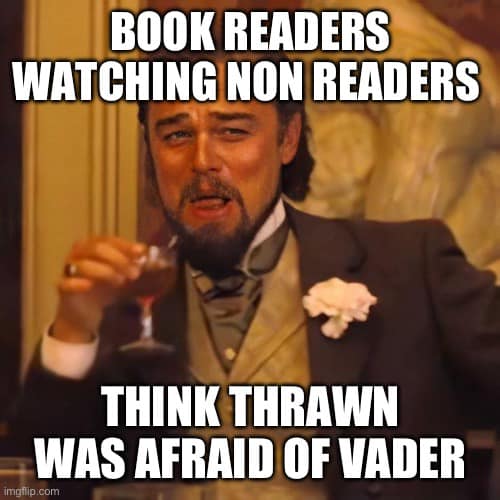
The meme features a still image of Leonardo DiCaprio as Jay Gatsby from The Great Gatsby (2013). Gatsby is depicted in a formal setting – likely one of his lavish parties – wearing a dark suit, waistcoat, and white shirt. He's holding a glass (presumably champagne) and looking with a somewhat condescending, amused, and slightly pained expression at something (or someone) off-camera. The text overlaid on the image reads "BOOK READERS WATCHING NON READERS THINK THRAWN WAS AFRAID OF VADER." This points to a niche understanding of Star Wars lore.
Foucauldian Genealogical Discourse Analysis
This meme creates a miniature "discourse" around literary/fandom knowledge and superiority. Foucault would likely be interested in how knowledge about characters like Grand Admiral Thrawn and Darth Vader has become a marker of a particular "truth regime" or power structure. The meme implies that understanding the power dynamics between Thrawn and Vader (in expanded universe Star Wars lore, Thrawn is often presented as more tactically brilliant but ultimately outmatched by Vader’s sheer power and backing) is a sign of being "in the know".
The meme constructs a binary: those who understand this nuance and those who don't. This binary is not naturally occurring. It's a product of cultural production (the books, the fandom discussions, the memes themselves) that privileges specific types of knowledge. The “book readers” (those who have engaged with the expanded lore) position themselves as possessing a "truth" about the Star Wars universe that “non-readers” are excluded from. The meme functions as a means of self-affirmation for those who share that "truth".
Critical Theory
From a Critical Theory perspective (particularly Adorno & Horkheimer), this meme can be seen as a micro-expression of cultural capital. Those "in the know" about Thrawn and Vader's relationship display a form of cultural knowledge that differentiates them from the masses. It demonstrates a level of engagement with media beyond surface-level consumption.
The meme subtly perpetuates a hierarchy of knowledge. It suggests that certain forms of cultural engagement (reading expanded universe novels/comics) are more valuable or intellectually superior to others. This contributes to the creation and maintenance of cultural distinctions and, potentially, reinforces social hierarchies. It's a playful but present assertion of "taste" and cultural competence.
Marxist Conflict Theory
Through a Marxist lens, this meme subtly illustrates a cultural class struggle. The "book readers" (who have invested time and resources into consuming extended Star Wars content) are symbolically positioned as the "bourgeoisie" of Star Wars fandom—possessing a privileged cultural "capital" (knowledge of complex lore). The "non-readers" are the "proletariat" – enjoying the base level of the product without engaging in the extended, niche aspects.
The meme functions as a form of symbolic capital for the "book readers" – a way of demonstrating their "superior" understanding and belonging to a specific, privileged group. It's a playful assertion of cultural dominance through shared, niche knowledge.
Postmodernism
This meme is very much a postmodern artifact. It relies on intertextuality—the interaction between different texts (the movie The Great Gatsby, the Star Wars universe, meme culture). The humor arises from the unexpected juxtaposition of these disparate elements.
The meme deconstructs the idea of a "single, authoritative" understanding of Star Wars. Instead, it presents a fractured, fragmented reality where knowledge is constructed through fandom, specialized engagement, and insider references.
The use of a meme format itself reinforces the postmodern idea of simulation. The image of Gatsby is simulating a specific emotional response (condescending amusement) to a modern cultural phenomenon, blurring the lines between reality and representation.
Queer Feminist Intersectional Analysis
This lens isn’t quite as strong as the others, but there’s a potential reading. The meme functions through an exclusionary "in-group" dynamic. The shared knowledge about the Star Wars universe can function as a form of boundary maintenance, creating a sense of belonging for those who are "in the know" while excluding those who are not. This can function similarly to how social groups construct identity and reinforce power dynamics. The playful nature of the meme doesn't necessarily negate the subtle potential for exclusion.
In conclusion, this meme, while seemingly lighthearted, offers a surprising amount of analytical fodder when viewed through different theoretical lenses. It’s a testament to how even seemingly trivial cultural products can reveal underlying power dynamics, social hierarchies, and the construction of knowledge.
simple-description (llama3.2-vision)
The meme is a screenshot from the 2012 movie "The Hunger Games" where actor Josh Hutcherson, who plays the character Peeta Mellark, has a shocked expression. The text overlayed on the image reads: "When you're reading a book about a character who's a lot more intimidating than the guy in your English Lit class" and "Book nerds: 1, 2,000 year old demigod god: 0".
tesseract-ocr
PLUG LT BS WATCHING'NON READERS A . ed . “ a WAS AFRAID OF WADER