First Seen
2023-05-10T21:03:40+00:00
simple-description (llama3.2-vision_11b)
The meme is an image of Montgomery "Scotty" Scott from Star Trek, with a caption that reads "I'm not a doctor, but I play one on TV... and I'm not a chef, but I cook on TV!" The meme is poking fun at the stereotype that someone can be an expert in one field, but also have a completely unrelated job. In this case, the image of Scotty is being used to highlight the absurdity of someone who is a chef on a TV show, but also has a completely unrelated job as a starship engineer.
detailed-analysis (gemma3-27b-vision)
Okay, let's break down this image from Invincible through several theoretical lenses.
Visual Description
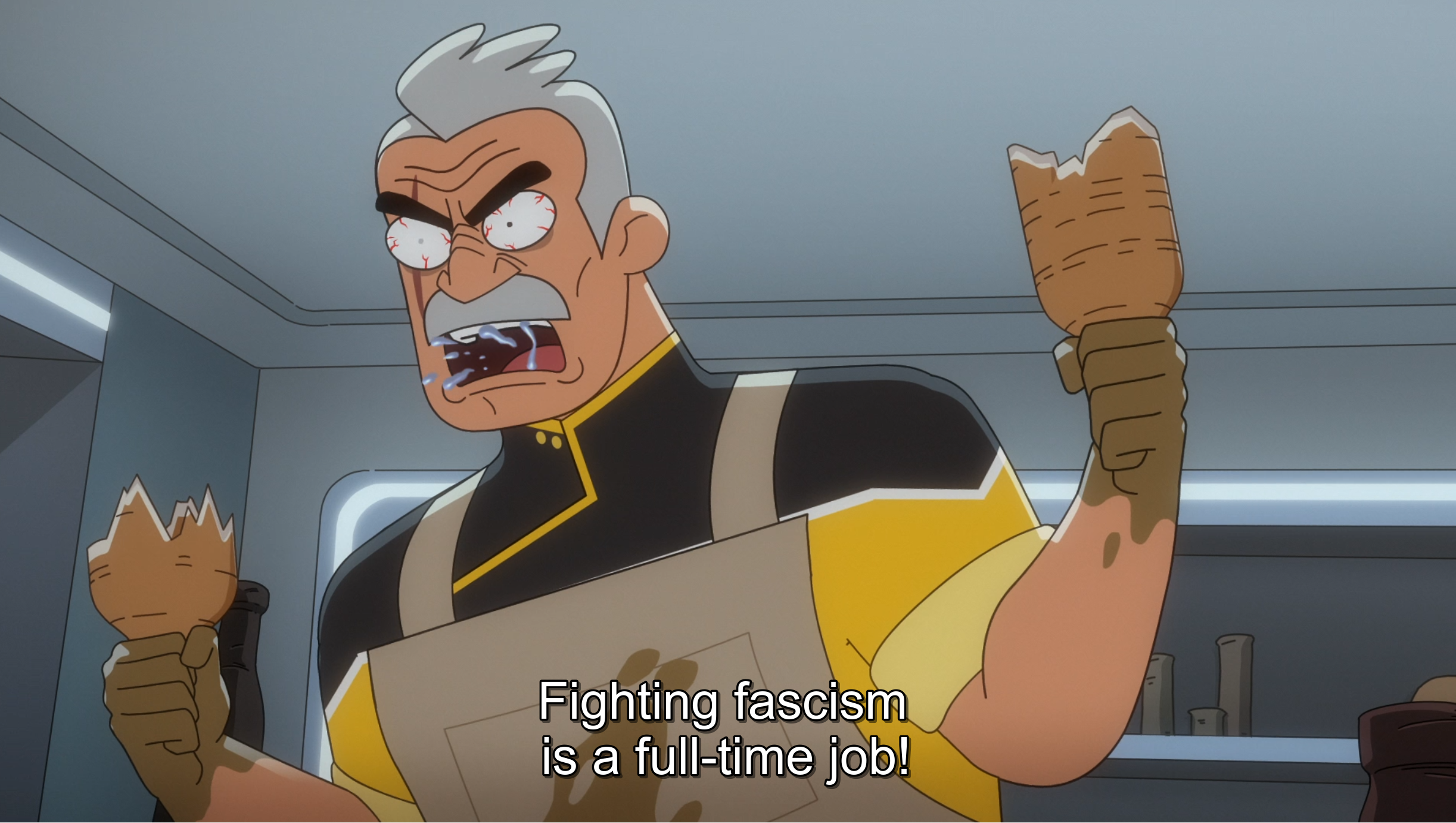
The image depicts an older man, presumably a hero or authority figure, in a state of agitation. He is facing the viewer with a distorted, almost cartoonishly angry expression. His mouth is open, showing teeth and a pink tongue, and his eyes are wide with fury. He's wearing a dark, form-fitting suit with yellow accents on the shoulders and chest. The background appears to be the interior of a futuristic, metallic spaceship or base – long, pale gray corridors and recessed lighting create a sterile, functional environment. His arms are raised and bent in a gesture of exasperation or emphasis, and one hand is clenched in a fist, while the other is slightly open and seems to be pointing. Text on the image reads "Fighting fascism is a full-time job!"
Foucauldian Genealogical Discourse Analysis
The statement "Fighting fascism is a full-time job!" can be examined through a Foucauldian lens. Foucault would be interested in the discourse surrounding fascism and resistance, and how it’s historically constructed. The assertion positions the fight against fascism not as a temporary task, but a constant, pervasive obligation. This framing reveals power dynamics.
- Power/Knowledge: The statement implies a knowledge of fascism as not merely a political ideology but a structure of power woven into the fabric of society. The "full-time job" suggests that dismantling that structure requires continual surveillance and intervention.
- Genealogy: A genealogical analysis might trace the historical development of the concept of "fascism" (and "anti-fascism") – how the terminology and understanding of it have changed over time, shaped by specific historical events and power struggles. It could examine the origins of resistance movements and how they have defined themselves against the perceived threat of fascism.
- Disciplinary Power: The call to a "full-time job" can be interpreted as a form of disciplinary power—a call to constant vigilance and self-regulation, framing individuals as perpetually responsible for combating a certain kind of threat.
Critical Theory (Frankfurt School)
The image and statement resonate with the concerns of Critical Theory. The character’s outrage suggests a systemic issue—fascism isn't just a political ideology but a pervasive force embedded in social structures.
- Culture Industry: If considered in the context of Invincible (a superhero narrative), the "full-time job" against fascism could be seen as a commentary on the ways in which media and popular culture both reflect and shape our understanding of political struggles. Superhero narratives, while offering a sense of empowerment, might also naturalize certain forms of conflict and obscure the underlying social and economic causes of injustice.
- Instrumental Reason: The emphasis on the constant effort required to fight fascism can be linked to the concept of instrumental reason—the tendency to prioritize efficiency and control above all else. It suggests a relentless drive to manage a problem rather than address its root causes.
Marxist Conflict Theory
From a Marxist perspective, the fight against fascism is inherently tied to class struggle. Fascism, in this framework, is seen as a tool used by the ruling class to maintain power and suppress dissent.
- Material Conditions: The "full-time job" could be interpreted as a recognition that dismantling the material conditions that give rise to fascism (economic inequality, social exploitation) is a protracted and demanding process.
- Hegemony: The character’s outrage might reflect a struggle against the hegemonic ideologies that support fascism—the ways in which dominant ideas are used to legitimize power structures.
- Class Consciousness: The statement could be a call for increased class consciousness and collective action to challenge the ruling class and its fascist tendencies.
Postmodernism
A postmodern reading would challenge the notion of a fixed or essential "fascism" and focus on the fluid, unstable nature of power relations.
- Deconstruction: The very term "fascism" would be subject to deconstruction—its meaning dissected and challenged to reveal its historical contingency and ideological biases.
- Simulacra and Simulation: The image could be seen as a reflection of the hyperreality in which we live—a world saturated with media and images that obscure the underlying realities of power.
- Local Narratives: A postmodern analysis might focus on the multiplicity of struggles against fascism, recognizing that resistance takes different forms in different contexts and is shaped by local narratives and power dynamics.
In summary: This single image and statement are ripe for analysis through multiple theoretical frameworks. The context of the show Invincible adds another layer—a superhero narrative that itself grapples with themes of power, justice, and the fight against evil. The depth of interpretation depends on which theoretical lens you choose to apply.
simple-description (llama3.2-vision)
The meme features an image of a character from the TV show "Rick and Morty" with a shocked expression. The character is holding a sign that reads "I'm a [insert job here]". The text "I'm a [insert job here]" is often replaced with a humorous or ironic job title, such as "I'm a professional snail trainer" or "I'm a professional couch warmer". In this specific meme, the text is "I'm a professional [censoring]".
tesseract-ocr
(- ' i Le ied.