First Seen
2024-06-08T18:01:59.090789+00:00
simple-description (llama3.2-vision_11b)
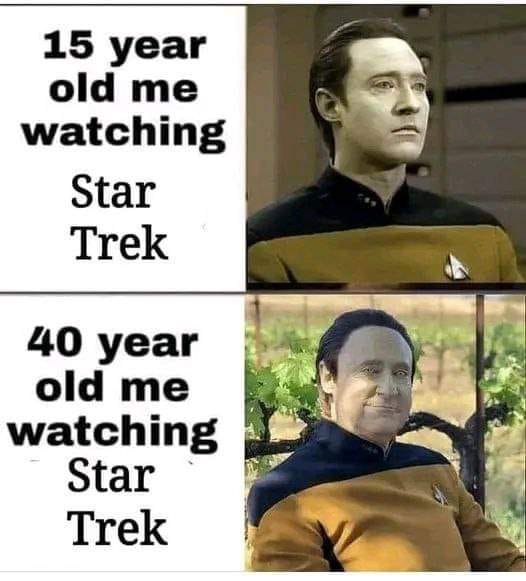
The meme is a humorous comparison between the author's current and past experiences with the Star Trek franchise. The image shows a split-screen of the same actor, Patrick Stewart, as Captain Jean-Luc Picard in Star Trek: The Next Generation. The left side of the image is captioned "15 years old" and the right side is captioned "40 years old", with the text "I was this optimistic when I was 15, now I'm this optimistic" implying that the author's enthusiasm for the franchise has waned with age.
detailed-analysis (gemma3-27b-vision)
Okay, let's break down this meme of Data (from Star Trek: The Next Generation) using the lenses you requested. Given the nature of the meme (a "before/after" format focused on aging and viewing habits), some of these lenses will be more fruitful than others. I'll indicate where the analysis feels less strong.
Visual Description
The meme is a "drakeposting" format (the "before/after" meme with two images and text). The top image depicts Data, as a younger actor, looking stoic and serious, even a bit judgmental. He's in his standard Starfleet uniform. The text above states "15 year old me watching Star Trek." The bottom image is Data (the same actor, but aged), sitting in a relaxed pose, with a slight smirk and a generally content expression. The text states "40 year old me watching Star Trek." The shift in expression is the primary visual element signifying a change in perception or attitude. The background is blurred greenery in both images.
Foucauldian Genealogical Discourse Analysis
This is a strong area for analysis. We can see a shift in discourse surrounding viewing habits and, more broadly, how we engage with media as we age.
- Power/Knowledge: At 15, the "knowledge" of Star Trek (as a science fiction genre, a source of entertainment) might be tied to a power dynamic of youth culture, a need to "fit in," or a desire to be seen as intelligent. The youthful Data reflects a seriousness as the viewer attempts to grasp the philosophical concepts or complex plotlines of the show. The 40 year old Data reflects a different form of understanding. No longer is the show a source of learning, but rather a source of comfort.
- Genealogy of Viewing: The shift from the serious, analytical young Data to the relaxed, content older Data could represent a genealogy of viewing habits. Initially, viewing Star Trek might be a "serious" intellectual pursuit. Over time, it transitions into a familiar comfort zone, a way to revisit a past self, or simply a relaxing pastime. The initial "need" to engage critically diminishes, and is replaced by enjoyment.
- Disciplinary Power: The meme implies a kind of self-discipline in the younger viewer – a need to understand the show, to "get it." The older viewer, seemingly freed from that need, embodies a different kind of power – the power of acceptance and enjoyment without judgment.
Critical Theory
We can look at this through a lens of evolving perspectives and subjective experience.
- Subjectivity & Perception: The meme highlights how our subjective experiences shape our understanding of media. What we "see" in Star Trek (or any media) isn't objective. It's filtered through our personal history, values, and current state of being. The younger self might focus on the spectacle, the scientific concepts, or the social commentary. The older self may simply enjoy the familiar world and characters, or nostalgically reflect on earlier life stages.
- Culture Industry: We can see the meme as commenting on the way media is consumed and internalized over a lifetime. The youthful, “serious” Data demonstrates the influence of media (sci-fi, specifically) as a status symbol or intellectual pursuit. The older Data demonstrates a detachment from external validation, instead consuming media simply for pleasure.
Marxist Conflict Theory
This is weaker, but we can draw some connections, however tenuous.
- Ideology and Consumption: The initial engagement with Star Trek might reflect an initial embrace of the “ideals” presented in the show (utopian future, progressive values). However, the older Data doesn’t necessarily display a challenge to those values, but a passive acceptance of them.
- Commodification of Nostalgia: Nostalgia is a commodity. The older Data enjoying Star Trek could be interpreted as a consumer participating in the re-consumption of familiar media for the comfort and sentimentality it provides. (It's a stretch, but we could say this meme reinforces a capitalist cycle of nostalgia.)
Postmodernism
This offers some useful insights:
- Irony and Detachment: The shift in expression could be seen as a move towards postmodern irony and detachment. The younger Data takes the show "seriously," while the older Data seems to acknowledge the inherent artifice and nostalgia of revisiting it.
- Fragmentation of Self: The meme implies a fragmentation of the self over time. The younger and older "Datas" are different expressions of the same person, reflecting the way our identities evolve and become layered over time.
- Simulacra and Simulation: The older Data isn't necessarily engaging with the "real" Star Trek but with a simulacrum of it – a hyperreal version informed by memory and nostalgia. The show has become less about the content and more about the experience of remembering.
Queer Feminist Intersectional Analysis
This is the weakest lens for this meme. While Star Trek does have progressive themes, the meme itself doesn't directly engage with issues of gender, sexuality, or intersectionality. We could argue (stretching a bit):
- Deconstruction of "Serious" Viewing: The meme could be read as subtly challenging the expectation that intellectual pursuits (like watching science fiction) need to be "serious" or "masculine." The relaxed, content older Data subverts that expectation.
- Reclaiming Comfort & Joy: The older Data’s apparent comfort could be seen as reclaiming a space for pleasure and enjoyment – something often denied to marginalized groups. (Again, a weak connection.)
I hope this comprehensive breakdown, with the noted strengths and weaknesses of each analytical lens, is helpful! Let me know if you’d like me to focus on any specific aspect or further explore a particular theoretical framework.
simple-description (llama3.2-vision)
This meme is a humorous comparison of two images of William Shatner, who played Captain James T. Kirk in the Star Trek franchise. The top image shows a young Shatner, and the bottom image shows an older Shatner. The text above the top image reads "15 years old me watching Star Trek", and the text above the bottom image reads "40 years old me watching Star Trek". The meme is poking fun at how one's attitude and behavior can change over time, and how one's love for a favorite TV show can remain the same.
tesseract-ocr
15 year rN old me mn. watching =] Star Trek ¥ ae 40 year » > toy be oldme [& eA ee watching | a Star & ag Trek | .