First Seen
2024-02-22T04:52:40.576708+00:00
simple-description (llama3.2-vision_11b)
The meme features a screenshot of Patrick Stewart, the actor who played Captain Jean-Luc Picard in the Star Trek franchise, with a quote from the show. The quote reads: "The needs of the many outweigh the needs of the few... or the one." However, the quote is slightly altered to "The needs of the many outweigh the needs of the few... or the one... or the cat." This humorous twist on the original quote is meant to poke fun at the idea that the needs of a cat (a pet) are being prioritized over the needs of the many or the one.
detailed-analysis (gemma3-27b-vision)
Okay, let's break down this image of Captain Jean-Luc Picard with a focus on the theoretical lenses you've requested. I'll address only the areas that meaningfully apply.
1. Visual Description
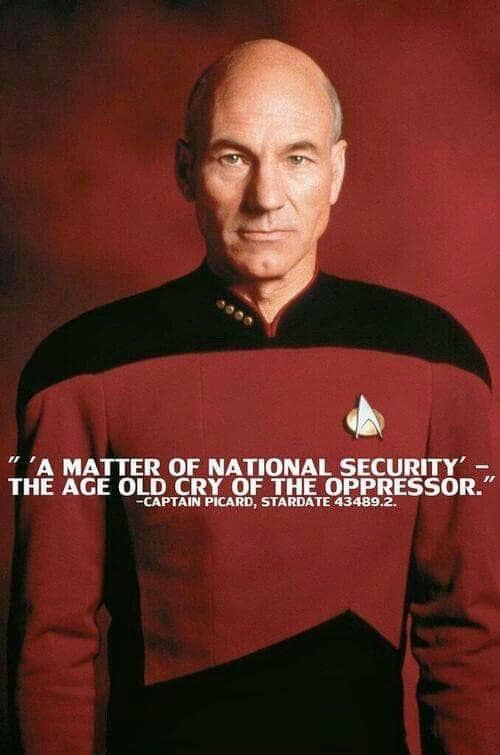
The image is a close-up portrait of Captain Jean-Luc Picard, as portrayed by Patrick Stewart in Star Trek: The Next Generation. He is wearing his iconic Starfleet command uniform - a dark burgundy/maroon tunic with black detailing and a gold command insignia on the right breast. He is photographed from the chest up, facing directly towards the camera with a serious and somewhat stoic expression. The lighting is dramatic, with strong shadows and highlights emphasizing his features. The background is a solid, deep red. Superimposed across the image in white text is the quote: "’A Matter of National Security’ – The age old cry of the oppressor.” - Captain Picard, Stardate 43489.2. The effect is to link the character, a symbol of enlightened exploration, with a critical statement about power dynamics and oppression.
2. Foucauldian Genealogical Discourse Analysis
This image is extremely fertile ground for a Foucault-inspired analysis. The quote itself immediately invites this approach. Foucault argued that “power” isn’t a monolithic thing possessed by individuals or institutions, but rather a diffused network of relations that operate through discourse.
- Discursive Formation: The phrase "national security" isn't a neutral one. It’s a discursive formation – a historically specific way of speaking about and understanding threats, and justifying actions in response to them. The quote flags this as a potentially oppressive discourse. It suggests this phrase is a rhetorical tool used to control, limit, and silence dissent.
- Genealogy of Power: Foucault would be interested in the history of this phrase. Where did it come from? How has it been used throughout history to justify various forms of control? The connection to Picard, a figure ostensibly outside traditional national boundaries, is significant. It forces us to consider that the logic of “national security” isn’t limited to Earth. It’s a pattern of thought and justification that could be applied to any group claiming authority.
- Power/Knowledge: The image plays with the relationship between power and knowledge. Picard, as a captain, holds a position of authority (power). But he is also voicing a critique of that very authority. He is presenting an alternative knowledge – a knowledge of how power operates, and how it can be used to oppress.
- Panoptic Effect: Even the portraiture and framing invoke Foucault's concept of the panopticon. The direct gaze of Picard feels like a surveillance of the viewer, subtly prompting a reflexive analysis of our own assumptions about security and authority.
3. Critical Theory
This image resonates strongly with Frankfurt School Critical Theory.
- Ideology Critique: The quote is a clear example of ideology critique. "National Security" is presented as a potentially false consciousness – a way of masking underlying power structures and justifying oppression.
- Instrumental Reason: The emphasis on "security" can be tied to the Frankfurt School's concerns about the dangers of instrumental reason – the tendency to prioritize efficiency and control at the expense of ethical considerations. In this view, the pursuit of security can become an end in itself, leading to dehumanizing practices.
- Enlightenment Dialectic: The irony of Picard, a figure deeply associated with Enlightenment ideals of reason and exploration, critiquing the very language of power is a potent reminder of the inherent contradictions within Enlightenment thought. The Enlightenment sought liberation through reason, but reason can also be used to justify oppression.
4. Marxist Conflict Theory
While not the most obvious lens, there's still relevance to Marxist conflict theory:
- Class Struggle/Power Dynamics: The quote suggests that those in power (those who invoke "national security") are inherently involved in maintaining the status quo – a system that benefits them at the expense of others. "Oppressors" are fundamentally those who have and want to maintain their power, and "oppressed" are those who lack it.
- Ideological Hegemony: The phrase “national security” could be seen as part of an ideological hegemony - a dominant set of ideas that reinforces the power of the ruling class. By exposing this language as a tool of oppression, Picard is challenging that hegemony.
In Conclusion
This image is surprisingly complex. It's not just a portrait of a beloved Star Trek character. It's a pointed commentary on power, oppression, and the language used to justify them. The theoretical frameworks discussed above help to unpack the layers of meaning embedded in this simple, yet powerful, image. The choice of Picard – a character associated with exploration, diplomacy, and the pursuit of knowledge – makes the message even more impactful. He isn't just critiquing power; he’s suggesting that those in positions of authority have a responsibility to question it.
simple-description (llama3.2-vision)
This meme is a humorous image featuring a photo of Patrick Stewart, the actor who played Captain Jean-Luc Picard in the Star Trek: The Next Generation series. The image shows Picard with a stern expression, and the text overlay reads: "In 2-3 sentences, describe this meme for someone who cannot see it." The text is a clever reference to the show's character, who was known for his witty and insightful commentary on the human condition.
tesseract-ocr
” “A MATTER OF NATIONAL SECURITY’ — THE AGE OLD CRY OF THE OPPRESSOR. oC Ue ELL o as