First Seen
2023-05-10T21:03:40+00:00
simple-description (llama3.2-vision_11b)
This meme is a humorous image featuring a character from the Star Trek franchise, specifically the bartender from the show, who is known for his clever and often sarcastic responses. The image shows the bartender with a raised eyebrow and a witty remark: "The needs of the many outweigh the needs of the few... and the needs of the one with a hangover."
detailed-analysis (gemma3-27b-vision)
Okay, let's break down this intriguing image, applying the requested theoretical frameworks where applicable.
Visual Description
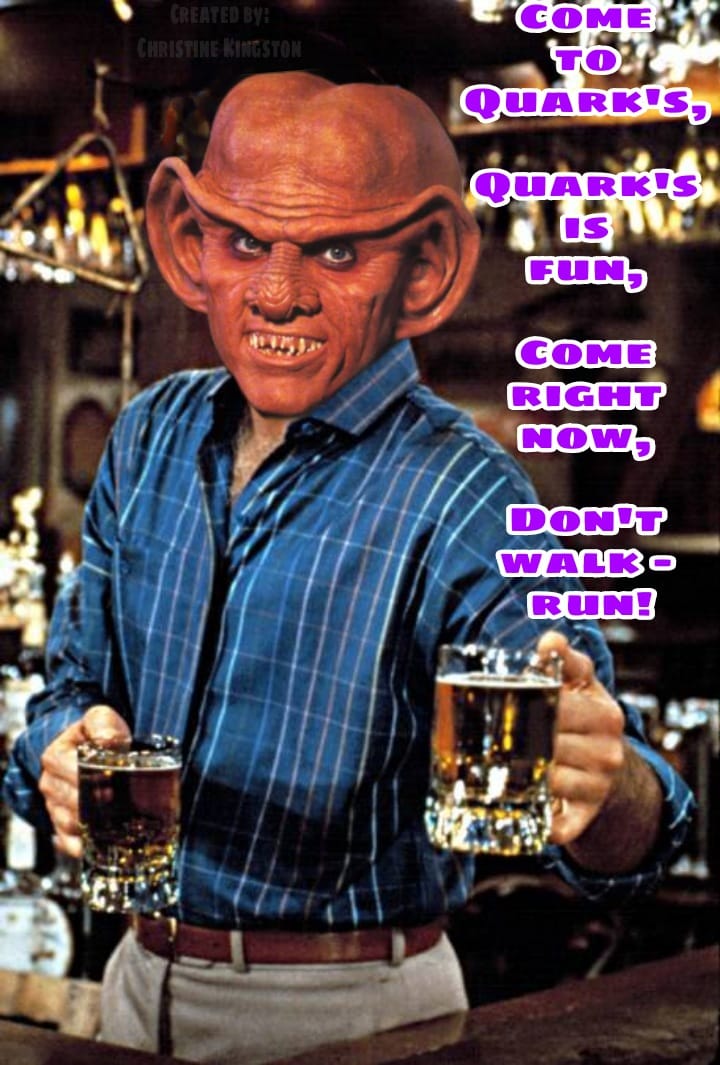
The image depicts a monstrous figure, clearly inspired by the character Quark from the television series Star Trek: Deep Space Nine. However, this is a distorted, almost nightmarish rendering. The figure has exaggerated, large ears and a grotesque, sneering expression. He's wearing a blue plaid shirt, a cowboy hat, and stands behind what appears to be a bar, holding a frothy mug (likely beer or a similar beverage). The background shows a dimly lit, somewhat seedy-looking bar interior with hanging decorations. Bright pink text appears on the right side of the image, proclaiming "COME TO QUARK'S," "QUARK'S IS FUN," "COME RIGHT NOW!" and "DON'T WALK - RUN!" The image is signed “Created by Christine Kingston”.
Foucauldian Genealogical Discourse Analysis
This image is rich for a Foucauldian analysis, primarily through its disruption of established "discourses" around the character of Quark. Foucault would analyze how the power dynamics inherent in the original Star Trek portrayal of Quark are reshaped and reconfigured in this image.
- Disruption of Normative Representation: The original Quark, while a non-human Ferengi and a capitalist, operated within the conventions of televised science fiction and a certain (albeit critical) portrayal of entrepreneurship. This image decenters that portrayal by presenting Quark as monstrous and frantic, emphasizing the more predatory and exploitative aspects of his character.
- Power/Knowledge: The frantic text ("DON'T WALK - RUN!") functions as an exercise of power, attempting to compel the viewer through language. The image itself operates as a "statement" within a discourse of consumerism/entertainment, positioning Quark not as a cunning negotiator but as a desperate, almost threatening force.
- Genealogy of Fear: Tracing the "genealogy" of Quark’s representation, we can see how this image departs from the original. It amplifies the Ferengi character's negative traits, portraying him as inherently frightening, rather than simply a morally ambiguous character. The image creates a narrative of fear surrounding Quark’s establishment.
Critical Theory
From a general Critical Theory perspective (drawing on the Frankfurt School), this image can be seen as a critique of consumer culture and unchecked capitalism.
- Reification: Quark, as a capitalist figure, embodies the reification of profit over people. This distorted image hyperbolizes that, presenting Quark as a monstrous embodiment of the relentless pursuit of wealth. The urgent, desperate advertising ("DON'T WALK - RUN!") emphasizes the relentless, almost predatory nature of capitalism.
- Commodification of Experience: The image implicitly critiques the commodification of entertainment and leisure. Quark's bar isn't a place for genuine connection, but a place where consumers are compelled to spend their money, even if it means succumbing to a frightening environment.
- Loss of Authenticity: The distortion of Quark’s appearance signals a loss of authenticity, suggesting that the original character has been twisted into a monstrous parody to serve the interests of profit.
Marxist Conflict Theory
This image lends itself particularly well to a Marxist interpretation.
- Class Struggle: Quark, as the owner of a bar, represents the capitalist class. The urgent, frantic advertising suggests a desperate need to attract customers (the working class) to generate profit. The monstrous depiction of Quark highlights the exploitation inherent in the capitalist system.
- Alienation: The distorted image and unsettling atmosphere might be interpreted as a representation of the alienation experienced by both the capitalist (Quark, reduced to a monstrous caricature) and the consumer (potentially frightened and exploited).
- Ideology: The text acts as ideological reinforcement, compelling consumers to participate in the capitalist system, even if it is portrayed as frightening or exploitative. It frames Quark's bar as desirable, despite its unsettling atmosphere, effectively masking the exploitative nature of capitalism.
Postmodernism
From a Postmodern perspective, this image exemplifies several key themes:
- Pastiche/Intertextuality: The image is heavily reliant on intertextuality, referencing the Star Trek universe while simultaneously subverting it. It mixes familiar elements with a grotesque aesthetic.
- Deconstruction: It deconstructs the original character of Quark, stripping away the nuances and complexities to present a hyper-exaggerated, monstrous version.
- Simulation and Simulacra: The image isn't a "real" portrayal of Quark, but a simulation, a copy of a copy, that has become detached from its original referent. The emphasis on spectacle and advertising reinforces this detachment.
- Loss of Grand Narratives: The image's cynicism and deconstruction of the heroic Star Trek narrative suggest a rejection of grand narratives and a move towards fragmented, subjective experiences.
Queer Feminist Intersectional Analysis: While this image doesn’t explicitly lend itself to a Queer Feminist Intersectional analysis in the same way as the other theoretical frameworks, a possible reading could be:
- Subversion of Masculinity: The exaggeration of Quark’s features and the monstrous depiction could be interpreted as a subversion of traditional masculine tropes. The distorted features challenge conventional standards of beauty and power.
- Capitalism and Exploitation: A Queer Feminist perspective can examine how capitalism often exploits marginalized communities. Quark's bar could be interpreted as a symbol of a system that preys on those vulnerable to its temptations.
It's important to note that these are just potential interpretations. The meaning of the image is open to debate and will vary depending on the viewer's perspective and theoretical framework.
simple-description (llama3.2-vision)
The meme is an image of the actor who played the alien character Hikaru Sulu in the original Star Trek series, George Takei, making a sarcastic comment about the popular science fiction franchise. The text in the image reads: "In a galaxy far, far away...".
tesseract-ocr
<<, | aa: ap iv ‘i . : mo Le a fe nna > IN Come) , —_ Goanie , . Y Ve n 4 ¢ wi — i aN han, ee } 7 i I) : oe ee | Sy cae 4 ‘ lla Ra" ee ae “We 2). ar eet im , .