First Seen
2023-05-10T21:03:40+00:00
simple-description (llama3.2-vision_11b)
The meme is a screenshot from the Star Trek franchise, featuring the character Mr. Spock raising an eyebrow in a humorous expression. The text "Live long and prosper" is often associated with the character, but in this meme, it's replaced with "Live long and prosper... NOT!"
detailed-analysis (gemma3-27b-vision)
Okay, here's an analysis of the provided Twitter post, broken down into the requested sections, addressing how each theoretical lens might apply (or explaining why it doesn't).
Please note: This analysis delves into theoretical interpretations and will be somewhat abstract. It depends on interpreting the image and the text in relation to these schools of thought.
1. Visual Description
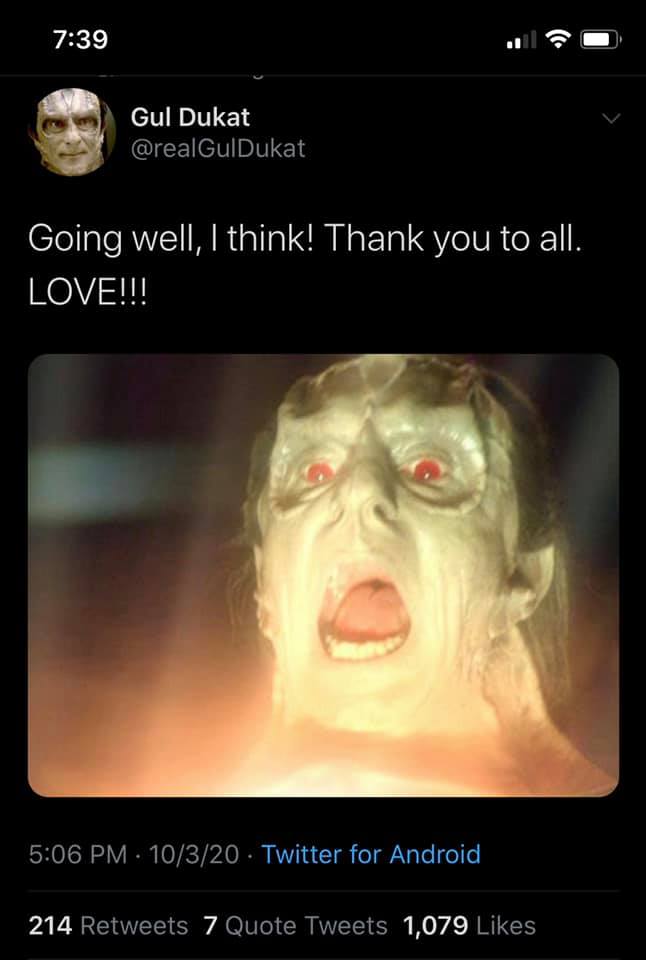
The image is a close-up portrait of the character Gul Dukat from Star Trek: Deep Space Nine. The lighting is dramatic, with a strong light source emphasizing his face and creating deep shadows. He is visibly "posed" and seems to have exaggerated features, with a slight smile and intense eyes. The image quality appears to have been manipulated for effect—likely digitally. There is a pinkish/purple color cast over the entire image. It evokes a theatrical or performative quality.
2. Foucauldian Genealogical Discourse Analysis
This post can be seen through a Foucauldian lens as a performance of power. Dukat is a character historically recognized in Star Trek canon as one embodying an abuse of power, a charming villain whose rhetoric masks manipulation and oppression.
- Discourse & Power: The post itself is an act of discourse—a statement designed to elicit a response. Dukat uses it to reassert a sense of control and visibility. His claim of "going well" is a performance of normalcy, a deliberate attempt to construct an image of well-being that belies his character's history.
- Genealogy of "Well-Being": A genealogical analysis might examine how the idea of "well-being" itself has been constructed through cultural and historical discourses. Dukat's appropriation of this term becomes ironic considering his past actions. He subverts the discourse of wellness to create a sinister effect.
- Panoptic Surveillance: The fact this is a Twitter post also places this performance into the domain of digital panopticism. The audience knows the character is 'watching' and responding, reinforcing his power.
3. Critical Theory
Critical Theory, particularly as rooted in the Frankfurt School, can be applied to understand the post's manipulation and ideological dimensions.
- Culture Industry: The use of a character from a popular science fiction franchise like Star Trek places the post within the "culture industry". Dukat's self-branding, through this post, is a product of the culture industry.
- False Consciousness: The character's claim of "going well" could be interpreted as a manipulation designed to generate approval, despite his history of wrong-doing. This attempts to create a 'false consciousness' in the audience—to obscure the true nature of his character and actions.
- Authoritarian Personality: Dukat, as a character, exhibits many traits associated with an authoritarian personality: narcissism, a desire for control, and a tendency to manipulate others. This post can be seen as an expression of that personality.
4. Marxist Conflict Theory
While not the most direct application, Marxist Conflict Theory can be seen in the power dynamics inherent in the post.
- Class Struggle (Applied Analogy): We can analogously apply the concept of class struggle. Dukat, in Star Trek, is a member of a ruling Cardassian class that historically oppressed the Bajoran people. This post can be seen as a reassertion of that power, an attempt to re-establish dominance.
- Ideology as Control: Dukat’s claim of “going well” can be interpreted as a form of ideological control—a way of legitimizing his actions and maintaining his status.
- Commodity Fetishism (Indirectly): The character and his likeness become a "commodity" within the realm of fandom. The post’s engagement (retweets, likes) demonstrate the audience's consumption of this “commodity.”
5. Postmodernism
Postmodernism is a strong lens through which to analyze this post.
- Hyperreality & Simulation: The image is clearly manipulated—it is a simulation of Dukat, not a realistic portrayal. This fits into the postmodern concept of hyperreality, where the distinction between reality and simulation becomes blurred.
- Irony & Parody: The post is arguably ironic. Given Dukat's reputation, a claim of "going well" is likely meant to be read with a degree of skepticism and mockery. This is a hallmark of postmodern humor.
- Deconstruction: The post invites deconstruction. We can question the meaning of "going well" in the context of Dukat’s character and actions. The claim challenges our pre-conceived notions of well-being and success.
- Loss of Grand Narratives: The post rejects any overarching, universal meaning. It’s a self-contained performance, divorced from any larger moral or ideological framework.
6. Queer Feminist Intersectional Analysis
This is where the analysis becomes more nuanced and requires a careful reading. While Dukat isn't overtly presented as queer, the character has been subject to queer interpretations by fans.
- Subversive Performance of Masculinity: Dukat’s performance of masculinity is intentionally over-the-top and often linked to themes of domination and control. This can be analyzed as a destabilization of traditional masculine norms.
- Power Dynamics: The post's focus on self-affirmation is a manifestation of power. Intersectional feminism emphasizes how power operates in complex ways, shaped by race, class, gender, and other social categories. Gul Dukat's self-regard can be framed as an expression of privilege and authority.
- Subversion/Appropriation: The character of Gul Dukat and his performance of masculinity can be seen as a subversion of societal norms, but is simultaneously used to reinforce power dynamics.
Important Considerations:
- This analysis is based on interpretations. Other readings are certainly possible.
- The context of the Twitter post (e.g., the account’s history, the reactions from other users) would enrich this analysis.
- The application of these theoretical lenses is not always straightforward. Some concepts fit more naturally than others.
I hope this detailed analysis is helpful! Let me know if you’d like me to elaborate on any of these points.
simple-description (llama3.2-vision)
The meme is a screenshot of a tweet from actor and comedian Dwayne "The Rock" Johnson, featuring a photo of himself with a shocked expression. The text in the image reads: "In the middle of a #Bollywood #Movie #Shoot in #Mumbai...". However, this is not the meme being described. The actual meme is a screenshot of a tweet from actor Dwayne "The Rock" Johnson's account, featuring a photo of a character from the movie "The Mummy" (2017) with a shocked expression, and the text reads: "In the middle of a #Bollywood #Movie #Shoot in #Mumbai..."
tesseract-ocr
7:39 oe? lew CS CUEP UL la . ‘ @realGulDukat Going well, | think! Thank you to all. LOVE!!! - — a ao - a i r A tinid " _ 4 _- 5:06 PM - 10/3/20 - Twitter for Android 214 Retweets 7 Quote Tweets 1,079 Likes