First Seen
2023-05-10T21:03:40+00:00
simple-description (llama3.2-vision_11b)
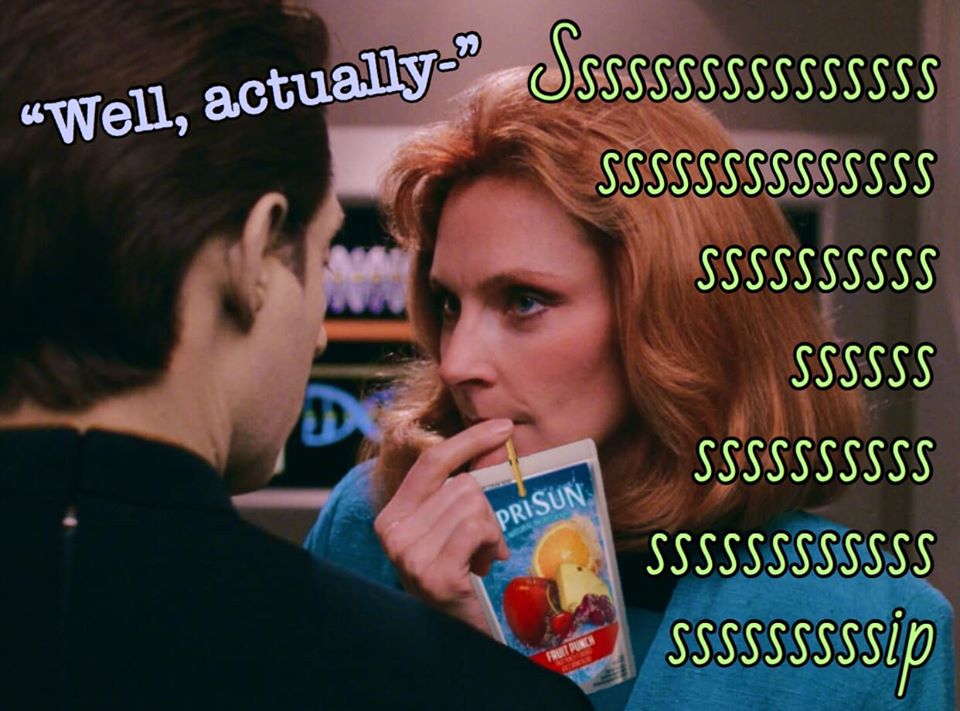
The meme is a screenshot from the TV show Star Trek: The Next Generation, featuring Captain Jean-Luc Picard and his android friend Data. The image shows Data holding a cup of Earl Grey tea and saying "I'm... reading... a book... on... vascular... surgery...". The text "I'm... reading... a book... on... vascular... surgery..." is a humorous take on Data's lack of understanding of human idioms and his literal interpretation of language.
detailed-analysis (gemma3-27b-vision)
Okay, let's break down this image through the requested theoretical lenses. This is a screen capture from the show Buffy the Vampire Slayer, specifically the episode "The Body", which is known for its stark portrayal of grief. (Note: the repeated "s" and "sip" annotations seem to be someone's playful highlighting of the moment.)
1. Visual Description
The image depicts a scene with two people in what appears to be a domestic setting, likely a kitchen or living room. The main subject is a woman (Buffy) with long blonde hair, turned in profile, deeply engrossed in drinking a juice box. Her expression is flat, almost vacant. She's wearing a blue sweater. The lighting is subdued, creating a somber mood. The background is blurry and indistinct, suggesting a focus on the internal emotional state of the subject. A male figure is partially visible on the left, seemingly engaged in conversation with Buffy, but his face is mostly obscured. The juice box, a "PriSun" brand, is prominently featured, with a bright red apple image on it. The overall color palette is cool and muted, with shades of blue and gray dominating.
2. Foucauldian Genealogical Discourse Analysis
This image, within the context of the episode "The Body," provides a fascinating case study in the manifestation of grief as discourse. Foucault would argue that grief isn't a purely internal, psychological state, but a set of practices, utterances, and ways of understanding that are historically and culturally constructed. Buffy's flat affect and almost robotic act of consuming the juice box represent a breakdown of normal grieving discourse.
Traditionally, grief is often spoken through tears, wailing, and expressing pain. Buffy doesn’t do this. Instead, she embodies a silent, numb withdrawal. The act of drinking the juice box is a ritualistic, almost mechanical, action – a way of occupying herself without confronting the overwhelming loss (her mother's death).
Foucault would examine how the discourse of grief has evolved in Western culture, and how Buffy's rejection of traditional expressions disrupts these normalized patterns. The juice box itself becomes a site where these discourses are renegotiated—a childlike act in a moment of adult devastation. It’s a refusal to perform the expected emotional labor.
3. Critical Theory
From a Critical Theory perspective (particularly drawing on the Frankfurt School), this image illustrates the alienation and dehumanization inherent in modern life. The episode, and this moment specifically, presents a realistic and unglamorous depiction of grief—stripping away the romanticized or religious frameworks that often structure how we understand and respond to death.
Buffy's withdrawal isn't a sign of strength or resilience, but a symptom of a society that lacks the emotional support structures to cope with profound loss. Her drinking of the juice box is a self-soothing mechanism, a futile attempt to regain some sense of control in a world that feels chaotic and meaningless. This can be seen as a critique of the increasingly individualistic and atomized nature of contemporary society. The lack of visible external support also suggests a critique of the capitalist system that prioritizes productivity and efficiency over emotional wellbeing.
4. Marxist Conflict Theory
While not immediately obvious, a Marxist reading can be applied, albeit subtly. The episode, and this scene, can be seen as an exposure of the limitations of individual agency within a larger social structure. Buffy, as a supernatural slayer, is already positioned as an outsider—struggling against forces beyond her control. Her mother’s death isn’t simply a personal tragedy, but a demonstration of the inherent vulnerability and precarity of life under conditions of powerlessness.
The "PriSun" juice box is a commodity—a product of the capitalist system. Buffy’s consumption of it, in this moment of grief, can be seen as a symbolic representation of her incorporation into that system. It’s a fleeting moment of comfort bought and paid for. The detachment from traditional grieving rituals also shows a lack of social cohesion - a consequence of capitalist individualism.
5. Postmodernism
This image embodies several tenets of postmodern thought. The fragmentation of Buffy’s emotional state – her flat affect, the mechanical act of drinking, the lack of overt emotional expression – aligns with the postmodern rejection of grand narratives and unified subjectivities. There is no coherent, easily identifiable expression of grief.
The image is also self-referential. The episode "The Body" is famous for its realism—its deliberate rejection of typical supernatural tropes. It comments on the conventions of television drama and narrative itself. This aligns with postmodernism’s emphasis on meta-narrative and self-awareness. The "PriSun" juice box, as a mundane, mass-produced object, further reinforces the postmodern blurring of high and low culture.
6. Queer Feminist Intersectional Analysis
This is where the reading gets particularly interesting. Buffy, as a strong, female protagonist, consistently subverts traditional gender roles. However, the context of this scene reveals a complex intersection of grief, vulnerability, and female socialization.
Often, women are expected to be more emotionally expressive than men, to perform grief in ways that align with societal expectations. Buffy's rejection of this expectation—her flat affect and withdrawal—can be seen as a radical act of resistance. She’s refusing to conform to the performative demands of femininity. This refusal, however, isn’t necessarily empowering. It’s a desperate attempt to cope with profound loss, but it highlights the ways in which societal expectations can constrain even the strongest of individuals. Furthermore, her internal struggle is often overlooked or dismissed. Her grief is invisible, which resonates with the experiences of many marginalized groups whose pain is often minimized or ignored.
The fact that her grief is expressed through this mundane act (drinking juice) can also be read as a feminized act—a way of self-soothing that is often associated with women. This is not inherently negative, but it highlights the ways in which gender roles can shape even the most intimate of experiences.
I hope this thorough breakdown is helpful! This image is remarkably rich and invites multiple interpretations through various critical lenses.
simple-description (llama3.2-vision)
This meme is an image of a character from Star Trek saying "Well, that's a good idea" while drinking from a cup that says "I'm not drinking that". The text "I'm not drinking that" is written in a humorous, childlike font to add to the comedic effect. The image is a play on the character's dry wit and the absurdity of the situation.
tesseract-ocr
Pe) 4 oa . 7) sana ies. te ae wy 7. m € Karon SP SONI