First Seen
2024-01-25T04:21:44.358107+00:00
simple-description (llama3.2-vision_11b)
The meme is a humorous comparison between the character of Mr. Spock from Star Trek and the actor who played him, Leonard Nimoy. The meme states that Mr. Spock would be "fascinating" at a gay bar, implying that he would be an attractive and interesting person to meet in a social setting. The meme is captioned "Fascinating" in a tone that is playful and lighthearted.
detailed-analysis (gemma3-27b-vision)
Okay, let's break down this intriguing internet post with a multi-layered analysis. It's a meme, combining a Star Trek ship with an image of actor Willem Dafoe in a distinctly predatory pose. Here's a breakdown, covering relevant areas.
Visual Description
The image consists of two panels.
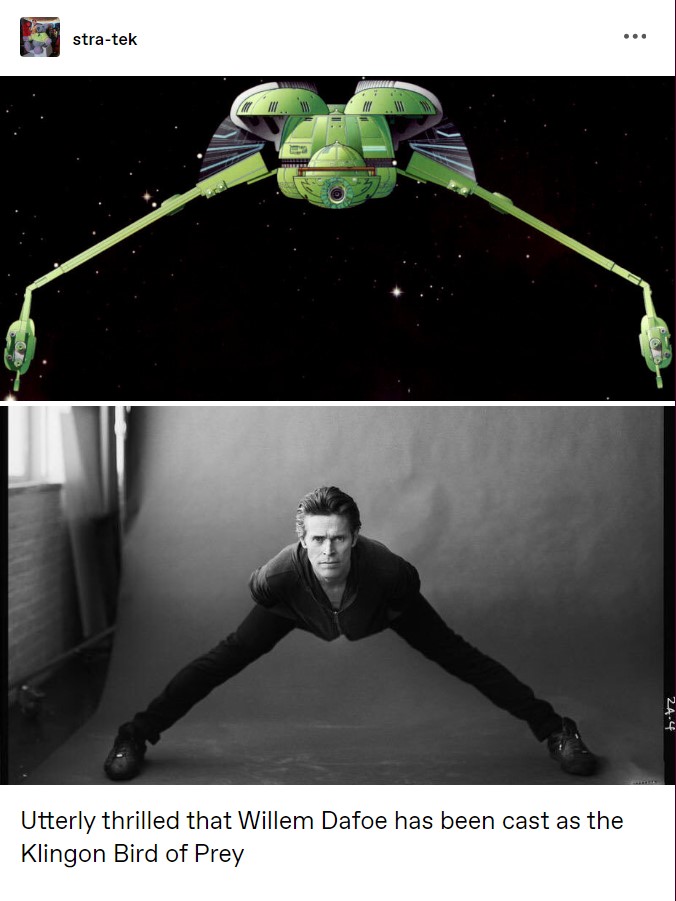
Top Panel: A digitally rendered depiction of a Klingon Bird-of-Prey spacecraft, the iconic warship from the Star Trek* universe. It's green, with the recognizable swept-back wing design. The backdrop is a starry, black space.
* Bottom Panel: A black and white photograph of actor Willem Dafoe, on all fours in a crouched, almost animalistic pose. He is wearing dark clothing, his limbs extended, suggesting a predator stalking its prey. The background is blurred, creating a sense of depth and focusing attention on Dafoe's body.
* Text: Above the images is the caption "Utterly thrilled that Willem Dafoe has been cast as the Klingon Bird of Prey".
Foucauldian Genealogical Discourse Analysis
This meme operates within a network of discourses surrounding Star Trek, fandom, performance, and actorly embodiment. A Foucauldian analysis would look at how "Klingon Bird of Prey" is constructed as a concept through decades of Star Trek media.
Discourse of Power: Klingons, within Star Trek*, are frequently portrayed as a powerful, warrior race. The Bird-of-Prey is their iconic vessel, embodying this power.
Genealogy of the Image: The meme doesn't just present Dafoe as the ship; it performs an association. It collapses the seemingly disparate concepts through visual juxtaposition. The genealogy would trace how Dafoe, through roles like the Green Goblin in Spider-Man* or various villainous characters, has become associated with predatory, threatening personas. The meme draws on this already-established "discourse of Dafoe-as-threat".
Power/Knowledge: The meme relies on the audience already possessing knowledge of Star Trek*, Klingons, and Dafoe’s acting career. This pre-existing knowledge is the "power" that enables the meme to function and create its humorous effect.
Critical Theory
This meme can be examined through a lens of spectacle and simulation, drawing from theorists like Jean Baudrillard.
Simulation and Hyperreality: The meme doesn't suggest that Dafoe literally is the Bird-of-Prey. It presents a playful simulation* of that idea. It is a layering of image and concept.
Spectacle: The meme is a spectacle about the idea of casting. It focuses attention on the image* of the pairing, rather than any actual casting decision. It’s a performance of fandom and speculation.
Commodification of Fandom: The meme relies on the audience’s enjoyment of Star Trek* and its associated imagery. The enjoyment is derived from the intersection of franchise recognition and pop culture.
Postmodernism
The meme is decidedly postmodern in several ways:
Intertextuality: It relies heavily on intertextuality – the blending of different cultural texts (Star Trek*, Dafoe’s filmography). The humor arises from the unexpected connection.
Pastiche/Parody: The meme is a form of playful pastiche—an imitation or combination of multiple styles or genres, playfully combining elements that don't traditionally belong together. It’s not necessarily mocking either Star Trek* or Dafoe, but it’s operating in a space of ironic remixing.
* Deconstruction of Meaning: The meme doesn't offer a straightforward interpretation. The collapsing of actor and spaceship resists easy categorization.
Queer Feminist Intersectional Analysis
While not immediately obvious, a queer feminist reading could explore the disruption of expected associations and the performance of identity.
* Subversion of Expectations: The meme subverts the expectation of how an actor is “cast” in a role. Casting is normally limited to an actor portraying a character, but this meme equates the actor to the machine. This deconstruction of traditional roles can be linked to a feminist desire to destabilize traditional categories of representation.
* Performance of Identity: Dafoe’s pose is an active performance of predatory physicality. This performance can be read through a queer lens, as a deliberate transgression of stereotypical masculine roles. (However, this is more nuanced and relies on recognizing Dafoe’s frequent blurring of gendered roles.)
* Intersection of Fan Identity: Examining how the meme is shared and interpreted within specific fandom communities can reveal intersections of identity and how different fans engage with the image.
Let me know if you'd like me to delve deeper into any of these areas, or explore other potential analytical frameworks!
simple-description (llama3.2-vision)
The meme features a photo of William Shatner in his iconic Star Trek: The Next Generation role as Captain James T. Kirk, but with a humorous twist: his face is Photoshopped to look like he's wearing a Klingon helmet from the Star Trek franchise. The image is captioned: "I'm William Shatner, but I'm a Klingon warrior now."
tesseract-ocr
ES Ss rr a ©: a ; : : we b &) iss ‘ 1 Ui a = ai #.,, ~~ a ys , K Utterly thrilled that Willem Dafoe has been cast as the Klingon Bird of Prey