First Seen
2024-01-20T01:09:29+00:00
simple-description (llama3.2-vision_11b)
This meme is a play on the classic Star Trek: The Next Generation episode "The Outcast," where a character's identity is explored and a character's identity is explored. The meme is a humorous take on the idea that a character's identity is being explored, and it uses a quote from the episode to make a joke about the character's identity. The image is likely a screenshot from the episode with the quote "I'm not a woman, I'm a man" written on it.
detailed-analysis (gemma3-27b-vision)
Okay, let's break down this meme/image using the requested theoretical frameworks. It's a bit of a darkly humorous image, so the application of these theories will be somewhat unconventional, focusing on how the image performs these theories rather than necessarily being a perfect example of them.
Visual Description
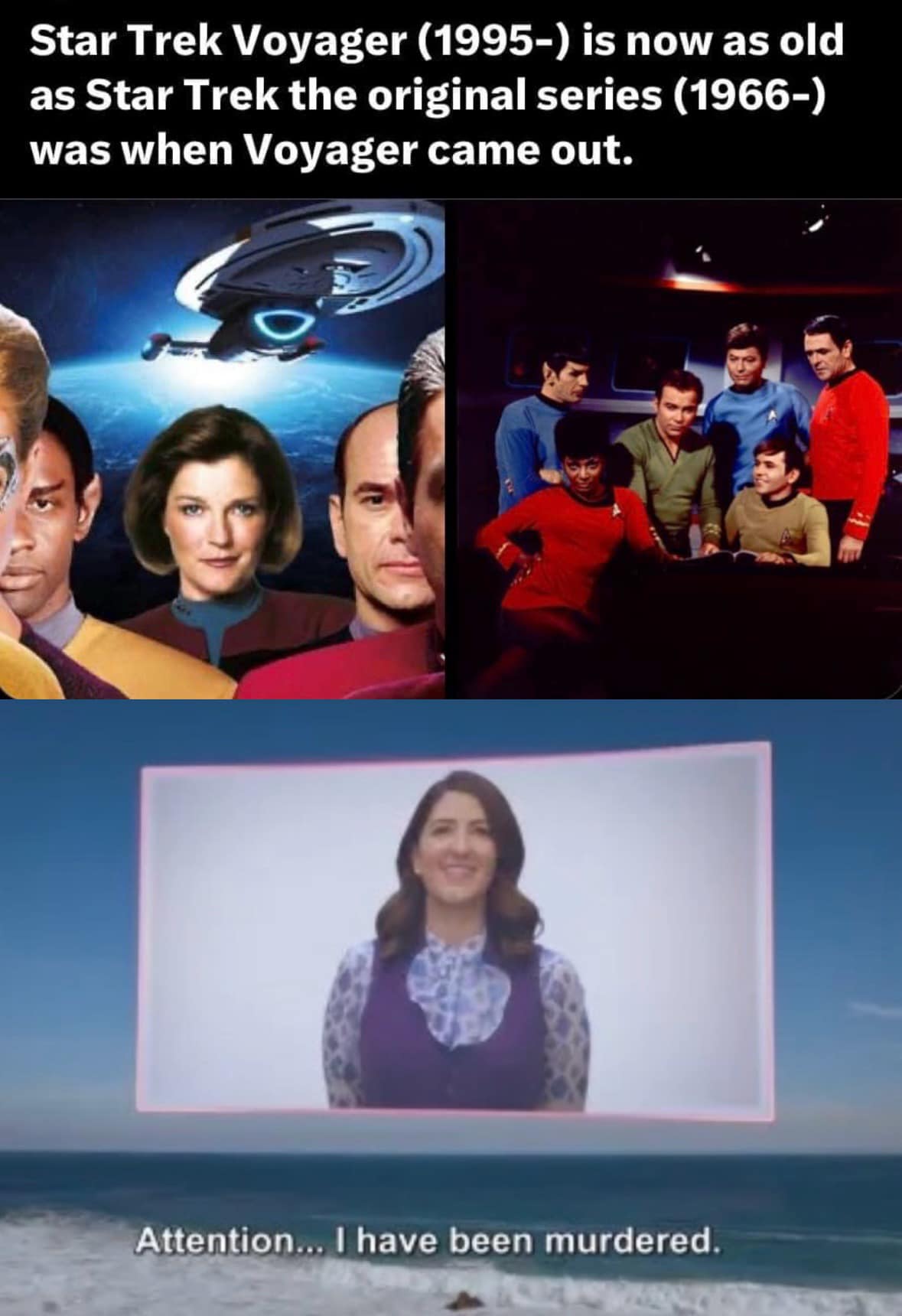
The image is a composite of three elements. The top section is a split screen. On the left is an image of the main cast of Star Trek: Voyager, seemingly from promotional material. The space ship is visible behind them. On the right is a vintage black and white image of the original Star Trek cast. The bottom section is a digitally-altered image depicting Kate Mulgrew (Captain Kathryn Janeway from Voyager) with a blood-splattered uniform and a screen displaying the message “Attention… I have been murdered.” The background is a blurred seascape. The image appears to be constructed to draw a parallel between the passage of time in science fiction fandom and the metaphorical “death” of a beloved character or show.
---
Foucauldian Genealogical Discourse Analysis
This meme touches on how the discourse surrounding Star Trek has evolved over time. Foucault would be interested in the power/knowledge relationships at play. Consider:
Historical Layers: The meme highlights the historical layering of Star Trek iterations. Each series (Original Series, Next Generation, Deep Space Nine, Voyager, Discovery, Picard, etc.) establishes a new "archive" of meanings, memories, and fan expectations. The meme notes the temporal distance between the original Star Trek and Voyager, implicitly positioning Voyager* as becoming part of that historical archive.
Discipline & Normalization: The original Star Trek represented a particular vision of the future and progressive values for its time. Later series were shaped by and responded to shifting cultural norms, creating a "discipline" of expectations for what Star Trek* "should" be. The meme’s dark humor (Janeway's "murder") could be interpreted as a frustration with how these later iterations are sometimes perceived as failing to live up to the promise of the original, or how fan interpretations can "kill" a series in the collective imagination.
Power Dynamics in Fandom: The meme subtly reveals power dynamics within the fandom. The original series holds a particular place in the “canon” for many fans. The “murder” image could be seen as a symbolic silencing of Voyager* and the actors/characters within it, by a group that favors earlier iterations.
---
Critical Theory
This image can be analyzed through a critical lens that questions the underlying assumptions of fandom, nostalgia, and the construction of meaning.
Commodification of Nostalgia: The meme draws on nostalgia for Star Trek*, a powerful force in contemporary culture. Nostalgia can be seen as a form of cultural consumption, where past media is repackaged and resold to satisfy a desire for comforting familiarity. The meme subtly acknowledges this commodification by juxtaposing different eras of the franchise.
The Myth of Progress: Star Trek is often associated with a utopian vision of the future. However, the meme challenges this vision by highlighting the passage of time and the realization that the future Star Trek* promised hasn’t fully arrived. The “murder” image could be read as a symbolic acknowledgement of the disillusionment that comes with the realization that even seemingly progressive visions are subject to the limitations of time and reality.
Deconstruction of Narrative: The meme deconstructs the linear narrative of Star Trek. It disrupts the expected flow of time and challenges the notion of a unified franchise identity. The jarring image of Janeway’s death, placed within the context of a temporal comparison, undermines the seamlessness of the Star Trek* universe.
---
Postmodernism
The meme embodies several characteristics of postmodernism:
Pastiche & Intertextuality: The image combines elements from different iterations of Star Trek*, creating a pastiche that acknowledges the fragmented nature of contemporary culture. The reference to the passage of time and the "murder" of a character are intertextual nods to the broader themes of loss, death, and nostalgia that permeate contemporary media.
* Irony & Self-Reflexivity: The meme is self-reflexive in its acknowledgement of the absurdity of fandom and the often-overblown emotional investment that fans have in their favorite media. The juxtaposition of the historical images and the violent imagery creates a darkly ironic effect.
Questioning of Grand Narratives: The meme challenges the grand narrative of Star Trek* as a progressive, utopian vision of the future. It exposes the limitations of this vision and suggests that even the most ambitious attempts to imagine a better future are ultimately subject to the constraints of time and reality.
---
Please note: The application of these theories is, as mentioned, somewhat interpretive and relies on understanding the image as a performance of theoretical concepts rather than a direct illustration of them. The humor and darkness of the image also complicate any straightforward theoretical analysis.
Let me know if you'd like me to elaborate on any of these points or explore other theoretical frameworks.
simple-description (llama3.2-vision)
This meme is a humorous comparison between the original Star Trek series (which aired from 1966-1969) and the more recent Star Trek: The Next Generation series, which aired from 1987-1994. The meme juxtaposes a young William Shatner (who played Captain James T. Kirk in the original series) with a younger Patrick Stewart (who played Captain Jean-Luc Picard in The Next Generation). The text "In 1966, I was a young, handsome, and vigorous 40-year-old" appears in the image, poking fun at the idea that the original series was set in the 23rd century, but the actors were actually much older when the show first aired.
tesseract-ocr
Star Trek Voyager (1995-) is now as old as Star Trek the original series (1966-) was when Voyager came out. A ees “s 7 : = S a = & | E Pr 4 : 4 od Ly S dh ies i ; * om 3 x ee | have been murdered.