First Seen
2023-05-10T21:03:40+00:00
simple-description (llama3.2-vision_11b)
The meme is a screenshot from the Star Trek: The Next Generation episode "The Outcast," featuring a character named K'Eplerian, who is a Betazoid. The image shows K'Eplerian with a shocked expression, and the text "I'm dead" is overlaid on top of it. The meme is likely referencing a scene where K'Eplerian is experiencing a severe emotional response to a traumatic event, and the text is a humorous take on that moment.
detailed-analysis (gemma3-27b-vision)
Okay, here's an analysis of the image and its meme text through the lenses you requested, with sections only for those theories that demonstrably apply.
## Visual Description
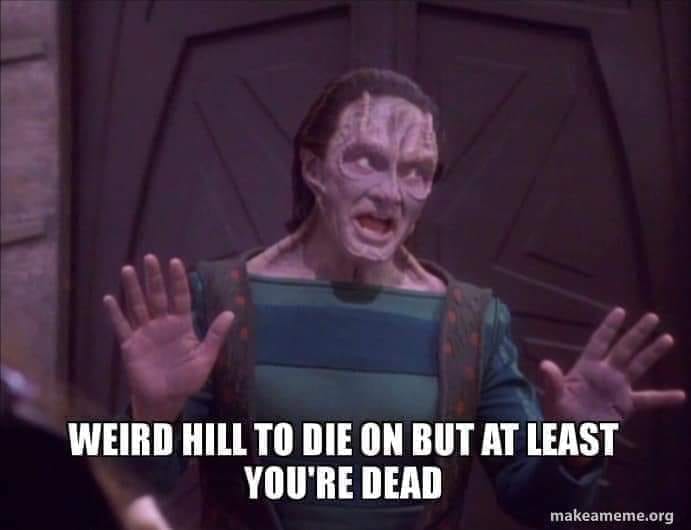
The image depicts a character, identified as Gul Dukat from the science fiction television series Star Trek: Deep Space Nine. He is a Cardassian, known for his complex and often villainous character. He's seen in an indoor setting that appears to be a corridor within a space station or ship. Dukat is making a dramatic gesture with both hands open and raised, and his face is contorted in an expression of frustration, defiance, or exasperation. The lighting is dramatic, emphasizing shadows and giving him an intense appearance. He's wearing Cardassian clothing that is ornate and indicative of status. The text overlaid on the image reads: "WEIRD HILL TO DIE ON BUT AT LEAST YOU'RE DEAD."
## Foucauldian Genealogical Discourse Analysis
The meme text can be examined through a Foucauldian lens as a moment of power and discourse. Foucault's concept of power/knowledge is particularly relevant. The statement is an assertion of control, even in the face of defeat (implied by the "you're dead" portion).
Discursive Formation: The phrase taps into a discourse of stubbornness and petty insistence on principle, even when that principle is nonsensical or self-destructive. The whole point of having a "hill to die on" is to signal unwavering commitment to something. Dukat recognizes* that hill is weird, but still asserts its importance. This constructs a particular image of Dukat as a character who clings to ideology.
* Genealogy: To understand this properly, we could trace the genealogy of "hills to die on" as a modern expression. Where did the idea of choosing a defining principle worth dying for come from? The phrase evokes imagery of both noble martyrdom and absurd stubbornness.
Power Dynamics: The statement is an assertion of dominance. It's a "take" that is deliberately provocative and dismissive of any opposing view. The power is not necessarily effective – the person is already dead – but it's expressed*. This is a classic example of how power operates not just through physical force but through the structuring of discourse.
## Critical Theory
This image and meme text operate powerfully as social commentary.
* Ideology Critique: The meme functions as a critique of ideological rigidity. Dukat, as a character known for his complex motivations and willingness to rationalize his actions, embodies a commitment to an ideology (Cardassian supremacy/self-importance) even when it’s demonstrably harmful or illogical. The "weird hill to die on" part highlights the absurdity of such commitments.
Subjectivity and Identity: The “hill to die on” represents something a person identifies with strongly. The meme implies that clinging to these self-constructed identities, even illogical ones, is a powerful force. Dukat needs* to assert the importance of his "hill," even in death, because it's part of his self-perception.
* Mass Culture and Spectacle: The meme's virality demonstrates how images from popular culture (Star Trek) are re-appropriated and used to comment on broader social phenomena. The meme acts as a form of cultural critique that uses the readily-understood visual of Dukat to create an immediate punchline.
## Postmodernism
The meme very strongly embraces several postmodern elements.
* Irony and Parody: The humor is inherently ironic. The phrase acknowledges the absurdity of clinging to a pointless principle while simultaneously asserting its importance. It's a self-aware commentary on human behavior.
Deconstruction of Meaning: The meme deconstructs the traditional notion of "dying for a principle." It suggests that the reason* for the principle is less important than the act of clinging to it.
* Playfulness and Fragmentation: The meme uses a fragmented image and text to create a playful but pointed commentary. It doesn't offer a serious solution or argument; it's simply a witty observation.
Intertextuality: The meme relies on the viewer's existing knowledge of the Star Trek* universe and the character of Gul Dukat to function. Its meaning is created through the interaction of this prior knowledge and the meme text.
Let me know if you'd like any of these sections expanded or further explored!
simple-description (llama3.2-vision)
This meme features a character from the TV show Star Trek: Deep Space Nine, a Ferengi named Quark. The image shows Quark with a shocked expression and his hands raised in a "what's going on?" gesture. The text overlay reads "When you finally get the hang of that thing you've been trying to do for years, but it's too late and you're dead."
tesseract-ocr
2 aA Gi. « Ay) Im a, Ye Tt Te ™ YOU'RE DEAD