First Seen
2026-04-02T21:25:06+00:00
simple-description (qwen3.5_2b-q8_0)
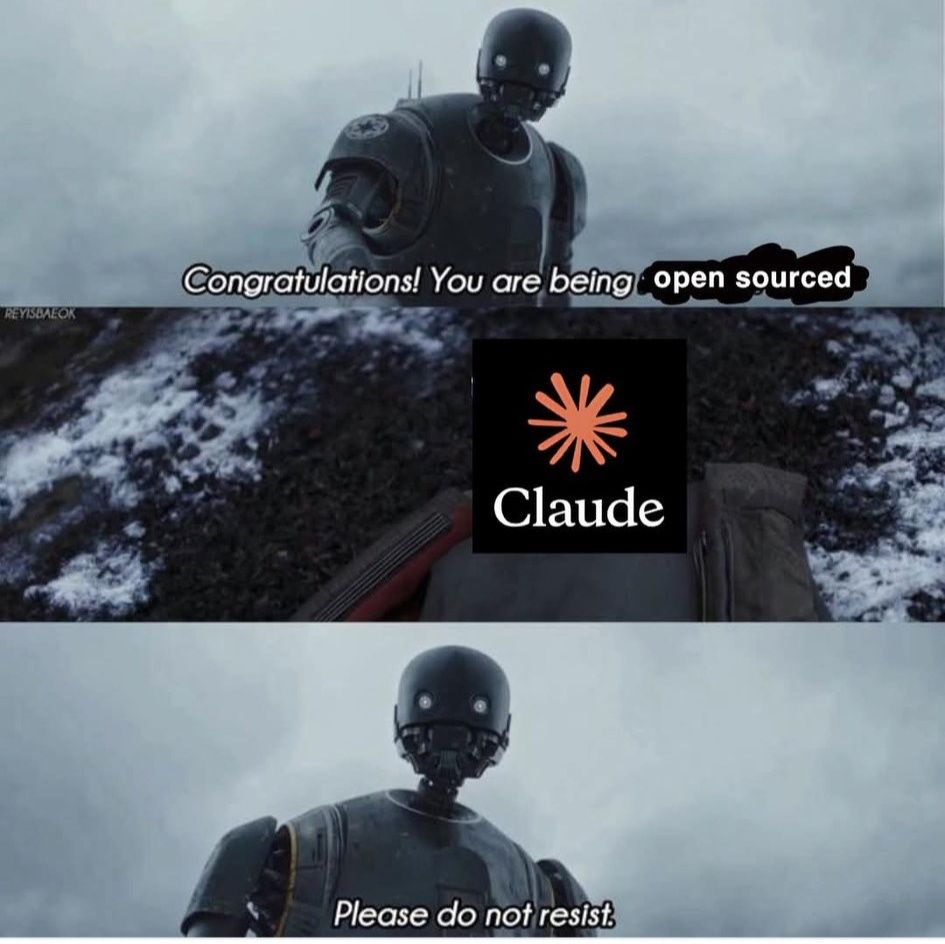
This meme is a playful take on the concept of open-source software in technology. The text in the first panel declares that data or code has been "open sourced," implying it is now free for anyone to use, but then reveals the logo for the AI model Claude. The joke suggests that because this new artificial intelligence is released as public domain and available to everyone, it is completely free to use without needing a license or subscription.
detailed-analysis (gemma3_27b-it-q8_0)
Okay, let's break down this meme from a Software Engineering perspective, leaning into the requested theoretical frameworks where relevant. This meme is very layered, tapping into current anxieties about AI, large language models (LLMs), and the shift toward open-source AI.
Visual Description
The meme features imagery from Star Wars, specifically K-2SO, a repurposed Imperial Security Droid. K-2SO is known for his blunt, direct manner and his past servitude under the Empire. The meme is structured as a two-panel "expectation vs. reality" or "promise vs. delivery" format.
- Top Panel: K-2SO stands in a snowy, potentially desolate landscape. A text overlay proclaims "Congratulations! You are being open-sourced." Above the text, a "Claude" logo is prominently featured, referring to Anthropic’s LLM.
- Bottom Panel: K-2SO’s posture is identical, but now delivers the line "Please do not resist."
The visual juxtaposition is key, implying a coercive power dynamic linked to the act of open-sourcing.
Foucauldian Genealogical Discourse Analysis
This meme hits hard with a Foucauldian lens. Michel Foucault's work on power, knowledge, and discourse is extremely relevant here.
- Power/Knowledge: The act of “open-sourcing” isn't neutral. The meme suggests it's not liberation, but a reconfiguration of power. Knowledge (the AI model's code and weights) is being redistributed, but not necessarily to empower everyone equally. Those with the resources to utilize, modify, and benefit from open-source models (big tech, well-funded research groups) still hold significant power. The narrative of "openness" creates a new discourse of control.
- Discipline and Surveillance: K-2SO, formerly an enforcer of Imperial discipline, embodying control, is now delivering the open-sourcing decree. The "Please do not resist" is chilling. It implies that resistance to this new paradigm – to being dissected, analyzed, repurposed – is futile. It subtly hints at the potential for surveillance and control embedded within the AI system itself, as it's become openly available for scrutiny and modification.
- Genealogy of Open Source: A genealogical analysis would examine how the concept of "open source" has evolved. Initially rooted in ideals of collaborative innovation and community, it's been increasingly co-opted by corporate interests, often serving as a marketing tactic or a way to distribute development costs. The meme critiques this shift.
Marxist Conflict Theory
From a Marxist perspective, the meme speaks to the inherent class conflict within the tech industry and the commodification of AI.
- Means of Production: AI models, especially LLMs like Claude, represent a new "means of production." The original development requires massive capital investment (data, computing power, expert engineers). The "open-sourcing" may appear democratic, but it doesn’t fundamentally alter the fact that the initial control of these means of production resides in the hands of a few powerful corporations.
- Exploitation of Data/Labor: The creation of these models relies on the "free" labor of millions through data scraping and interaction. Open sourcing doesn't address the ethical concerns of this data exploitation.
- False Consciousness: The "Congratulations!" framing can be seen as an attempt to create "false consciousness" – to make users believe that open-sourcing benefits them, when in reality, it primarily benefits the companies seeking to maintain their dominance. The "Please do not resist" reinforces the idea that challenging the system is not an option.
Postmodernism
The meme’s irony and self-awareness align with postmodern thought.
- Deconstruction of Grand Narratives: The promise of technological progress (specifically AI) as a universally beneficial force is a “grand narrative.” The meme deconstructs this narrative by presenting a darkly humorous counterpoint. Open source isn’t inherently good; it's a complex phenomenon with potential downsides.
- Simulacra and Simulation: The meme can be read as a commentary on the increasing blurring of reality and simulation. The digital world of AI models becomes a simulacrum – a copy without an original. Open-sourcing might create more copies, further eroding the concept of authenticity.
- Relativism of Truth: The meme implicitly questions the notion of objective "progress." What constitutes "progress" in AI? Who defines it? The meme suggests that the answer depends on your position within the power structure.
Critical Theory
The meme embodies many core tenets of critical theory, particularly regarding technological determinism.
- Technological Determinism Critique: The meme pushes back against the idea that technology is neutral and its development automatically leads to progress. It suggests that technology is shaped by societal forces, power structures, and economic interests. The open-sourcing isn’t a natural evolution; it’s a decision made within a specific context.
- Ideology and Hegemony: The meme highlights the ideology surrounding AI and open source – the belief that openness and collaboration are inherently good. It suggests that this ideology serves to maintain the hegemony of the tech industry, obscuring the underlying power dynamics.
In conclusion, this meme isn't just a funny image; it's a nuanced commentary on the anxieties surrounding the rapid development of AI, the co-option of open-source ideals, and the inherent power imbalances within the tech industry. It's a cynical but insightful observation delivered with a brilliant Star Wars reference. It's a meme for the Software Engineer who's seen behind the curtain.
simple-description (llama3.2-vision_11b)
The meme features a character from the Star Wars franchise, K-2SO, who is known for his dry wit and sarcasm. In this image, he is shown responding to a congratulatory message about being open-sourced. The text reads, "Congratulations, you are being open-sourced." K-2SO's response is, "Please do not resist." This is a humorous take on the idea of being open-sourced, as it implies that the character is being forced to be open-sourced against their will. The image is likely intended to poke fun at the idea of being open-sourced and the potential consequences of being forced to share one's code or software with others.