First Seen
2025-04-11T04:18:37.964505+00:00
detailed-analysis (gemma3_27b-it-q8_0)
Okay, let's break down this meme from a Software Engineering perspective, leveraging the requested theoretical frameworks where applicable. It's a bit playful, but has serious roots in the realities of OS design trade-offs.
Visual Description
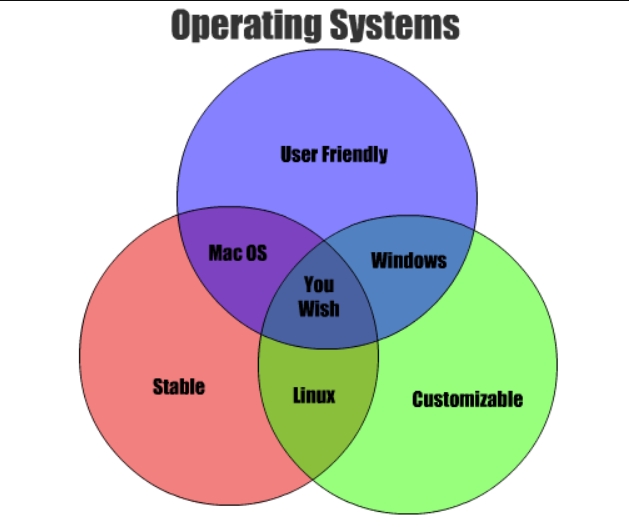
The meme uses a three-way Venn diagram to illustrate the perceived strengths and weaknesses of three major operating systems: macOS, Windows, and Linux.
- macOS is positioned as being primarily Stable (overlapping with the central 'You Wish' area) and a little User Friendly.
- Windows is presented as mostly User Friendly (overlapping with the central 'You Wish' area) and slightly Customizable.
- Linux is depicted as mainly Customizable (overlapping with the central 'You Wish' area) and somewhat Stable.
- The overlap of all three – the area labeled "You Wish" – suggests that no single operating system perfectly embodies all three qualities. A system offering maximal stability, customization and user-friendliness is the ideal, but remains elusive.
Foucauldian Genealogical Discourse Analysis
From a Foucault-inspired perspective, this meme represents a discourse about operating systems. The meme doesn't just present objective facts, but actively constructs meaning about these systems. Let's unpack this:
- Power/Knowledge: The very terms used – "Stable," "User Friendly," "Customizable" – are not neutral. They are categories defined by developers, users, and marketing forces. They represent a specific configuration of "power/knowledge" (Foucault’s key concept). The developers who prioritize one aspect (e.g., stability) exert power by shaping the system in that way, and this impacts the knowledge (experience) users have of that system.
- Genealogy: The meme implicitly reveals a genealogy – a historical tracing of the development of these concepts. Early operating systems were rarely user-friendly; customization was minimal. Windows actively pursued user-friendliness as a key differentiator. Linux emerged from a hacker culture that prioritized customization. macOS carved out a niche focused on stability and ease of use within a controlled environment.
- Disciplinary Power: The positioning of each OS within the diagram subtly exerts disciplinary power. It implies that users who value stability should choose macOS, those seeking ease of use should choose Windows, and those desiring customization should choose Linux. The diagram becomes a norm against which users evaluate their options, and which shapes their behavior.
- The Absence of the Perfect OS: The "You Wish" area is crucial. It illustrates a yearning for a singular, ideal system, a system that reflects a desire for complete control, stability, and convenience. This "ideal" OS reinforces the idea of operating systems as imperfect and always under development.
Critical Theory
Applying Critical Theory, we can see this meme engaging with the idea of ideology and the constraints imposed by technical systems.
- Reification: The diagram reifies (turns into a "thing") abstract qualities like "stability" and "user-friendliness," as though they are inherent properties of the OS rather than decisions made during the design and development process. This obscures the fact that these characteristics are human choices with social and political implications.
- Instrumental Reason: The pursuit of "optimization" for any one of these qualities (stability, user-friendliness, customization) can be seen through the lens of instrumental reason – the rationalization of the world through technical means. The focus on making the system "better" according to certain metrics potentially overlooks broader ethical or social concerns.
- False Consciousness: Users may accept the limitations implied by the diagram (e.g., "Linux is hard to use") as simply the way things are, rather than recognizing that the complexity of Linux stems from design choices and cultural values. This could be argued as a form of false consciousness.
Marxist Conflict Theory
From a Marxist perspective, the meme reveals underlying class and power dynamics within the software industry.
- Labor and Control: The creation of these operating systems is, fundamentally, a product of labor. The choices made during development (e.g., prioritizing user-friendliness over customization) reflect the interests of the owners of the means of production (the companies developing the OS) and their target market.
- Commodity Fetishism: The operating system becomes a commodity – an object valued not for the labor that went into creating it, but for its perceived properties. The meme participates in this fetishism by focusing on qualities like “stability” and “customization” without acknowledging the underlying social relations of production.
- The "You Wish" Area as Utopia: The area of "You Wish" can be viewed as a utopian aspiration – the desire for an OS that serves the needs of all users equally. However, this is impossible within a capitalist system where resources are allocated based on profit, not need.
- Open Source vs. Proprietary: The situation of Linux in the diagram also reflects an ideological tension. Linux, as an open-source project, embodies a form of collective, communal production, contrasting with the proprietary, commercially-driven development of Windows and macOS.
Postmodernism
A postmodern reading emphasizes the relativity and subjectivity of the categories.
- Deconstruction: The diagram deconstructs the notion of a “perfect” operating system. It shows that any attempt to define an OS based on these qualities will inevitably be incomplete and contradictory.
- Simulacra and Simulation: The "stability," "user-friendliness," and "customizability" are themselves simulacra – representations of qualities that may or may not correspond to a real experience. Marketing and user perception create a “simulation” of these qualities.
- Fragmentation: The meme reflects the fragmentation of experience in the digital age. There is no single, unifying truth about operating systems. Each user will have a different experience based on their individual needs and preferences.
Queer Feminist Intersectional Analysis (Less Directly Applicable, But Potential Insights)
This is where the application is more tangential, but potentially insightful.
- Representation & Exclusion: The lack of consideration for accessibility, inclusivity or the diverse needs of users with different abilities or backgrounds could be pointed out. For example, the assumption that "user-friendly" is a universally understood and achievable goal overlooks the fact that what is user-friendly for one person may be exclusionary for another.
- Non-Binary Systems: The three-way Venn diagram reinforces a binary (or at least tripartite) categorization. This could be critiqued for failing to recognize the complexities and non-binary nature of user experience and system design. There are systems and configurations that don't neatly fall into these categories.
- Invisible Labor: The often-unacknowledged labor of maintaining, updating, and troubleshooting these systems, often falling disproportionately on marginalized groups, could be brought into focus.
In conclusion, this seemingly simple meme provides a surprisingly rich ground for analysis through various theoretical lenses, highlighting the complex interplay between technology, society, power, and individual experience. It's a reminder that even seemingly technical choices are deeply embedded in social and political contexts.
simple-description (llama3.2-vision_11b)
The meme is a humorous representation of the three operating systems (Windows, Mac OS, and Linux) as a Venn diagram, with each circle overlapping to represent the commonalities between them. The text in the meme reads "You want a Linux system like Mac OS. But you are also like Windows. And you are like a stable system."
detailed-analysis (gemma3-27b-vision)
Okay, here's an analysis of the Venn diagram you provided, broken down into relevant sections as requested. I'll indicate sections that don't apply with an explanation.
Visual Description
The image is a Venn diagram depicting three overlapping circles representing operating systems: Mac OS, Windows, and Linux. Each circle is a different color: red for Mac OS, blue for Windows, and green for Linux.
- Mac OS is predominantly associated with the concept of "Stable."
- Windows is associated with the concept of "User Friendly."
- Linux is associated with the concept of "Customizable."
- The overlap of Mac OS and Windows results in a zone labeled "You Wish."
- The overlap of Mac OS and Linux results in a zone labeled "You Wish."
- The overlap of Windows and Linux results in a zone labeled "You Wish."
- The central area where all three circles intersect is labeled "You Wish."
The diagram uses simple shapes and labels, creating a visual hierarchy and emphasizing certain characteristics of each operating system. The use of “You Wish” in overlapping regions and the central core suggests a level of aspiration or perhaps a critique of the limitations of each OS.
Foucauldian Genealogical Discourse Analysis
This diagram is a small example of how discourse shapes our understanding of technology. Foucault's work demonstrates how knowledge is not neutral but is tied to power.
- The Construction of 'Qualities': The diagram constructs specific qualities for each OS. "Stable," "User Friendly," and "Customizable" aren’t inherent properties. They are discursively created – defined by marketing, user experience design, community perceptions, and the way tech is talked about. The diagram implies these are the primary characteristics, which is a power move in shaping how we think about these OS.
- Power/Knowledge: The diagram reinforces a certain power dynamic. By associating Mac OS with "Stable" it arguably positions it as the reliable, professional choice (a narrative Apple has heavily invested in). Windows’ association with “user friendly” positions it as accessible, but perhaps lacking the sophistication of Mac. Linux is positioned as powerful but complex and only approachable with expert knowledge.
- The 'You Wish' Zone: The labeling of the overlapping areas as "You Wish" is particularly interesting. It suggests that the ideal operating system would combine these qualities – stability, user-friendliness, and customizability. But by labeling it as "You Wish," the diagram suggests that this ideal is unattainable. This could be interpreted as a power mechanism: reinforcing the necessity of choosing between these systems, and thus staying within the established technological and market order.
- Genealogical Trace: Looking at the history of OS development reveals how these qualities have been historically produced. Early operating systems were more about function than user experience. Over time, marketing and user interface design pushed for "user-friendliness." The rise of open-source movements created a demand for "customizability."
Critical Theory
Applying a Critical Theory lens, specifically drawing on the Frankfurt School, suggests this diagram is more than a neutral presentation of features. It exposes and perpetuates ideologies.
- Technological Rationality: The diagram can be seen as embodying "technological rationality"—the belief that technical efficiency and features are the ultimate values. The focus on stability, user-friendliness, and customizability, while seemingly practical, obscures broader questions about the social impact of technology.
- Commodification & Consumerism: The diagram implicitly participates in the commodification of operating systems. By highlighting “desirable” characteristics, it encourages consumption. It reinforces the idea that buying the OS with the right features will solve a problem or fulfill a need.
- Ideology & False Consciousness: The framing of OS qualities contributes to a kind of “false consciousness.” It obscures the fact that all OS are built on complex structures of power, labor, and data collection. It makes the technology seem natural and inevitable, rather than a product of specific social forces.
- The "You Wish" Core: The central “You Wish” space is key. It indicates an inherent lack in each system, perpetuating a state of perpetual desire and a need for the next upgrade or the perfect system (which will never come). This is a key mechanism of capitalist consumer culture.
Marxist Conflict Theory
From a Marxist perspective, this diagram can be read as a representation of the struggle for dominance in the technology market and the alienation of the user.
- Class Struggle (of Operating Systems): The diagram illustrates a competitive landscape where each operating system is vying for market share. Mac OS, Windows, and Linux are, in effect, competing classes, each trying to impose its own logic and control over the user.
- Mode of Production & Control: The diagram doesn’t show the underlying mode of production of these OS. The labor, resources, and intellectual property that go into creating these systems are obscured. This invisibility reinforces the power of the corporations and developers who control the means of production.
- Alienation: The “You Wish” core highlights the inherent limitations of each system. Users are constantly confronted with the fact that their ideal OS doesn’t exist, leading to a sense of alienation and dissatisfaction.
- Commodity Fetishism: The emphasis on features (stability, user-friendliness, customizability) obscures the social relations that underpin the creation of these systems. It encourages users to treat the OS as a pure commodity, divorced from the labor and resources that went into its creation.
Postmodernism
A postmodern reading of this diagram would focus on the destabilization of meaning and the rejection of grand narratives.
- Deconstruction of Categories: The diagram creates neat categories (“Stable,” “User Friendly,” “Customizable”), but these categories are ultimately fluid and subjective. What constitutes "stability" or "user-friendliness" is open to interpretation and depends on the user's context and perspective.
- Simulation & Hyperreality: The diagram itself is a simulation of the OS landscape. It's a simplified representation that doesn't capture the complexity of these systems. This can be seen as contributing to a state of "hyperreality" where representations become more real than the reality they represent.
- Rejection of Grand Narratives: The diagram doesn’t offer a universal truth about operating systems. It acknowledges that there is no single "best" OS, but rather a multiplicity of options, each with its own strengths and weaknesses.
- Play of Signifiers: The qualities labeled (“Stable,” “User Friendly,” “Customizable”) are signifiers that have no inherent meaning. Their meaning is created through cultural and social conventions.
Queer Feminist Intersectional Analysis
This is the least obviously applicable lens, but a thoughtful analysis can be made.
- Binary Opposition & Essentialism: The diagram reinforces a binary opposition between different operating systems. It positions each OS as having distinct and essential qualities, reinforcing a rigid categorization. This is a common tactic in power structures that seek to categorize and control people.
- The "Ideal" as Heteronormative: The “You Wish” core can be seen as representing an unattainable "ideal" OS. This "ideal" implicitly reflects dominant norms and values, potentially excluding the needs and preferences of marginalized users.
- Access & Inequality: The cost of operating systems and associated hardware creates a digital divide. Access to technology is not equal, and this inequality disproportionately affects marginalized communities.
- Intersectionality: The diagram doesn’t acknowledge the intersectionality of identities and experiences. Users come from diverse backgrounds, and their experiences with technology are shaped by their gender, race, class, ability, and other factors.
I hope this provides a thorough and nuanced analysis of the image. Let me know if you would like me to elaborate on any of these points!
simple-description (llama3.2-vision)
The meme is a Venn diagram with three overlapping circles labeled "Windows", "Linux", and "MacOS". The intersection of the three circles is labeled "You wish". The implication is that the user is experiencing technical difficulties with all three operating systems, and is therefore wishing they could use a single, stable, and user-friendly operating system.