First Seen
2023-05-10T21:03:40+00:00
simple-description (llama3.2-vision_11b)
The meme depicts a developer being asked to write a simple program to print "Hello, World!" to the console, but instead of writing code, they produce a 10-page document with a complex explanation of the programming language, its history, and its implementation details. The text reads: "The code is too long to include here, but it's a 10 page document detailing the implementation of a 3 page program that prints 'Hello, World!' to the console. It's a 10 page document detailing the implementation of a 3 page program that prints 'Hello, World!' to the console."
This meme is a humorous representation of the common issue in software engineering where developers overcomplicate simple tasks, often due to a lack of understanding of the simplicity of the task or a desire to demonstrate their knowledge.
detailed-analysis (gemma3-27b-vision)
Okay, let's break down this image through a series of analytical lenses, as requested.
Visual Description
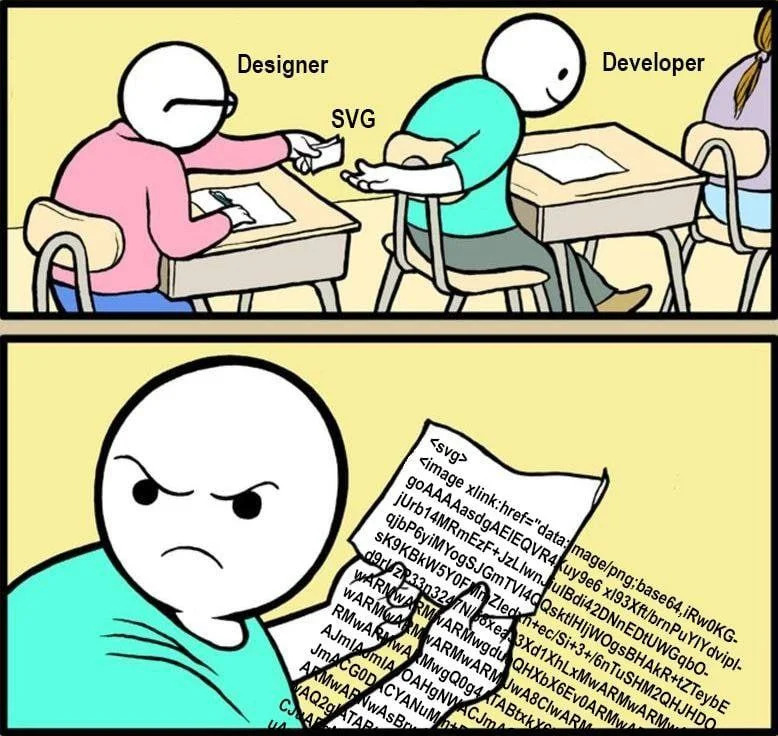
The image is a two-panel cartoon depicting a classic tension between designers and developers.
- Panel 1 (Designer): A person with purple hair and a furrowed brow is labeled "Designer." The background is a plain, flat blue. The figure is depicted as outwardly expressive, looking frustrated or angry. The overall aesthetic is simple and minimalist.
- Panel 2 (Developer): A person, likely meant to represent a developer, is labeled as such. The background is filled with lines of code—specifically, an SVG (Scalable Vector Graphics) code snippet. The developer is depicted with an even more intense, furious expression, looking almost menacing. The image focuses on the complexity and potentially overwhelming nature of code.
- Overall: The contrast is key. The designer's side is clean and aesthetically focused, while the developer's is cluttered with technical detail. The expressions of frustration suggest a breakdown in communication or a perceived imbalance of effort.
Foucauldian Genealogical Discourse Analysis
This image is potent for a Foucauldian reading.
- Discourse & Power: The image illustrates a discourse surrounding the roles of designers and developers. This discourse constructs these roles through a binary opposition—the aesthetic vs. the technical. The power dynamic, therefore, isn't simply about who "wins" an argument, but how the discourse creates the conditions for conflict. The "Designer" is constructed as focusing on “high-level” creative concerns, while the “Developer” is relegated to the “low-level” implementation of those concerns.
- Genealogy: Examining the history of this dynamic—the genealogy—reveals how these roles evolved. Early days of web development saw individuals handling both design and coding. As the field specialized, these roles were divided, and with that division came the potential for power imbalances and misunderstandings. The image isn't about individual personalities, but the historical forces that created this tension.
- Knowledge/Power: The code in the developer's panel represents a form of knowledge, and with that knowledge comes power. The designer, perhaps, is seen as relying on the developer's knowledge, creating a power differential. The very representation of code as dense and overwhelming reinforces this perceived power imbalance.
Critical Theory
Applying a Critical Theory lens, we can analyze the image as a critique of the fragmentation of labor in the digital age.
- Alienation: The image represents a form of alienation, echoing Marxist concepts. The designer's vision is divorced from the practicalities of its realization. The developer is reduced to implementing someone else's vision, possibly losing sight of their creative input. Both roles are alienated from a holistic understanding of the final product.
- Commodification: The image subtly highlights the commodification of creativity and technical skill. The designer's "vision" and the developer's "code" are treated as products to be exchanged within a project. This exchange often ignores the inherent value of the creative and intellectual labor involved.
- Ideology: The image reinforces an ideology that prioritizes aesthetics (often associated with "high culture") over technical implementation. While technical skill is necessary, it is often devalued in comparison to the "creative vision".
Marxist Conflict Theory
This image is ripe for analysis within a Marxist framework.
- Class Conflict: While not a literal "class" conflict, the image represents a conflict arising from differing modes of production. The designer represents a more abstract, conceptual form of labor, while the developer embodies the concrete, material labor of coding. This division creates inherent tension.
- Exploitation: One could argue that this setup can lead to a form of exploitation. The developer's expertise and labor are often taken for granted, while the designer receives disproportionate credit for the "final product."
- False Consciousness: The image can be interpreted as reflecting false consciousness. Both roles are trapped in a system that pits them against each other, obscuring the fact that they are both essential to the success of the project and could benefit from collaboration.
Postmodernism
A postmodern reading focuses on the breakdown of grand narratives and the deconstruction of roles.
- Rejection of Essentialism: The image challenges the idea of a clear, essential "Designer" or "Developer." These roles are fluid and constantly negotiated. The image deconstructs the idea that there is a "correct" way to approach a project.
- Simulacra & Simulation: The very fact that these roles are represented by simplified caricatures suggests a degree of simulation. The image is not about real people, but about representations of roles within the digital world.
- Fragmentation: The image embodies the postmodern characteristic of fragmentation. The designer and developer operate in separate spheres, with limited communication or understanding.
Queer Feminist Intersectional Analysis
While the image doesn't explicitly address gender or sexuality, an intersectional lens allows us to consider how power dynamics are amplified or mitigated based on these factors.
- Gendered Roles: Traditionally, design fields have been more heavily populated by women, while software development has been dominated by men. This historical imbalance can reinforce existing power dynamics. The image, even without depicting gender, can be read as subtly reinforcing these norms.
- Intersectionality of Skill: A queer feminist analysis would examine how different forms of skill are valued within the tech industry. The emphasis on technical prowess over creative vision can be linked to broader societal biases.
- Challenging Binary Opposition: The strict division between designer and developer can be seen as a rigid binary opposition, similar to traditional gender roles. A queer feminist perspective would challenge this binary and advocate for more fluid and collaborative approaches to work.
I hope this detailed analysis, broken down by these theoretical frameworks, is helpful! Let me know if you'd like any of these points expanded or clarified.
simple-description (llama3.2-vision)
The meme is a humorous illustration of a programmer or developer being handed a document by a designer or artist. The document is labeled as a "SVG" (Scalable Vector Graphics) file, which is a type of vector graphics file used for designing and creating visual elements. The programmer's response, "SVG... in a text file?" is a sarcastic comment implying that the designer has provided the programmer with a plain text file instead of a graphical file, which is unexpected and frustrating.
tesseract-ocr
Designer i Developer 4 p svG y ~ s TA q pe R NI aN qo =F Ne t Pym I ies TT eo) %S, Yingo* %G6 A inact ‘Me J x poking ey on “iy hy fen, ' ap Ut Rez geMy » Vag ia Barge ‘B26, hay ee pM larg Wp, 2p iy $4 ayia “if nf, rec May toe pkg in tae Ai, fee Cina one, ing Mong, Ao, ag fe gets ng taaran hie ey, Nr Ao Mies Wing trap Rig Ay Miya®