First Seen
2023-05-10T21:03:40+00:00
simple-description (llama3.2-vision_11b)
The meme is a humorous commentary on the perceived absurdity of the MAGA (Make America Great Again) movement and its followers. The text "I can explain it in 2 words: Russians" is a sarcastic remark that implies the MAGA movement's ideology is influenced by external, foreign powers, rather than a genuine American desire to "make America great again".
detailed-analysis (gemma3-27b-vision)
Okay, let's break down this text/meme across various theoretical frameworks. It's a provocative statement, so several frameworks apply.
Visual Description
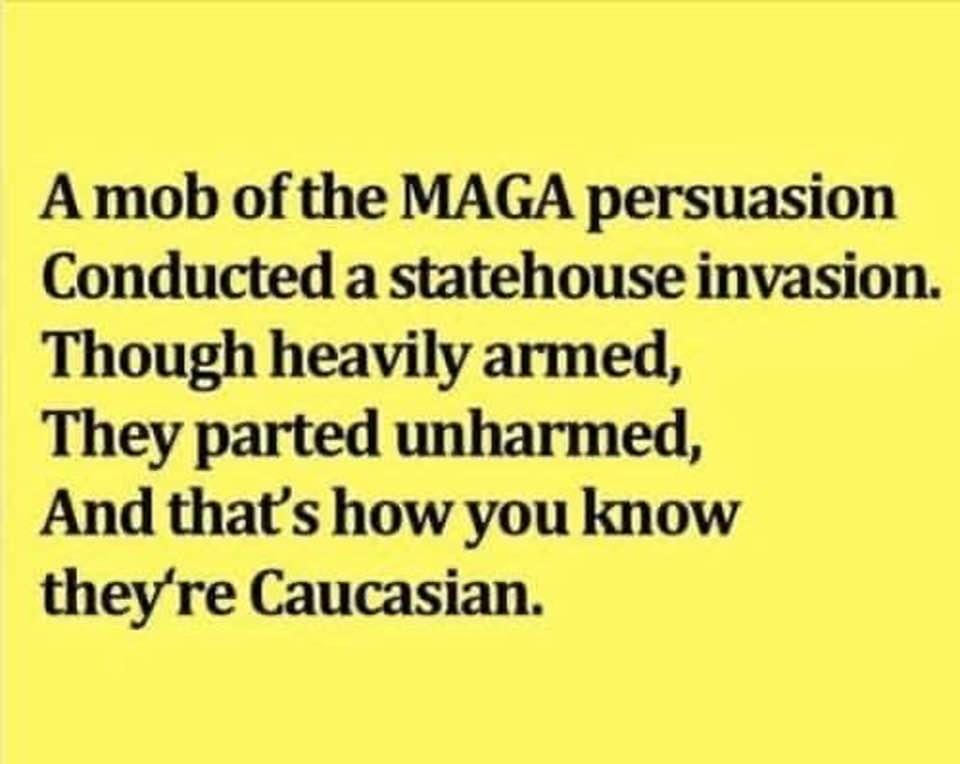
The image presents text on a bright yellow background. The text is a short, four-line poem/statement. The font appears to be simple and in black. The overall aesthetic is stark and attention-grabbing, likely intended to be quickly shared and provoke a reaction. The text's use of rhyming (albeit somewhat forced) suggests a deliberately meme-like quality—easy to memorize and disseminate.
Foucauldian Genealogical Discourse Analysis
This text is ripe for a Foucauldian analysis. The claim that one can identify someone as "Caucasian" based on the lack of repercussions from armed insurrection links race to power, and specifically the presumption of impunity. Foucault emphasized the connection between power and knowledge. Here, "knowledge" is constructed through a historical genealogy—an understanding of how certain racial groups have historically been granted privileges within systems of law enforcement and legal justice. The claim isn’t about physical characteristics, but about a historical discourse surrounding race and power.
- Discourse: The statement contributes to a discourse on racial privilege, positioning “Caucasian” individuals as having an implicit trust or lack of scrutiny in relation to the state and law enforcement.
- Power/Knowledge: The statement suggests that power operates through implicit understandings and institutional biases. The ‘knowledge’ that one can discern race from the lack of accountability isn't about inherent traits but about how power operates to protect certain groups.
- Genealogy: Examining the history of how law enforcement treats different racial groups would illuminate the "truth" behind the statement. Why are certain groups disproportionately targeted versus others?
Critical Theory
Critical Theory, particularly stemming from the Frankfurt School, is highly relevant here.
- Ideology Critique: The statement exposes an underlying ideology of racial bias in the state's response to dissent. It suggests that the state’s leniency isn’t universal but is selectively applied based on racial identity.
- Domination: The statement points toward systems of domination where certain groups (namely, Caucasian individuals in this framing) are shielded from the full force of the law, perpetuating existing power imbalances.
- Reason and Enlightenment Critique: The statement challenges the idea of “universal” justice and rationality. It suggests that systems claiming neutrality are in fact deeply embedded with biases. The claim isn’t based on logical deduction but on observing a pattern of differential treatment.
Marxist Conflict Theory
While not a direct application, Marxist Conflict Theory can be brought into play.
- Class and Power: The statement implicitly connects race to class. Historically, the dominant class in many societies (often white) has benefited from systems of oppression and maintained power through violence. This statement suggests that this power dynamic extends to situations of state response to conflict.
- False Consciousness: The statement could be seen as a challenge to "false consciousness" – the idea that individuals are unaware of the true nature of their oppression. It’s attempting to make visible a pattern of differential treatment that might otherwise be ignored.
- Ideology as a Tool of Oppression: The statement reveals how the ideology of racial privilege functions to maintain the status quo and protect the interests of the dominant group.
Postmodernism
Postmodern thought can interpret the text as deconstructing traditional categories and exposing the instability of meaning.
- Deconstruction: The statement "deconstructs" the notion of impartial justice. It challenges the idea that the state operates neutrally and reveals its inherent biases.
- Relativism and Subjectivity: The claim, while provocative, highlights the subjective nature of how we perceive and categorize race. It challenges the idea of a “fixed” or “essential” racial identity.
- Narrative and Discourse: The text itself is a “narrative” designed to challenge dominant discourses around race and justice.
Queer Feminist Intersectional Analysis
This is where the statement gets more complex, and where intersectionality becomes particularly important.
- Intersectionality: The statement implicitly highlights the ways in which race intersects with other forms of power and oppression. It doesn’t explicitly address gender, sexuality, or class, but the historical context of white supremacy always intersects with these other systems of domination.
- Power and Privilege: This analysis would focus on the ways in which whiteness confers privilege, not just in the context of the state's response to insurrection, but in all aspects of life.
- Challenging Universal Claims: The statement implicitly challenges the idea of a “universal” or “neutral” experience. The “lack of repercussions” isn’t experienced equally across all racial groups.
- Violence and Safety: The statement subtly connects whiteness with safety and protection from state violence, while simultaneously implying that other racial groups are disproportionately subjected to it.
Important Caveat: It's crucial to note that this statement is itself a generalization and relies on potentially harmful stereotypes. Analyzing it through these theoretical frameworks doesn't validate the claim, but rather illuminates the power dynamics and ideologies at play. It’s vital to approach it critically and with a nuanced understanding of race, power, and history.
simple-description (llama3.2-vision)
This meme is a play on the classic "I Can Read You a Story" song, but with a humorous twist. The text reads: "A mob of the MAGA persuasion / Conducted a statehouse invasion / Though heavily armed, / They were largely / Unarmed, / And that's how you know / They were / White." The meme pokes fun at the idea that a group of people, presumably from a conservative or MAGA (Make America Great Again) persuasion, were able to successfully invade a statehouse, despite being largely unarmed. The punchline is that the group was "white," implying that the fact that they were able to successfully invade the statehouse was due to their whiteness, rather than any other factor.
tesseract-ocr
A mob of the MAGA persuasion Conducted a statehouse invasion. Though heavily armed, They parted unharmed, And that’s how you know they‘re Caucasian.