First Seen
2023-05-10T21:03:40+00:00
simple-description (llama3.2-vision_11b)
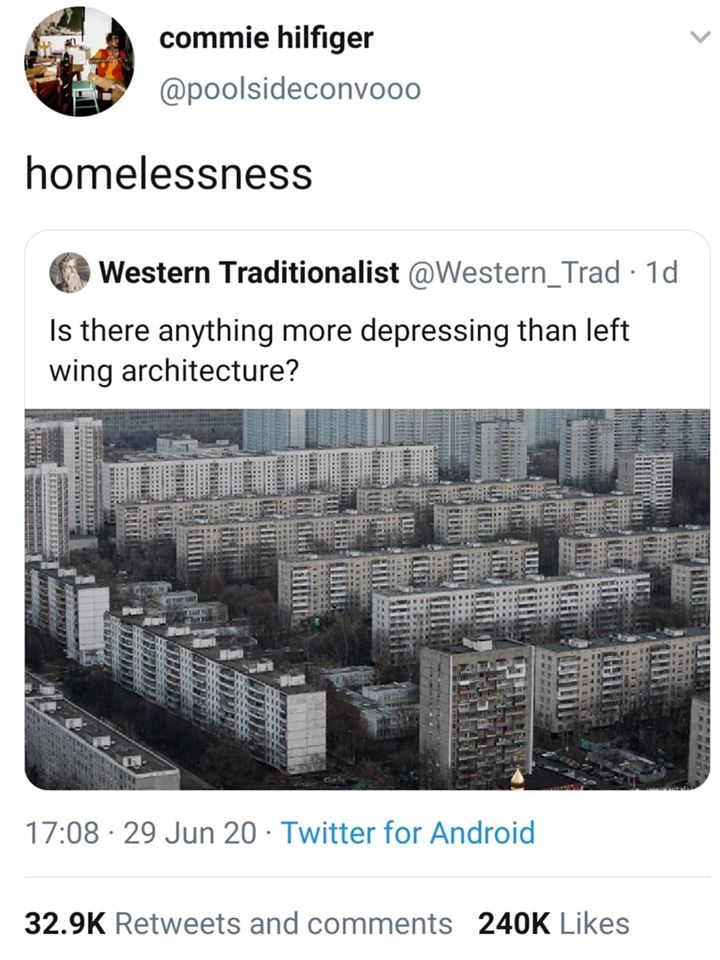
The meme is a screenshot of a Twitter conversation where someone asks "is there anything more depressing than left wing architecture?" The question is likely referring to the idea that some left-wing or socialist architectural designs can be aesthetically unappealing or even depressing, such as the infamous " Brutalist" architecture style. The meme is likely being used to poke fun at the idea that some people might find certain types of architecture to be depressing or unappealing.
detailed-analysis (gemma3-27b-vision)
Here's an analysis of the Twitter post, broken down into the requested theoretical frameworks. Please note that applying all of these to a single image and text post is a complex exercise, and some interpretations might overlap.
Visual Description
The image is a monochrome (likely black and white or heavily desaturated) photograph of large-scale, high-rise public housing or council estates. The buildings are repetitive, boxy, and densely packed. They appear uniform and imposing, lacking individuality or aesthetic ornamentation. The photograph appears to be taken from a slightly low angle, enhancing the scale and weight of the architecture. There is evidence of urban grit - slightly blurred cars and perhaps some indications of dirt or decay. The lighting appears flat, contributing to a somber mood. The title of the post is "homelessness".
---
Critical Theory
The post explicitly links the architectural style to a feeling of depression and is inherently critical of a certain type of urban planning. A critical theorist would look at how this architecture embodies specific power dynamics and contributes to social alienation. The architecture is presented not simply as a functional solution to housing, but as a symbol of a failed social project.
The post implies a critique of the socio-political ideologies associated with this architectural style (often linked to socialist or modernist planning). This critique suggests that the pursuit of a rational, standardized urban environment can come at the cost of individual expression, community, and psychological well-being.
The directness of the claim ("Is there anything more depressing...") invites the viewer to participate in the critical judgment.
---
Marxist Conflict Theory
From a Marxist perspective, this architectural style is a physical manifestation of class struggle and the control of the means of production (housing). The uniform, dense high-rises could be interpreted as an attempt to house a working-class population efficiently, but also as a means of control and surveillance. The lack of aesthetic consideration could be seen as indicative of the devaluation of the lives of those who inhabit these spaces.
The title "homelessness" introduces the concept of lack as a fundamental issue. These architectural styles were meant to solve homelessness, but the post implies they haven't. This suggests a failure of the system to provide basic needs, and hints at a contradiction between the stated goals of socialist or modernist planning and the reality of life within these structures.
The tweet plays into a tension between the 'ideal' of social housing and the lived experiences within it. It asks us to consider who benefits from such building projects and what the real cost is in terms of human well-being.
---
Foucauldian Genealogical Discourse Analysis
Foucault would be interested in the discourse surrounding this architectural style, and how that discourse has shifted over time. The question (“Is there anything more depressing…?”) is a key point. It suggests a historical shift in the interpretation of this architecture. Originally, these buildings may have been seen as progressive solutions to housing problems; the post indicates a contemporary view where they are viewed as depressing.
A genealogical analysis would trace the power/knowledge relations that have shaped this architectural style and its reception. What assumptions about urban planning, social control, and the lives of the working class underlie the creation of these buildings? How have these assumptions been challenged or reinforced over time? The tweet’s success (32.9K Retweets) could be seen as a symptom of a changing discourse around post-war public housing.
The very act of labeling the architecture as "depressing" is a power move. It establishes a particular way of understanding and evaluating these buildings, potentially overshadowing other interpretations.
---
Postmodernism
A postmodern reading might focus on the deconstruction of the modernist ideals embedded in this architecture. Modernism, with its emphasis on rationality, standardization, and universal solutions, is being implicitly rejected. The post suggests that these ideals have failed to deliver on their promises and have created an alienating and oppressive environment.
The monochromatic image itself can be viewed as a postmodern aesthetic choice. It strips away color and detail, emphasizing the starkness and uniformity of the architecture.
Postmodernism rejects "grand narratives" or universal explanations, so the post's implicit critique of a particular architectural ideology aligns with this approach.
---
Queer Feminist Intersectional Analysis
This framework is the most difficult to apply directly, as the post doesn't explicitly address gender or sexuality. However, it's possible to consider how this architecture might disproportionately impact marginalized groups. For example, high-rise public housing can sometimes be associated with a lack of safety and surveillance for women and LGBTQ+ individuals.
Intersectional analysis would also acknowledge that the experience of living in this architecture is likely shaped by the intersection of class, race, and other social categories. The post's critique of the architecture could be seen as a critique of a system that historically marginalizes these groups. The feeling of "depression" it evokes might be more acute for those already experiencing systemic oppression.
It is important to note that without further context, it is difficult to make strong claims about the intersectional implications of this post.
Let me know if you would like me to expand on any of these analyses or explore different theoretical perspectives.
simple-description (llama3.2-vision)
The meme is a screenshot of a Twitter conversation where a user asks if anything is more depressing than the London 2012 Olympics' "Zoobic" mascot, a furry, anthropomorphic zoo animal. The user's friend responds that nothing is more depressing than a picture of a empty, abandoned, and decaying apartment complex in Moscow.
tesseract-ocr
fw. commie hilfiger @poolsideconvooo homelessness @ Western Traditionalist @Western_Trad - 1d ls there anything more depressing than left wing architecture? ‘ gawanmnnye | lle ss eager) ce eae = SS | Ere |) — ' . 17:08 - 29 Jun 20 - Twitter for Android 32.9K Retweets and comments 240K Likes