First Seen
2023-05-10T21:03:40+00:00
simple-description (llama3.2-vision_11b)
From the perspective of Symbolic Interactionism, the meme is a humorous representation of the tension between the individual's desire for autonomy and the societal expectations of politeness. The meme juxtaposes the formal, polite phrase "the honourable" with the informal, playful phrase "boi", highlighting the contrast between the two. The image shows a photo of a dignified, aristocratic-looking man, with the text "the honourable" written above him, next to a photo of a young, casual-looking man, with the text "boi" written above him.
detailed-analysis (gemma3-27b-vision)
Okay, let's break down this meme using the requested theoretical frameworks. This is a complex image, lending itself to multiple interpretations.
Visual Description
The meme is a two-panel comparison, employing a common format for comedic effect.
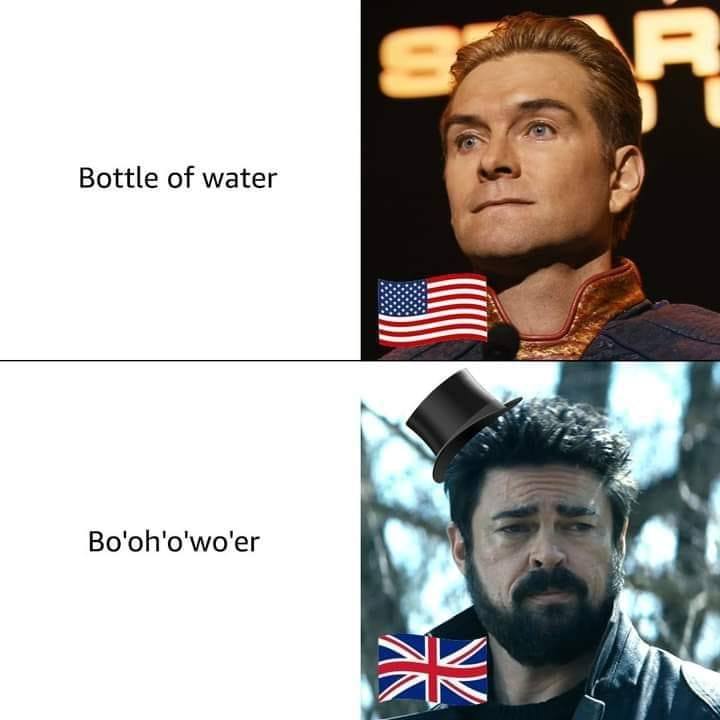
- Top Panel: Features a close-up shot of Homelander (Antony Starr) from "The Boys" television series. He is shown in his superhero costume, with a distinctly cold, detached expression. Below the image is the phrase "Bottle of water." A United States flag is placed below him.
- Bottom Panel: Displays Hugh Grant as a character in a movie. He wears a top hat, and has a sorrowful expression. Below the image is the phrase "Bo’oh’wo’er." A United Kingdom flag is placed below him.
The contrast between the two panels is deliberate. Homelander is a hyper-masculine, powerful, and often unsettling figure. Hugh Grant, in the image, projects a more traditionally British, melancholic persona. The chosen phrases ("Bottle of water" and "Bo’oh’wo’er") are nonsensical and seemingly unrelated to the images, creating an absurdist juxtaposition.
Foucauldian Genealogical Discourse Analysis
This meme can be examined through a Foucauldian lens by looking at how it constructs discourses of national identity and masculinity.
- Homelander & American Power: Homelander, as a symbol of American exceptionalism (albeit a dark one), represents a discourse of overt power, hyper-masculinity, and control. The image reinforces this by associating him with the American flag. He embodies a discourse of surveillance (a key Foucaultian concept) and a manufactured heroism. His detached expression hints at the power dynamics inherent in the discourse itself—a power over the perceived "other."
- Hugh Grant & British Stoicism: Hugh Grant, with his sad expression and the phrase “Bo’oh’wo’er,” represents a very different discourse – a constructed image of British reserve, emotional repression, and perhaps even self-deprecation. The phrase, nonsensical as it is, seems to evoke a particular style of British speech and demeanor. This is a discourse of internalization— emotions are contained, not projected, and suffering is endured silently.
- Power/Knowledge: The meme creates a contrast through juxtaposition. Foucault argues that power and knowledge are inextricably linked. Here, the meme asserts particular knowledge about American and British national characteristics (the hyper-masculine, controlling American versus the reserved, melancholic Brit). This, in turn, reinforces those stereotypes, even as it potentially satirizes them.
Critical Theory
From a Critical Theory perspective, this meme reveals societal structures and how they are perpetuated through representation.
- Stereotyping & Essentialism: The meme relies heavily on stereotypes of American and British national character. It essentializes these nationalities, suggesting that Americans are inherently powerful and domineering, while Britons are inherently reserved and melancholic. This reinforces pre-existing biases and obscures the complexities of individual identity.
- Ideology: The meme can be read as a commentary on ideologies of national pride and the construction of "us" vs. "them." By juxtaposing these two images, it highlights the differences in how national identities are performed and perceived. It raises questions about the constructed nature of these categories and the power dynamics they embody.
- Culture Industry: We can also relate this to the culture industry (Adorno & Horkheimer), where popular media (in this case, a meme) contributes to the standardization of cultural values and the perpetuation of dominant ideologies.
Marxist Conflict Theory
A Marxist interpretation focuses on class and power dynamics within and between nations.
- Hegemony & Soft Power: The meme implicitly touches upon the concepts of hegemony and soft power. The United States, historically, has exerted significant economic and cultural dominance globally. The image of Homelander represents a display of this perceived strength and power. Conversely, the image of Hugh Grant, coupled with the nonsensical phrase, can be seen as a subtle commentary on Britain’s diminishing global influence.
- National Identity & Capital: National identity is often tied to economic systems and the pursuit of capital. The meme could be interpreted as a symbolic representation of the competition between the US and the UK for economic and cultural dominance. The US is associated with overt power (Homelander), while the UK is portrayed as more subdued and reliant on cultural exports.
- Symbolic Struggle: The contrast between the two images can be seen as a symbolic representation of class struggle on a national level. The US represents a nation that projects power and control, while the UK is portrayed as more introspective and melancholic.
Postmodernism
From a postmodern perspective, this meme embodies several key characteristics:
- Hyperreality & Simulacra: The meme presents simulacra—copies of copies—of national stereotypes. The images are not "real" representations of Americans or Britons but rather stylized, exaggerated versions that contribute to a hyperreality. The nonsense phrases ("Bottle of water," "Bo’oh’wo’er") further disrupt the idea of a fixed or authentic reality.
- Intertextuality & Pastiche: The meme relies heavily on intertextuality. Viewers are expected to recognize Homelander from "The Boys" and Hugh Grant from his numerous film roles. This draws on pre-existing cultural knowledge and creates multiple layers of meaning. It's also a form of pastiche—a playful mixing of styles and references.
- Deconstruction & Playfulness: The meme deconstructs traditional notions of national identity by juxtaposing these images and phrases in an absurd and unexpected way. This challenges the idea that national identity is a fixed or essential category and highlights its constructed nature. The absurdity and playfulness are hallmarks of postmodern art.
Queer Feminist Intersectional Analysis
This is the most challenging framework to apply, as the meme doesn't explicitly address gender, sexuality, or intersectionality. However, we can explore it through a lens of performance and subversion.
- Masculinity & Performance: The image of Homelander relies heavily on a hyper-masculine performance. This performance is constructed and often disturbing. Queer theory examines how gender and sexuality are performed and how these performances can be used to challenge dominant norms. Homelander’s over-the-top masculinity can be read as a parody of traditional heroism.
- National Identity & Gendered Expectations: National identities are often intertwined with gendered expectations. The meme can be seen as a commentary on how certain nations are associated with specific gender roles (e.g., the US with aggressive masculinity, the UK with reserved stoicism).
- Subversion through Absurdity: The nonsense phrases and the absurd juxtaposition of images can be seen as a form of subversion. By disrupting traditional expectations and challenging the logic of national identity, the meme creates a space for alternative interpretations and challenges dominant narratives. It disrupts the expected flow of meaning.
It's important to note that these are just a few possible interpretations, and the meaning of the meme is open to debate. The power of memes lies in their ability to be reinterpreted and adapted by different audiences.
simple-description (llama3.2-vision)
The meme is a visual joke that plays on the difference between American and British English pronunciation of the word "bottle". The meme shows two images side by side: one of a person with a "bottle" of water, with the text "bottle" spelled as "bottl" (with a "l" instead of an "l"), and a second image of a person with a "bottle" of water, with the text "bottle" spelled as "bottl" (with an "l" instead of an "l") next to a British flag, with the text "bottl" (with an "l" instead of an "l") and "bottl" (with an "l" instead of an "l") next to a British flag, with the text "bottl" (with an "l" instead of an "l") and "bottl" (with an "l" instead of an "l") next to a British flag, with the text "bottl" (with an "l" instead of an "l")
tesseract-ocr
oe ; (7 Bottle of water f — ae —— ol =e Bo'oh'o'wo'er \ ee rr | 4 ; oP . Eg an ie ae